

Your Residency Verification Process: A Framework for Districts to Start the Year With Confidence
A strong residency verification process is what separates a smooth August from a chaotic one. For K-12 school districts, August is the most operationally demanding period of the year. Enrollment volumes peak, staffing models are tested, and compliance expectations tighten all at once. In this environment, student residency verification becomes a critical pressure point.
District administrators must make high-volume decisions quickly, while ensuring those decisions are accurate, equitable, and defensible. That is increasingly difficult as verification moves beyond basic document checks into a more complex mix of data validation and behavioral confirmation. This article presents a structured residency verification process designed to help districts manage August enrollment surges with greater clarity and confidence.
Why August Is a Critical Inflection Point for Your Residency Verification Process
Several forces converge in August to put every district’s residency verification process under maximum strain.
Enrollment Timing Is Highly Concentrated
According to the National Center for Education Statistics, more than 49 million students are enrolled in U.S. public elementary and secondary schools, and the majority of new registrations and transfers happen in late summer. Consequently, this creates a compressed window where districts must verify eligibility, assign placements, and resolve discrepancies all at once.
Residency Accuracy Directly Impacts Funding
District funding models are closely tied to enrollment and attendance counts. The U.S. Department of Education indicates that funding allocations depend on students residing within district boundaries. As a result, even marginal inaccuracies in residency can lead to misaligned funding, overextension of district resources, and capacity challenges across schools and transportation systems.
Compliance Expectations Are Increasing
Residency determinations are no longer purely administrative. Instead, they must be consistent across cases, supported by evidence, and defensible if challenged. This shift reflects a broader trend toward documentation-driven decision-making in education administration. For more on staying ahead of these reviews, see our guide on Residency Reviews for School Districts.
Verification Complexity Continues to Grow
Districts are navigating multi-household living arrangements, conflicting documentation, and increased reliance on digital records. Therefore, the residency verification process is evolving from simple document review into multi-source validation and investigation workflows.
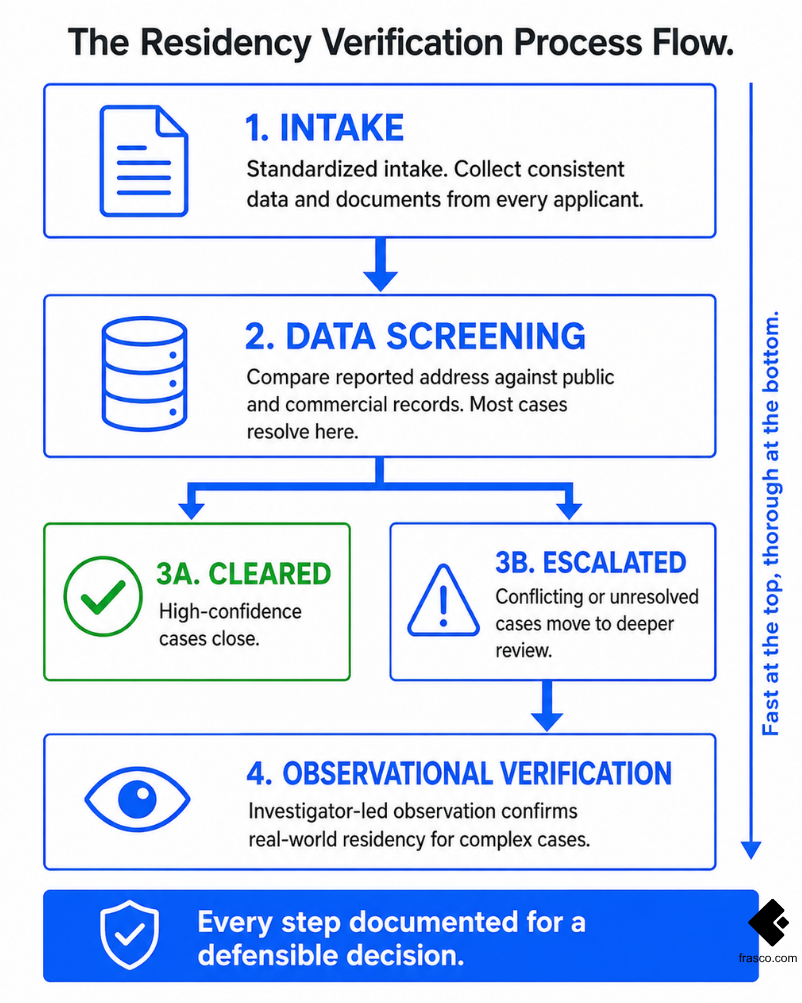
Your Residency Verification Process Framework
This eight-step framework turns a high-pressure August into a structured, defensible residency verification process.
1. Establish Structured Intake and Standardization
High-volume conditions amplify inconsistency. Without a standardized intake process, districts risk uneven evaluation and delayed decisions. A structured intake model should capture consistent data across all applicants, require uniform documentation, and flag incomplete or conflicting information early. As a result, it creates a stable foundation for every downstream decision.
2. Apply Data-Led Initial Screening
Not every case requires escalation. Early-stage screening using data indicators quickly identifies high-confidence cases and cases requiring further review. This database-driven step compares reported addresses against public and commercial records, which may include property ownership records, vehicle registrations, and voter registration data. Consequently, districts can prioritize time and resources far more effectively. Frasco’s Student Residency Verification for K-12 Districts page describes this database-driven comparison in detail.
3. Validate Beyond Self-Reported Documentation
Submitted documents do not always reflect actual residency patterns. Cross-referencing external data provides objective validation, reduces reliance on self-declared information, and creates greater consistency in decision-making. In practice, this shift toward data-backed verification reflects a broader move toward evidence-based operational workflows.
4. Define Clear Escalation Criteria
Cases should move beyond initial review only when necessary. Common escalation triggers include conflicting data signals, incomplete verification from initial screening, and patterns that require additional confirmation. A defined escalation framework ensures consistency, fairness, and efficiency across every case.
5. Incorporate Observational Verification for Complex Cases
Certain residency questions cannot be resolved through documentation or data alone. In these situations, observational methods may be required to confirm overnight residency patterns or daily movement related to school attendance. These methods include remote observational monitoring and investigator-led observation, which document real-world residency behavior over time.
6. Prioritize Documentation and Defensibility
Every residency decision should be supported by a clear audit trail. Effective documentation includes data findings, case-specific notes, and supporting evidence. The emphasis on defensible outcomes reflects a critical need for decisions that can withstand scrutiny during audits or appeals.
7. Balance Speed With Accuracy
August requires rapid decision-making. However, speed without structure creates downstream issues. A tiered residency verification process supports fast initial screening, targeted escalation, and efficient case resolution. This balance protects operational efficiency without compromising integrity.
8. Align Cross-Functional Stakeholders
Residency verification spans enrollment and registration, compliance and legal, and student services. Alignment across these groups ensures consistent criteria, clear accountability, and reduced internal friction. As a result, the whole process runs more smoothly under pressure.
The Role of External Investigative Support in the Residency Verification Process
As complexity grows, many districts supplement internal workflows with third-party investigative support.
An effective provider should offer scalable support during peak enrollment periods, data-driven screening at early stages, observational verification when required, and consistent, documented methods. This type of support allows districts to reduce internal workload, improve case turnaround time, and strengthen confidence in outcomes.
Why a Tailored, Technology-Forward Approach Matters
Modern residency challenges require flexibility, so the right partner adapts to each district’s needs.
Districts benefit from providers that adapt to local residency policies, combine data analysis with observational capabilities, and deliver consistent methods across cases. In addition, a family-owned provider model can offer greater accountability, direct collaboration, and customized service delivery. Together, this combination aligns with district needs for precision, transparency, and responsiveness.
Start the Year With a Confident Residency Verification Process
August will continue to be a high-pressure operational window for school districts. However, the residency verification process does not need to be a source of uncertainty. A structured framework rooted in data, clarity, and defensibility enables districts to manage enrollment surges more effectively, reduce risk, and start the school year with confidence.
Ultimately, the districts that treat residency verification as a structured process rather than a scramble are the ones that enter September with clean records and confident decisions.
Frequently Asked Questions About the Residency Verification Process
Q1. What is a residency verification process?
A residency verification process is the structured system a school district uses to confirm that a student’s primary residence falls within district boundaries. It typically moves from standardized intake to data screening, escalation, and observational verification, with each step documented for a defensible decision.
Q2. Why do districts need a residency verification process in August?
August brings the year’s highest volume of registrations and transfers, all under tight timelines. A structured residency verification process helps districts make fast decisions that are still accurate, consistent, and defensible when volume peaks.
Q3. What are the steps in a strong residency verification process?
A strong process includes standardized intake, data-led screening against public records, validation beyond self-reported documents, clear escalation criteria, observational verification for complex cases, thorough documentation, a balance of speed and accuracy, and cross-functional alignment.
Q4. When should a district escalate a residency case?
A district should escalate when data signals conflict, when initial screening leaves questions unresolved, or when patterns require additional confirmation. Escalated cases may call for observational verification to document real-world residency over time.
Want to Learn More?
See how school districts use investigations to protect resources and keep enrollment fair.
📄 Download our white paper: Protecting Educational Resources: 4 Ways to Address Residency Fraud
Stay Updated: Get our latest posts, school-district fraud trends, and upcoming events—right in your feed 👉 Follow Frasco on LinkedIn
Contact Us Today
Frasco® District Residency Investigations delivers ethical and efficient solutions tailored to your needs. Have questions or want to discuss your investigative needs further? Schedule a call with one of our experts today to find the answers you’re looking for.
If you know a school district that could benefit from our investigative services, Submit a Referral Here to help them protect their resources and strengthen community trust.
Disclaimer: This blog post is for informational purposes only and should not be considered legal advice. Please consult your general counsel for specific legal guidance. Frasco investigators are licensed, and our operations comply with US industry, federal, state, and local laws.