

Your Residency Audit Model: How to Stabilize Enrollment Data After Opening Weeks
A September residency audit is where districts turn opening-week uncertainty into stable, defensible enrollment data. By September, most districts have completed initial enrollment, but a new challenge begins: stabilizing that data. The opening weeks of the school year often reveal inconsistencies that were not visible during August intake. Address discrepancies, incomplete documentation, and shifting residency patterns begin to surface as attendance settles.
For district administrators, this period is critical. It is the window where districts must validate early enrollment decisions, resolve outstanding residency questions, and protect funding tied to accurate student counts. This article outlines a structured residency audit model that reflects how districts can transition from high-volume intake to targeted follow-up investigations. It builds directly on the August intake work covered in our Residency Verification Process Guide.
Why September Matters for Your Residency Audit
September is the first real opportunity to test August’s enrollment decisions against actual behavior, which is exactly what a residency audit does.
Enrollment Volatility Extends Beyond August
While August is the peak intake period, September is when districts begin to observe real attendance behavior. According to the National Center for Education Statistics, more than 49 million students attend public schools in the United States, and student mobility remains a persistent factor, with thousands of students transferring or adjusting enrollment after the year begins. Consequently, a gap opens between reported residency during enrollment and verified residency based on actual patterns.
Funding Accuracy Depends on Early Validation
The U.S. Department of Education notes that school funding is closely tied to enrollment counts and attendance reporting. Therefore, September becomes the first chance to confirm enrollment accuracy and identify mismatches between reported and actual residency. Left unverified, these discrepancies can lead to misallocated district resources, incorrect funding assumptions, and operational inefficiencies across staffing and transportation.
Compliance Expectations Intensify After Enrollment
Once the school year begins, residency decisions are more likely to be scrutinized internally, challenged by families, and reviewed during audits. As a result, districts must ensure every determination rests on clear documentation, consistent methodology, and objective evidence.
The Shift From Volume to Precision
August is about throughput. September is about refinement. Districts move from broad intake processing to focused case validation and investigation. In short, this shift requires a more deliberate, evidence-based residency audit model.
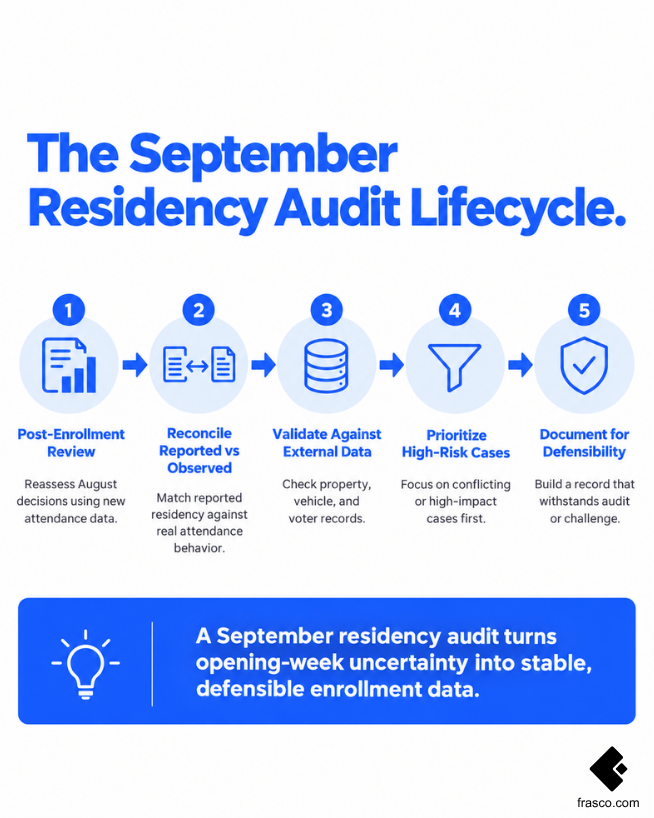
Your September Residency Audit Model
This eight-step residency audit model helps districts move from high-volume intake to targeted, defensible follow-up.
1. Prioritize Post-Enrollment Data Review
The first step is reassessing initial enrollment decisions using newly available data. Key signals include attendance irregularities in the first weeks, transportation inconsistencies, and reports from school staff or community members. This stage helps identify the cases that require follow-up, rather than reprocessing the entire enrollment population.
2. Reconcile Reported Residency With Observed Behavior
Once school begins, districts gain behavioral indicators that were not available during enrollment, such as daily arrival patterns, bus stop usage, and guardian travel routines. When documentation alone is insufficient, observational methods confirm actual residency behavior over time, as described on Frasco’s Student Residency Verification guide. This alignment between reported and observed behavior is essential to a credible residency audit.
3. Strengthen Data Validation Using External Sources
Post-enrollment validation should include updated checks against property ownership records, vehicle registrations, voter registration data, and utility information where available. These database comparisons provide objective insight into residency claims, which ensures follow-up investigations rest on reliable data rather than assumption.
4. Focus on High-Risk and High-Impact Cases
Not all discrepancies require equal attention. Priority should go to cases with conflicting data and behavioral signals, situations affecting high-demand schools or programs, and repeat or unresolved cases from August. Consequently, this targeted approach improves efficiency while protecting district resources where the impact is greatest.
5. Use Escalation Strategically
Escalation in September should be more deliberate than during enrollment. Cases should move to advanced investigation when initial data validation is inconclusive, when behavioral patterns raise concerns, or when additional documentation fails to resolve discrepancies. This keeps resources focused while maintaining rigor.
6. Incorporate Observational Evidence Where Necessary
In complex cases, observational evidence provides clarity that records alone cannot. Methods may include time-based observation of residency patterns, monitoring overnight presence, and tracking daily movement related to school attendance. These approaches help confirm actual living arrangements, which is critical in disputed cases.
7. Build Defensibility Into Every Decision
September is when residency decisions begin to face closer scrutiny. Therefore, every case should include documented data findings, a clear rationale for conclusions, and supporting evidence. Defensible outcomes are the whole point of a residency audit, because they withstand review or challenge.
8. Align Teams Around Consistent Decision Criteria
Post-enrollment investigations often involve enrollment administrators, legal and compliance teams, and school leadership. Alignment across these groups ensures consistent decisions, reduced internal conflict, and improved confidence in outcomes.
The Role of Third-Party Support in Your Residency Audit
As districts shift from volume to precision, internal teams can face capacity constraints during the residency audit.
Third-party investigative support provides scalable follow-up capacity, objective data validation, observational verification, and standardized methodology across cases. This combination of data analysis and field verification supports districts in resolving cases more efficiently, reducing internal workload, and improving confidence in decisions.
Why a Tailored, Technology-Forward Approach Matters
Residency challenges vary across districts, so a standardized approach is often insufficient.
Districts benefit from solutions that adapt to local residency policies, integrate multiple data sources, combine technology with human observation, and deliver consistent, repeatable processes. In addition, a family-owned provider model offers direct accountability, flexibility in approach, and a focus on long-term partnership.
Start the Year on a Stable Foundation
September is the turning point between enrollment and operational stability. Districts that take a structured, evidence-based approach to their residency audit during this period are better positioned to protect district resources, maintain accurate enrollment data, reduce risk, and strengthen confidence in decision-making.
Ultimately, a clear and consistent residency audit model is not just operationally beneficial. It is essential to starting the school year on a stable foundation.
Frequently Asked Questions About the Residency Audit
Q1. What is a residency audit?
A residency audit is the structured process a school district uses after enrollment to validate that students live within district boundaries. It reconciles reported residency against observed attendance behavior, checks external data, and documents each decision so it can withstand review.
Q2. Why do districts conduct a residency audit in September?
September is the first time districts can compare reported residency against real attendance behavior. A residency audit at this point catches discrepancies that were not visible during August intake, which protects funding accuracy and audit defensibility.
Q3. How is a September residency audit different from August enrollment?
August intake is about processing high volume quickly. A September residency audit is about precision: validating early decisions, investigating specific discrepancies, and resolving the cases that opening-week data has flagged.
Q4. What makes a residency audit decision defensible?
A defensible residency audit decision rests on documented data findings, a clear rationale, and supporting evidence, including observational verification where records alone are insufficient. Consistent methodology across cases is what holds up during audits or family challenges.
Want to Learn More?
See how school districts use investigations to protect resources and keep enrollment fair.
📄 Download our white paper: Protecting Educational Resources: 4 Ways to Address Residency Fraud
Stay Updated: Get our latest posts, school-district fraud trends, and upcoming events—right in your feed 👉 Follow Frasco on LinkedIn
Contact Us Today
Frasco® District Residency Investigations delivers ethical and efficient solutions tailored to your needs. Have questions or want to discuss your investigative needs further? Schedule a call with one of our experts today to find the answers you’re looking for.
If you know a school district that could benefit from our investigative services, Submit a Referral Here to help them protect their resources and strengthen community trust.
Disclaimer: This blog post is for informational purposes only and should not be considered legal advice. Please consult your general counsel for specific legal guidance. Frasco investigators are licensed, and our operations comply with US industry, federal, state, and local laws.