

Your Peak Season Student Enrollment Verification Checklist: How to Scale Without Overloading Staff
Each July, school districts enter one of the busiest periods of the year: peak enrollment season. Registration surges, address changes climb, and questions around student enrollment verification grow more frequent and more complex. At the same time, administrators must balance limited staffing, compliance expectations, and tight timelines tied to funding and reporting cycles.
This guide outlines a practical, data-informed checklist to help districts manage student enrollment verification at scale while keeping accuracy, consistency, and defensibility. With the right process in place, your team can handle the surge without burning out or cutting corners.
Why July Matters for Student Enrollment Verification
July is a critical window in the K-12 enrollment cycle, and it puts student enrollment verification at the center of district operations.
Three pressures converge during this month. First, districts finalize enrollment ahead of the school year. Second, funding allocations tie directly to accurate student counts. Third, residency compliance reviews increase sharply. According to the National Center for Education Statistics, public schools in the United States enroll over 49 million students annually, which creates a heavy administrative load during enrollment.
In addition, education funding formulas in many states rely on average daily attendance or enrollment counts. As a result, wrong residency data can directly reduce a district’s budget. That financial link is why student enrollment verification is not just an administrative task. It is a budget-protection function.
A few trends make the July window especially demanding:
- Enrollment validation activity peaks between June and September.
- Districts see a surge in documentation review and exception cases.
- Consequently, manual processes often become a bottleneck during this period.
Your Student Enrollment Verification Checklist
Use these eight steps to build a scalable, defensible student enrollment verification process before the July surge peaks.
1. Identify Early Indicators of Residency Risk
Many residency issues are detectable before they escalate. Common early indicators include:
- Mismatched addresses across public records
- Frequent address updates within short periods
- Non-local vehicle registrations or utility records
A structured, database-driven first step lets districts filter low-risk cases quickly and prioritize higher-risk cases for review. This approach reflects a growing shift toward data-first verification workflows in education compliance. For more on getting ahead of these cases early, see our guide on residency reviews for school districts → https://frasco.com/residency-reviews-for-school-districts-start-before-summer/.
2. Standardize Your Initial Review Process
One of the most common operational challenges is inconsistency. Without a defined process, staff apply different criteria, cases get handled unevenly, and decisions become harder to defend later.
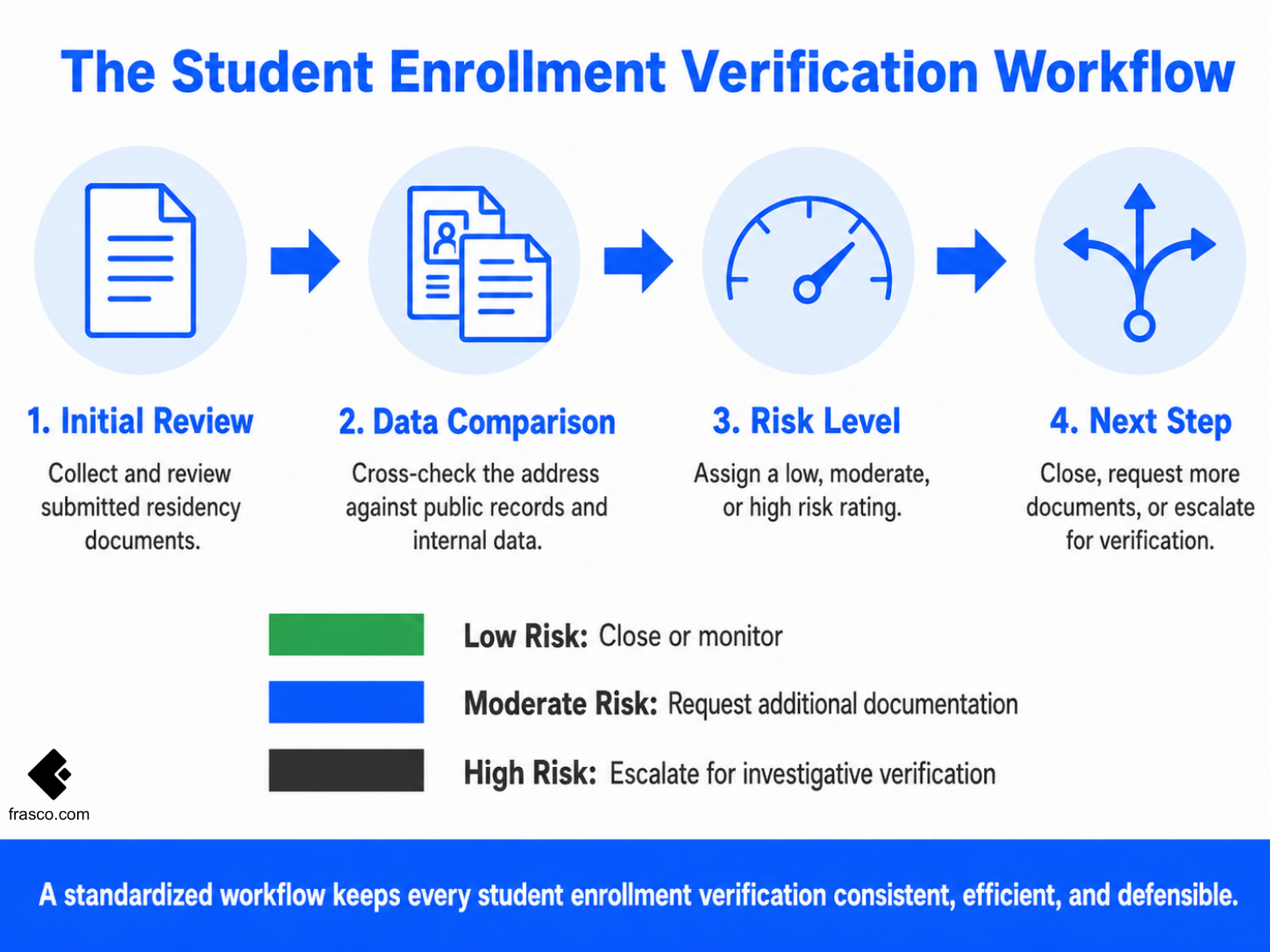
A standardized student enrollment verification approach should include a defined checklist of records to review, consistent documentation requirements, and clear thresholds for escalation. Consequently, every case follows the same defensible path from intake to decision.
3. Use Scalable Database Research Before Field Work
During peak enrollment, scalability is essential. Database-driven reviews can include property ownership records, voter registrations, vehicle registrations, and business filings. Because these checks happen at scale, they reduce manual workload before any field work begins.
This reflects broader digital trends in education administration, where districts increasingly adopt centralized data approaches. According to the U.S. Government Accountability Office, administrative burden remains a persistent challenge in school systems, and staff often take on compliance responsibilities beyond their primary roles.
4. Define Clear Escalation Criteria
A key challenge for district staff is knowing when to escalate a case. Without clarity, minor issues can eat up too much time while high-risk cases get delayed.
A structured escalation model should answer three questions. First, is the submitted documentation insufficient Next, are the inconsistencies significantenough to act on? Finally, does the case call for observational evidence? In practice, the tiers are simple: low risk means close or monitor, moderate risk means request additional documentation, and high risk means investigative escalation.
5. Incorporate Observational Evidence When Needed
In certain cases, documentation alone is not enough. Behavior-based verification, such as documenting overnight residency patterns or daily travel routines, can provide additional clarity. This reflects a broader shift toward multi-source verification that combines static records with observable patterns. When a case reaches this stage, an experienced investigative partner can handle it discreetly, as described in our guide on clearing residency cases over the summer →
https://frasco.com/school-residency-investigation-use-summer-to-clear-cases/.
6. Reduce Burden on District Staff
A consistent theme across districts is resource constraint. According to the Learning Policy Institute, school systems continue to face staffing shortages across administrative and operational roles, which increases pressure during peak periods like enrollment.
The workload challenges are real:
- Districts face high case volumes
- Time-intensive documentation reviews
- Sensitive communications with families
Therefore, scalable support models help districts maintain focus on core responsibilities, avoid bottlenecks, and improve case turnaround time.
7. Ensure Documentation Is Defensible
Residency decisions can become contested. Without strong documentation, appeals grow more likely, cases require rework, and administrative time increases.
A defensible student enrollment verification case should include verified records from multiple sources, timestamped observations where applicable, and clear documentation of the process followed. This aligns with rising compliance expectations across the education sector.
8. Plan for Audit and Reporting Requirements
Residency decisions can become contested. Without strong documentation, appeals grow more likely, cases require rework, and administrative time increases.
A defensible student enrollment verification case should include verified records from multiple sources, timestamped observations where applicable, and clear documentation of the process followed. This aligns with rising compliance expectations across the education sector.
Why Scalable Student Enrollment Verification Support Matters
The complexity of verification during peak enrollment points to a growing need for structured, external support models.
An effective investigative partner should provide scalable capacity during high-volume periods, data-driven insights for early-stage reviews, observational capabilities for escalated cases, and documentation that supports defensible outcomes.
Frasco’s approach is built around these principles. It combines a tiered workflow from database research to observational verification, a consistent and repeatable method, and solutions designed specifically for school district policies. As a result, districts can align investigation intensity with case risk, maintain consistency across cases, and reduce internal workload during peak periods. You can learn more on our district residency investigations page → https://frasco.com/district-residency-investigations/.
Practical Takeaways
As districts prepare for peak enrollment, a few priorities make the biggest difference for student enrollment verification.
Focus on standardizing processes early, prioritizing data-driven reviews, defining escalation criteria clearly, and planning for audit readiness. At the same time, avoid relying solely on manual reviews, treating all cases equally, and delaying escalation decisions.
Peak enrollment season will always present operational challenges. However, districts that adopt structured, scalable approaches to student enrollment verification can improve efficiency, reduce risk, and make more confident decisions. As enrollment volumes grow and compliance expectations rise, the ability to manage residency cases at scale is no longer optional. It is a foundational part of modern district operations.
Frequently Asked Questions About Student Enrollment Verification
Q1. What is student enrollment verification?
Student enrollment verification is the process school districts use to confirm that a student’s primary residence falls within district boundaries. It supports accurate funding, fair resource allocation, and compliance with state residency requirements, and it typically combines document review, data checks, and escalation for higher-risk cases.
Q2. Why is student enrollment verification harder during July?
July is peak enrollment season. Registration surges, address changes climb, and exception cases multiply, all while staffing stays limited. As a result, manual processes become a bottleneck, and districts need scalable, standardized student enrollment verification workflows to keep up.
Q3. How can districts scale student enrollment verification without adding staff?
Districts can scale by starting with database-driven reviews that filter low-risk cases automatically, standardizing the review process, and escalating only higher-risk cases for deeper verification. This tiered approach focuses limited staff time where it matters most.
Q4. What makes a student enrollment verification decision defensible?
A defensible decision rests on verified records from multiple sources, a consistent documented process, and timestamped observations where applicable. Strong documentation reduces successful appeals and supports the district during audits and reporting cycles.
Want to Learn More?
See how school districts use investigations to protect resources and keep enrollment fair.
📄 Download our white paper: Protecting Educational Resources: 4 Ways to Address Residency Fraud
Stay Updated: Get our latest posts, school-district fraud trends, and upcoming events—right in your feed 👉 Follow Frasco on LinkedIn
Contact Us Today
Frasco® District Residency Investigations delivers ethical and efficient solutions tailored to your needs. Have questions or want to discuss your investigative needs further? Schedule a call with one of our experts today to find the answers you’re looking for.
If you know a school district that could benefit from our investigative services, Submit a Referral Here to help them protect their resources and strengthen community trust.
Disclaimer: This blog post is for informational purposes only and should not be considered legal advice. Please consult your general counsel for specific legal guidance. Frasco investigators are licensed, and our operations comply with US industry, federal, state, and local laws.