

Slip and Fall Claims in Hospitality: A Peak Season Playbook for Faster, Defensible Outcomes
Slip and fall claims are the most common and most costly incidents hospitality organizations face, and they surge during peak travel season. As guest volume climbs through August, so does foot traffic across lobbies, pools, restaurants, and event spaces, and every busy surface becomes a potential incident. For risk and claims professionals, the challenge is not eliminating these claims. It is investigating and validating each one efficiently, accurately, and consistently.
This playbook explains why slip and fall claims spike in peak season, how to investigate them before the evidence disappears, and how the same discipline protects your organization against the other claim types that rise alongside them. Structured processes and third-party investigative support sit at the center of that work.
Why Slip and Fall Claims Spike During Peak Travel Season
Higher occupancy, seasonal staffing, and compressed timelines combine to make slip and fall claims both more frequent and harder to validate.
Volume Amplifies Risk
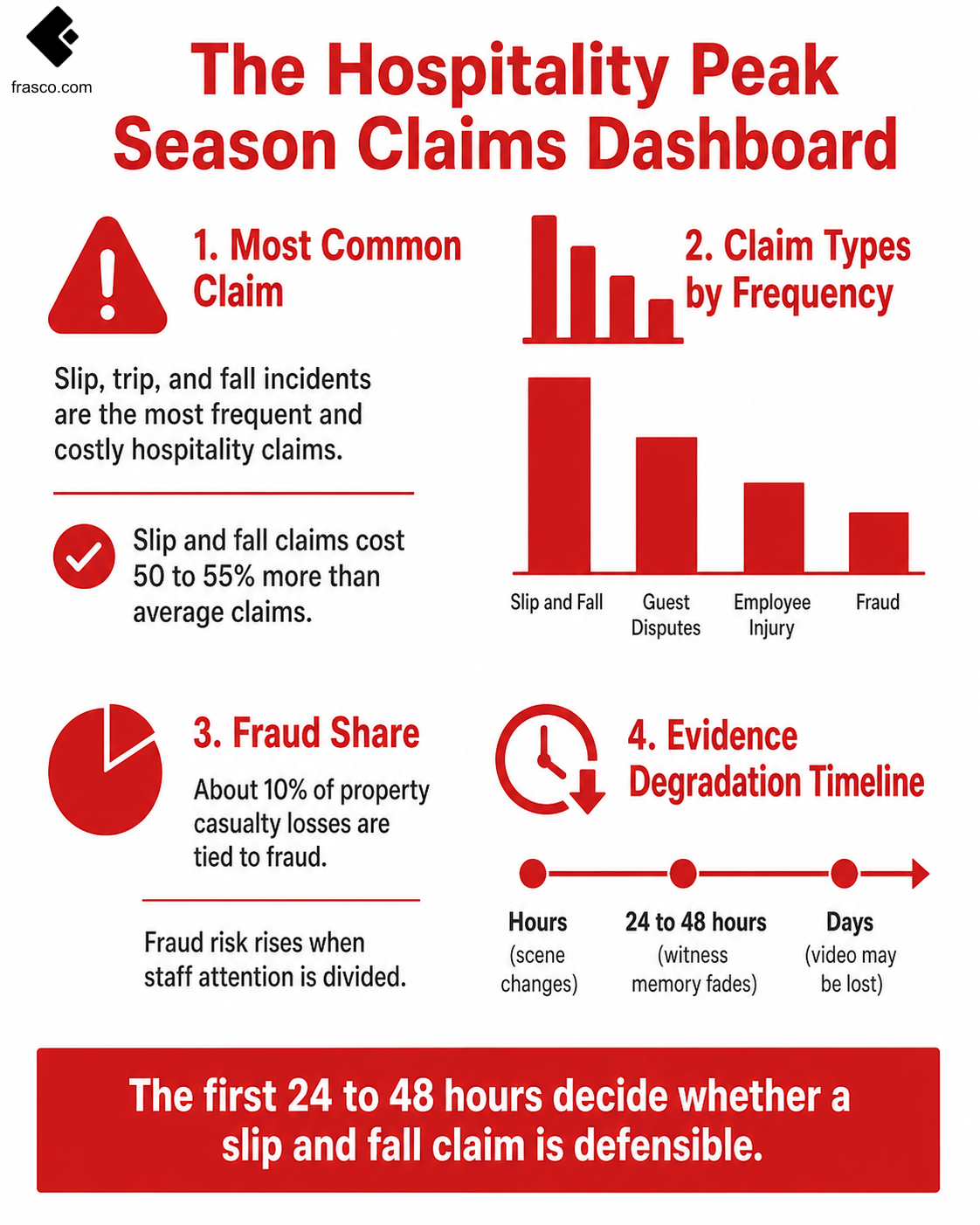
Higher occupancy means more guest interactions, greater use of facilities and amenities, and more opportunities for incidents. Even well-managed operations see a higher frequency of slip and fall events during peak months, alongside more guest disputes and employee injuries. According to The CLM, slip and fall claims cost 50 to 55 percent more than average claims, so each incident carries outsized financial weight.
Staffing Variability Introduces Inconsistency
Seasonal hiring often results in reduced training time, less familiarity with procedures, and inconsistent documentation practices. Consequently, these gaps directly affect how a slip and fall incident is recorded and later investigated. A poorly documented incident is far harder to defend.
Claim Timelines Compress
During peak season, incidents must be documented quickly because evidence can degrade within hours. Delays reduce the ability to validate slip and fall claims effectively, which weakens both cost control and legal positioning.
How to Investigate and Validate Slip and Fall Claims
A structured investigation process is what turns a slip and fall claim from an uncertain liability into a documented, defensible decision.
1. Standardize Early Response Protocols
Make sure incidents are reported immediately, key details are captured consistently, and escalation pathways are clearly defined. A standard first response is the foundation of every defensible slip and fall claim.
2. Prioritize Early Investigation
The first 24 to 48 hours are critical. Use them to capture accurate witness statements, secure video evidence before it is overwritten, and document environmental conditions such as floor surface, lighting, and signage. In slip and fall claims, this early window often determines the outcome.
3. Use Structured Validation Frameworks
Establish consistent criteria for evaluating claim legitimacy, identifying inconsistencies, and documenting conclusions. As a result, every slip and fall claim is judged against the same standard, which strengthens defensibility if the claim is later challenged.
4. Integrate Third-Party Investigative Resources
Third-party investigators provide independent fact validation, scalable coverage across locations, and consistent investigative methods. This is especially valuable for multi-location hospitality organizations and high-volume incident environments, where internal teams cannot always absorb the peak season surge.
Beyond Slip and Fall: The Other Claims That Rise in Peak Season
Slip and fall claims lead the peak season surge, but the same investigative discipline protects against four related exposures.
While slip and fall incidents are the most common, risk teams should watch four other categories that rise alongside them:
-
Guest disputes and liability claims involving service, safety, or property damage, which require clear documentation and objective validation
-
Employee injury claims, which increase as seasonal labor raises injury rates and training variability
- Evidence gaps, where delays produce missing witness statements, lost video footage, and incomplete incident reports
- Fraud indicators, including exaggerated claims, repeated claimant patterns, and inconsistent narratives, which grow more likely when staff attention is divided
Insurance fraud accounts for about 10 percent of property casualty losses in the United States, representing more than 300 billion dollars annually, according to the Coalition Against Insurance Fraud. For a broader view of managing these exposures across guests and staff, see our guide on hospitality risk management and reducing guest and staff claims →
https://frasco.com/hospitality-risk-management-reducing-guest-and-staff-claims-before-costs-rise/.
From Incident to Validation: Closing the Operational Gap
Most organizations report incidents well. The gap usually appears in what happens next.
Common issues include delayed escalation to investigation, inconsistent documentation standards, and a lack of centralized evidence management. Therefore, these gaps create uncertainty in liability decisions, claim valuation, and legal positioning, exactly the areas where a slip and fall claim can become expensive.
Third-party investigative providers help close this gap in three ways:
- Capacity: Peak season creates incident spikes that internal teams cannot always absorb.
- Consistency: External investigators apply standardized processes across locations, ensuring comparable evidence quality and reliable reporting.
- Objectivity: Independent investigations strengthen claim defensibility and decision confidence.
Why Faster Slip and Fall Investigation Improves Guest Satisfaction
At first glance, investigation and guest satisfaction seem separate. In practice, they are closely linked.
Effective investigation processes enable faster resolution, reduce prolonged disputes, and support transparent communication. In turn, this improves guest trust, brand reputation, and operational stability. When a slip and fall claim is handled quickly and fairly, the guest experience is protected rather than damaged, and the organization resolves the claim with confidence.
Your Peak Season Slip and Fall Readiness Checklist
Use these four steps to prepare before peak season pressure peaks.
- Conduct a peak season readiness review of incident response protocols, documentation standards, and investigation workflows.
- Identify high-risk properties using historical data, so you can focus resources where incidents are most likely.
- Align cross-functional teams across risk management, operations, claims, and legal.
- Evaluate investigative partnerships, looking for providers that offer tailored solutions, technology-enabled reporting, and scalable support across locations.
At the enterprise level, investigation is not a tactical afterthought. It is a strategic function that supports financial performance, legal outcomes, and brand protection. Organizations that treat investigation as an integrated part of their risk strategy are better positioned to manage peak season effectively.
Turning Peak Season Pressure Into Defensible Outcomes
Peak travel season does not just increase slip and fall claims. It exposes gaps in how organizations investigate and validate them. By focusing on early response, structured investigation, and third-party support, risk managers can streamline claims while protecting the guest experience.
In a high-volume environment, clarity and consistency drive better outcomes. The organizations that prepare their slip and fall investigation process now are the ones that enter peak season ready to resolve every claim with speed and confidence.
Frequently Asked Questions About Slip and Fall Claims
Q1. Why are slip and fall claims so common in hospitality?
Slip and fall claims are common because hotels, resorts, and restaurants combine high foot traffic with surfaces that change quickly, wet pool decks, freshly cleaned floors, and crowded event spaces. During peak season, higher occupancy and seasonal staffing increase both the frequency and the cost of these claims.
Q2. How should a hotel investigate a slip and fall claim?
A hotel should report the incident immediately, capture witness statements and video within the first 24 to 48 hours, document environmental conditions like flooring and signage, and validate the claim against consistent criteria. Early, structured investigation is what makes a slip and fall claim defensible.
Q3. What makes a slip and fall claim defensible?
A defensible slip and fall claim rests on prompt documentation, secured video evidence, consistent witness statements, and a clear record of the environmental conditions at the time. Independent third-party investigation strengthens that record and supports confident liability decisions.
Q4. Why do slip and fall claims increase during peak season?
Peak season brings higher occupancy, more foot traffic, and seasonal staff who may be less familiar with documentation procedures. Together, these factors raise both the number of slip and fall claims and the risk that any single claim is poorly documented and harder to defend.
Want to Learn More?
At Frasco, we believe knowledge plays a critical role in hospitality risk management. We provide resources designed to help risk professionals navigate claims, investigations, and evolving exposure with confidence.
📄 Download our white paper: Service with a Smile: Navigating Fraud in Hospitality’s Top 3 Claims
Stay Updated: Get real-time insights, the latest blogs, and updates on upcoming industry events.
👉 Follow Frasco on LinkedIn
Contact Us Today
Frasco® Investigative Services delivers ethical and efficient solutions tailored to your needs. Have questions or want to discuss your investigative needs further? Contact one of our experienced experts today to find the answers you’re looking for.
Disclaimer: This blog post is for informational purposes only and should not be considered legal advice. Please consult your general counsel for specific legal guidance. Frasco investigators are licensed, and our operations comply with US industry, federal, state, and local laws.