

Your Mid-Year Mortgage Risk Management Checklist: Maintaining Loan Integrity During Peak Summer Volume
For mortgage lenders and servicers, mid-year is more than a calendar milestone. It is a stress test for your entire mortgage risk management process.
As origination volume rises during the peak summer homebuying season, risk exposure rises alongside it. Teams are under pressure to move faster, pipelines expand unevenly, and even strong processes can struggle to keep up. At the same time, fraud risk is not static. Instead, it scales with opportunity.
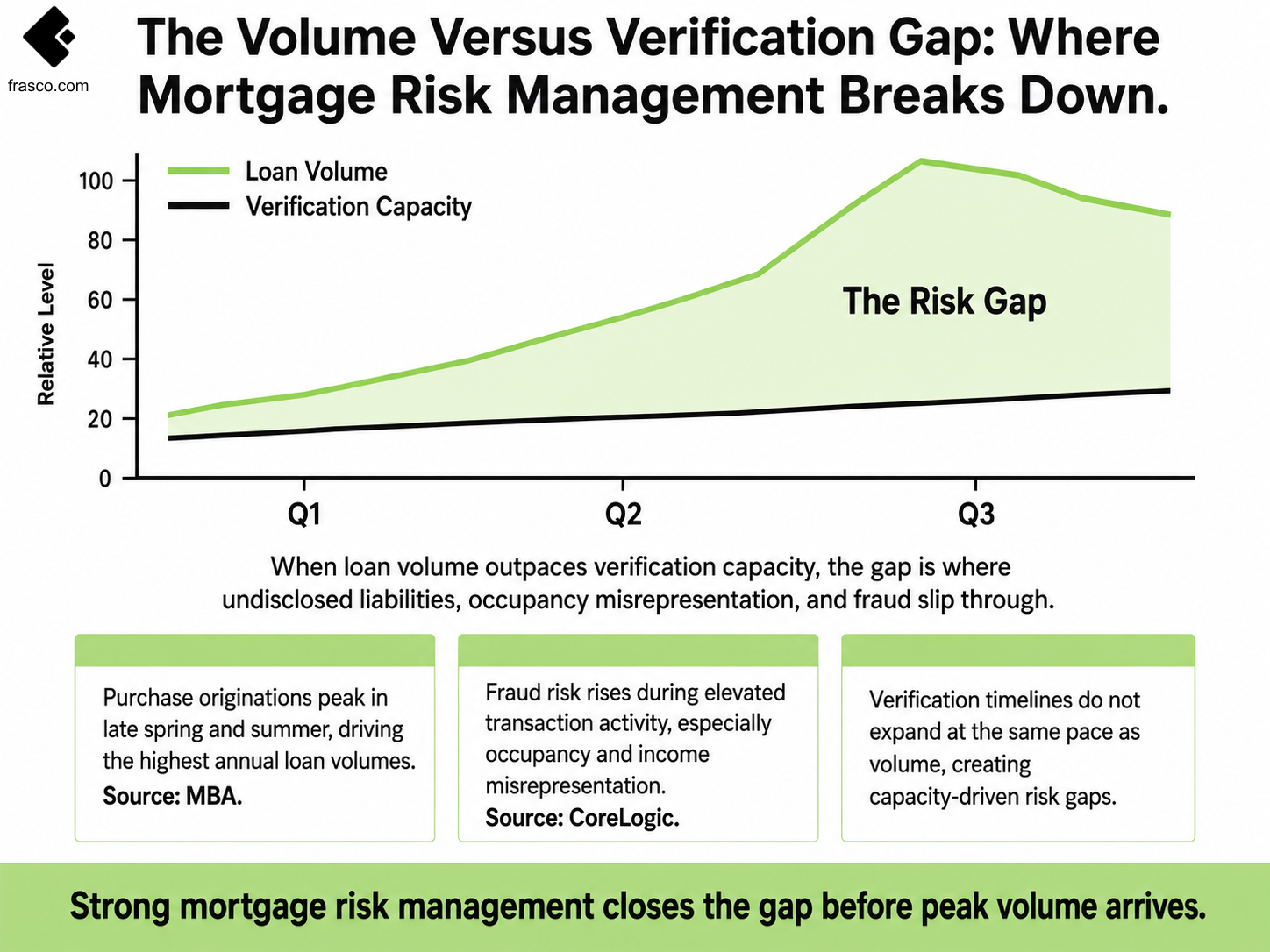
According to the Mortgage Bankers Association, purchase originations typically peak during late spring and summer, driving the highest annual loan volumes in the United States. Meanwhile, core processing timelines do not expand at the same pace, which creates conditions where verification gaps open up. Compounding this pressure, analysis from CoreLogic consistently shows that mortgage fraud risk rises during periods of high transaction activity, especially in occupancy misrepresentation and income falsification.
This is where a structured mid-year mortgage risk management checklist becomes essential. Use the ten checkpoints below to maintain loan integrity before peak volume exposes the gaps.
1. Did Volume-Driven Verification Gaps Appear in Q2?
Peak periods often expose bottlenecks in even the strongest mortgage risk management process. Typically, underwriting teams prioritize throughput, QC reviews shift toward sampling rather than full validation, and internal risk teams become reactive instead of proactive.
During volume surges, lenders commonly face incomplete borrower validation and delayed follow-up on inconsistencies. This is not a process failure. Rather, it is a capacity issue.
Checklist:
- Did any loans move forward with limited secondary validation?
- Did turnaround times increase beyond acceptable thresholds?
- Did the team defer or deprioritize risk escalations?
Insight: During high-volume periods, even minor verification gaps can lead to material downstream risk.
2. Are Undisclosed Liabilities and Borrower Relationships Fully Identified?
Undisclosed liabilities remain one of the most persistent factors in mortgage risk management. Generally, these risks increase when borrowers manage multiple properties, when investors move quickly in competitive markets, and when documentation is altered or selectively presented.
Checklist:
- Are your processes catching layered liabilities across multiple sources?
- Do QC teams have time to investigate anomalies fully?
- Does your team verify borrower relationships beyond surface-level data?
3. Is Occupancy Verification Keeping Pace With Loan Volume?
Occupancy misrepresentation is one of the most common fraud indicators during high-transaction periods, which makes it a priority for any mortgage risk management program. For example, CoreLogic reports that a significant share of fraud risk alerts tie directly to occupancy risk and investor misrepresentation.
Checklist:
- Does your team cross-validate occupancy claims across data sources?
- Do you use field verification when signals are unclear?
- Does your team track vacancy or investor property indicators?
For a deeper look at preparing for fraud risk before volume peaks, see our lender’s guide to peak season mortgage fraud risk → https://frasco.com/mortgage-fraud-risk-a-lenders-guide-to-peak-season-2026/.
4. Is Your Mortgage Risk Management Scalable During Peak Periods?
Most lenders rely on internal teams for verification and risk assessment. That works under steady conditions, but it does not scale easily. As a result, during mid-year surges, investigation queues grow, turnaround times increase, and lower-risk cases receive less attention. This creates a tiering problem where only the highest-risk loans receive deep scrutiny.
Checklist:
- Can your current team handle a 20 to 40 percent volume increase?
- Are investigation timelines consistent during peak cycles?
- Do you have flexible support for targeted cases?
5. Is Your Documentation Audit-Ready Across All Loan Stages?
In strong mortgage risk management, audit defensibility is not a year-end activity. Instead, it is a continuous requirement. Regulatory expectations and investor scrutiny call for documentation that shows independent verification, consistent methods, and clear evidence trails.
Checklist:
- Can your files withstand investor or regulator review?
- Does your team document and resolve inconsistencies clearly?
- Is your reporting standardized across teams?
To build defect prevention into your documentation early, see our guide on mortgage quality control to stop defects before they start →
https://frasco.com/mortgage-quality-control-stop-defects-before-they-start/.
6. Does Your Mortgage Risk Management Go Beyond Automated Systems?
Automation has improved speed. However, it has not eliminated risk. Certain risk signals require human investigation to support sound mortgage risk management, including employer legitimacy, asset sourcing anomalies, and behavioral inconsistencies.
Checklist:
- Does your team escalate high-risk cases beyond automated checks?
- Do you use manual validation when patterns do not match?
- Does your team leverage third-party verification sources?
7. Are You Equipped to Detect Early-Stage Red Flags?
The ability to detect early risk determines downstream outcomes, which is why early detection sits at the center of effective mortgage risk management. Specifically, this includes pre-funding inconsistencies, borrower data mismatches, and property use signals.
Checklist:
- Does your team identify red flags before closing?
- Do you prioritize post-closing reviews for high-risk segments?
- Does your team feed insights back into underwriting?
For more on catching risk early in the loan lifecycle, see our guide on mortgage fraud detection and how lenders catch risk early → https://frasco.com/mortgage-fraud-detection-how-lenders-catch-risk-early/.
8. Is Your Mortgage Risk Management Aligned Across Teams?
Fragmentation is one of the most overlooked risks in mortgage risk management. When underwriting, QC, and risk teams work in silos, information slips away, teams duplicate investigations, and risk signals go unnoticed. Frasco emphasizes integration without disrupting underwriting or QC workflows.
Checklist:
- Can your teams see risk signals across departments?
- Do teams reuse findings across the loan lifecycle?
- Does your team standardize investigation outputs?
9. Are You Prepared for Second-Half Economic Shifts?
The second half of the year often brings changes in interest rates, borrower behavior, and default trends. Therefore, market uncertainty raises the importance of accurate borrower data and financial validation within your mortgage risk management strategy. According to the Mortgage Bankers Association, shifts in rates directly affect origination mix and borrower qualification profiles.
Checklist:
- Does your team monitor hardship indicators?
- Do you validate borrower financial changes?
- Does your team adjust risk thresholds for market conditions?
Rising default risk makes early intervention essential. See our guide on how field investigations reduce early payment default risk → https://frasco.com/early-payment-default-how-field-investigations-reduce-risk/.
10. Do You Have a Scalable Investigative Partner?
A key takeaway from mid-year mortgage risk management assessments is this: most organizations do not need more tools. Instead, they need flexible investigative capacity.
The Frasco model provides targeted desktop investigations, field verification when needed, and full forensic reviews across borrower, property, and financial risk areas. As a result, lenders and servicers can scale up during peak volume, focus internal teams on core workflows, and apply deeper investigation where it matters most.
Checklist:
- Can your investigative capacity flex with volume?
- Can you choose desktop or field options based on case complexity?
- Can you access deeper forensic review for the highest-risk loans?
Mid-Year Is the Moment to Strengthen Mortgage Risk Management
Mid-year volume is not just a growth opportunity. Rather, it is a risk inflection point. Organizations that maintain loan integrity during this period focus on scalable verification processes, early detection of red flags, defensible documentation, and alignment across teams.
The result is not just fewer errors. Ultimately, it is stronger portfolios and more confident decision-making. By reviewing your mortgage risk management process against this checklist now, your organization can enter the second half of 2026 ready for whatever the market brings.
Frequently Asked Questions About Mortgage Risk Management
1. What is mortgage risk management?
Mortgage risk management is the structured process lenders and servicers use to identify, verify, and control risk across the loan lifecycle. Generally, strong mortgage risk management includes borrower validation, occupancy verification, fraud detection, audit-ready documentation, and scalable investigative capacity during high-volume periods.
2. Why is mid-year critical for mortgage risk management?
Mid-year brings the peak summer homebuying season, which drives the highest annual loan volumes. When volume outpaces verification capacity, risk gaps open. As a result, reviewing your mortgage risk management process before the peak helps close those gaps before they create downstream losses.
3. How does loan volume affect mortgage risk?
As loan volume rises, verification timelines often do not expand at the same pace. Consequently, this creates a gap where undisclosed liabilities, occupancy misrepresentation, and fraud can slip through. Effective mortgage risk management scales verification capacity to match volume.
4. How can lenders scale mortgage risk management during peak season?
Lenders can scale mortgage risk management by combining internal teams with flexible external investigative support. Specifically, targeted desktop investigations, field verification, and forensic reviews let lenders apply deeper scrutiny to high-risk loans without slowing funding velocity.
Want to Learn More?
At Frasco, we believe knowledge is the foundation of stronger, smarter lending practices. That’s why we provide resources to help lenders deepen their understanding of risk mitigation and compliance.
📄 Download our white paper:
Unlocking Success: 3 Keys for Maximizing Occupancy Verification in Mortgage Lending
Stay Updated: Get real-time insights, the latest blogs, and updates on upcoming industry events.
👉 Follow Frasco on LinkedIn
Contact Us Today
Frasco® Mortgage Risk Mitigation delivers ethical and efficient solutions tailored to your needs. Have questions or want to discuss your investigative needs further? Schedule a call with one of our experts today to find the answers you’re looking for.
If you know a company that could benefit from our investigative services, Submit a Referral Here to help them make informed decisions and prevent costly risks.
Disclaimer: This blog post is for informational purposes only and should not be considered legal advice. Please consult your general counsel for specific legal guidance. Frasco investigators are licensed, and our operations comply with US industry, federal, state, and local laws.