
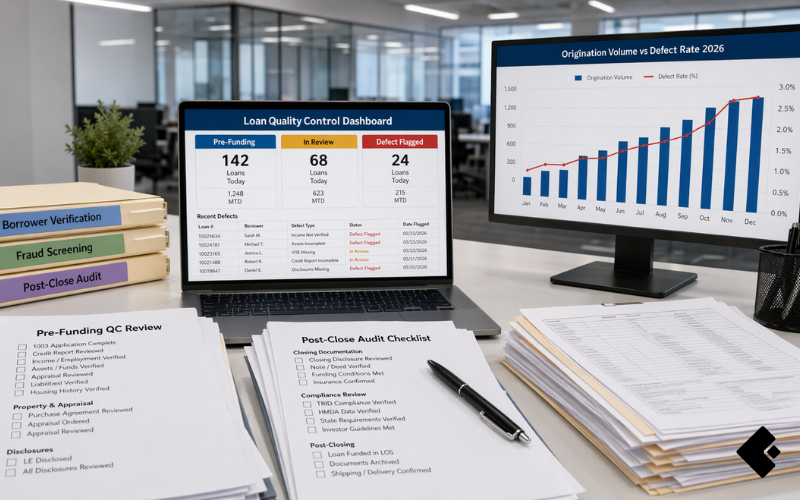
Mortgage Quality Control: How Third-Party Verification Strengthens Pre-Funding and Post-Close QC During High-Volume Periods
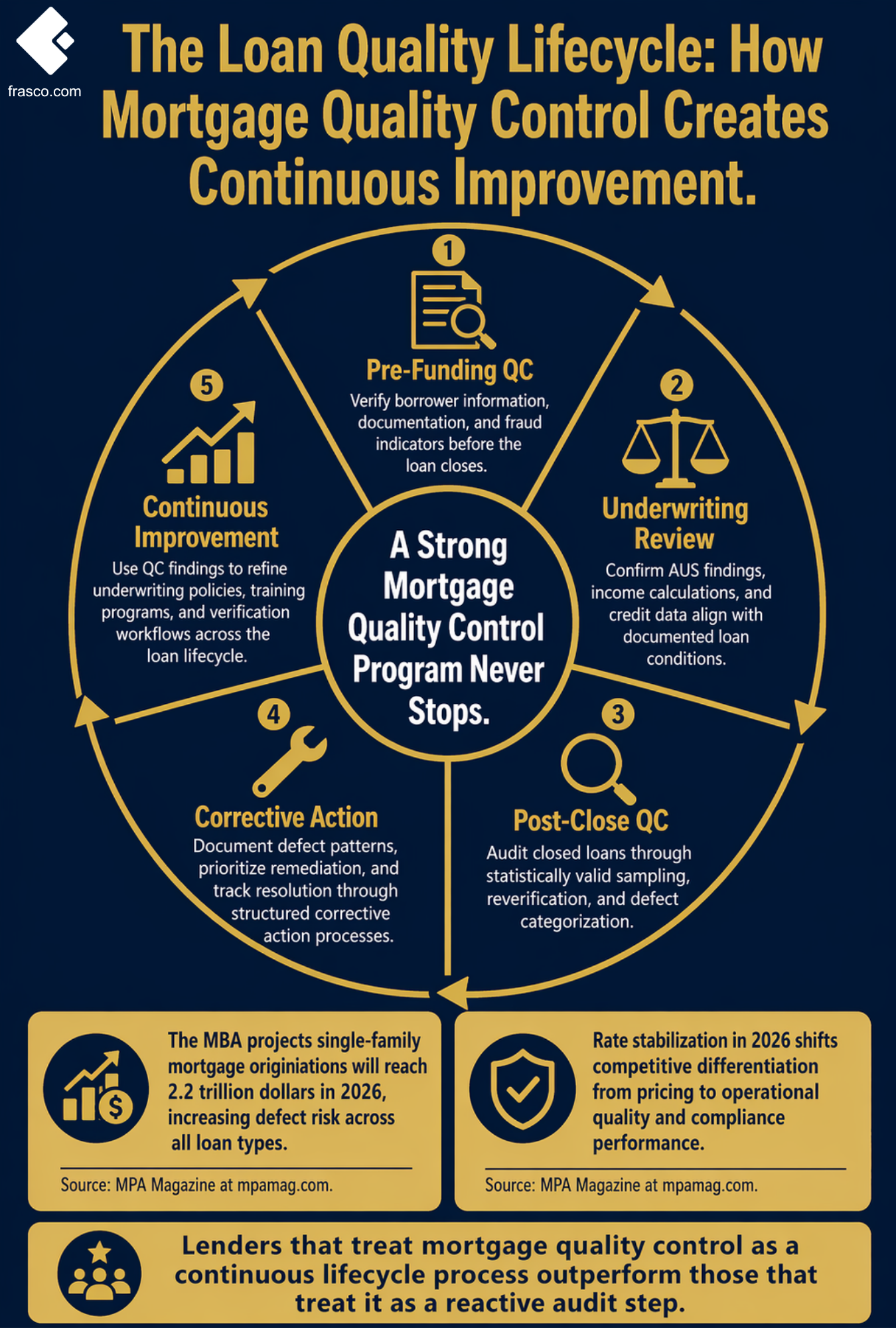
Mortgage quality control has never carried more operational weight than it does in 2026. The mortgage industry continues to operate under shifting market conditions that place growing pressure on accuracy, defect prevention, and compliance performance. According to recent forecasts, the Mortgage Bankers Association expects single-family originations to reach 2.2 trillion dollars in 2026, an increase from the previous year. (Source: mpamag.com) As origination volumes rise, so does the risk of defects slipping through internal review processes that were not built to handle the additional load.
This expansion is happening alongside a broader housing market reset where buyer leverage increases and underwriting standards tighten. In this environment, lenders cannot afford errors in pre-funding or post-close audits. Furthermore, third-party verification offers a reliable buffer that strengthens internal mortgage quality control programs, especially during high-volume periods when internal teams are stretched thin. (Source: mpamag.com)
This guide explores the role of independent verification in mortgage quality control, covers the 2026 market trends driving the need for stronger oversight, and provides practical checklists and data-backed insights for pre-funding and post-close QC programs.
Four Market Conditions Shaping Mortgage Quality Control Priorities in 2026
Understanding what is driving QC pressure in 2026 helps lenders and risk professionals prioritize where to invest their mortgage quality control resources.
1. Rising Loan Volume Increases Defect Risk
Forecasts show single-family mortgage originations climbing to 2.2 trillion dollars in 2026. As lenders process more files, defect probability rises due to time pressure, staffing limits, and the use of less experienced reviewers during volume spikes. Consequently, organizations without scalable mortgage quality control processes face growing exposure to loan defects and repurchase demands.
(Source: mpamag.com)
2. Rate Stabilization Shifts Focus to Operational Quality
Analysts expect 30-year fixed rates to average around 6.2 percent in early 2026, declining slightly to 5.9 percent by year-end. As a result, this relative rate stability means competitive advantage moves away from rate-driven strategies and toward operational quality, borrower experience, and compliance performance. Mortgage quality control becomes a primary differentiator in this environment. (Source: mpamag.com)
3. Housing Market Reset Increases Documentation Scrutiny
Economists predict a 2026 market correction where buyers regain leverage. This environment typically produces higher demands for documentation accuracy, valuation transparency, and regulatory alignment. Therefore, mortgage quality control programs that rely solely on internal reviews face greater exposure when investor and regulatory scrutiny intensifies. (Source: mpamag.com)
4. Moderate Market Growth Keeps Efficiency Pressure High
Industry analysts caution that market improvement will be gradual rather than fast. This sustained but modest activity keeps steady pressure on lenders to remain efficient without increasing operational costs. Moreover, organizations that invest in structured mortgage quality control partnerships during this period build the scalable infrastructure they need when volumes peak. (Source: mpamag.com)
Together, these conditions confirm that proactive, scalable mortgage quality control strategies are not optional in 2026. They are a financial and operational necessity.
Why Third-Party Verification Is Essential to Mortgage Quality Control in High-Volume Cycles
During high-volume months, internal QC teams face workflow bottlenecks and staffing strain that create conditions where defects go undetected. Third-party verification directly addresses this risk.
Internal mortgage quality control teams can struggle to keep pace during peak periods, leading to rushed reviews and inconsistent sampling. Trusted third-party providers offer an essential safeguard by supplying expertise, scalability, and neutrality that internal teams cannot always provide under volume pressure.
Key benefits of third-party mortgage quality control support include:
- Independent accuracy checks: A neutral review removes internal bias and detects issues more objectively than reviews conducted by teams close to the origination process
- Reduced processing delays: Third-party firms expand capacity quickly during volume spikes, keeping review cycles on schedule without adding permanent headcount
- Lower loan defect rates: Consistent external reviews catch documentation gaps, calculation errors, and verification failures early before they reach investors or regulators
- Better compliance alignment: Third-party mortgage quality control providers stay current on regulatory changes and investor guidelines, reducing the risk of compliance gaps during fast-moving market cycles
- Enhanced borrower trust: Accurate loan files reduce repurchase risk and protect lender reputation with secondary market investors
Pre-Funding Mortgage Quality Control: A Practical Checklist for High-Volume Periods
Use this checklist to strengthen your pre-funding mortgage quality control process, particularly during periods of elevated origination volume.
Borrower Information Verification
- Confirm borrower identity using reliable, independently sourced verification tools that are not subject to the same internal bias as origination staff reviews
- Validate employment and income using third-party verification when internal data is incomplete, inconsistent, or cannot be independently confirmed
- Cross-check assets and bank statements for red flags including round-number deposits, untraceable transfers, or patterns that suggest undisclosed liabilities
Documentation Review
- Confirm all required disclosures are included and signed before the file advances in the mortgage quality control workflow
- Validate loan estimates and closing cost details for compliance accuracy against current TRID and investor requirements
- Confirm appraisals include required comparable sales, photographs, and market analysis that support the stated property value
Fraud and Red Flag Screening
- Review inconsistencies between application data and third-party verification reports that may indicate misrepresentation
- Examine occupancy claims carefully, particularly in states or regions with elevated fraud incidence rates
- Check for altered documents, mismatched fonts, or inconsistent file metadata that signal potential document manipulation
Underwriting Accuracy
- Verify credit report details match borrower-supplied information throughout the file
- Confirm AUS findings align with all documented loan conditions before the file moves to closing
- Ensure debt-to-income calculations are accurately supported by verified income documentation
Third-party verification partners can execute many of these steps, providing scalable mortgage quality control support that internal teams consistently need during peak origination volume.
![Early Payment Default Red Flags — What Field Investigations Uncover]<br />
Alt Text: "A checklist infographic showing the key early payment default red flags that field-based mortgage investigations uncover, including borrower employment issues, occupancy misrepresentation, property neglect, and neighborhood economic decline indicators.](https://frasco.com/wp-content/uploads/2026/04/FMRM-202605-Blog-Post-Infographic-1.png "FMRM - 202604 - Blog Post Infographic 1")
Post-Close Mortgage Quality Control: 2026 Best Practices for Risk Professionals
Post-close audits remain one of the strongest defenses against defects that were not caught during pre-funding review. As the 2026 market stabilizes, investor and regulator expectations for post-close transparency are increasing.
Having a third-party partner conduct post-close mortgage quality control reviews adds both credibility and consistency to internal findings. Furthermore, it demonstrates to investors and regulators that QC outcomes are objective and free from internal influence. Post-close priorities should include the following:
Sampling Accuracy
Implement statistically valid sampling methods aligned with investor guidelines from Fannie Mae, Freddie Mac, FHA, and VA. Random and discretionary sampling approaches should be structured to give every loan a chance of selection within required timeframes.
Reverification Procedures
Use third-party reverification tools to independently confirm employment, occupancy, and asset details after closing. Additionally, reverification catches changes in borrower circumstances that occurred between application and funding but were not identified during pre-funding review.
Document Defect Categorization
Classify identified issues by severity level to prioritize which defects require immediate remediation and which can be addressed through standard corrective action cycles. Consistent categorization supports more accurate reporting to leadership and investors.
Corrective Action Tracking
Document defect patterns across loan files to identify training gaps, process failures, or underwriting inconsistencies that require systemic correction. In addition, tracked corrective actions provide defensible evidence of mortgage quality control responsiveness during investor and regulatory audits.
Reporting and Feedback Loops
Deliver post-close mortgage quality control findings to leadership teams in a structured, consistent format that supports data-driven decision making. Consistent reporting builds the institutional knowledge needed to improve pre-funding controls over time.
How Third-Party Verification Supports Both QC Stages
By integrating external verification at both pre-funding and post-close stages, lenders build a mortgage quality control program that is consistent, scalable, and defensible across every market condition.
Specifically, third-party mortgage quality control support delivers four outcomes that directly protect lenders in the 2026 market environment:
- Consistency: Uniform standards applied across fluctuating internal workloads ensure that mortgage quality control outcomes do not vary based on staffing levels or volume pressure
- Speed: Faster review cycles during peak demand reduce turn time and improve the borrower experience without sacrificing accuracy
- Risk mitigation: Proactive identification of defects reduces repurchase exposure and regulatory findings before they affect the lender’s investor relationships
- Data integrity: Independent verification protects lenders from errors introduced by manual oversight, system misalignment, or internal bias in the origination process
Build a Stronger Mortgage Quality Control Program Before 2026 Volume Peaks
As origination volumes rise toward the MBA’s 2.2 trillion dollar projection, lenders face real and growing exposure from defects that internal teams alone cannot consistently catch at pace. Third-party mortgage quality control verification offers a practical, reliable, and scalable solution for both pre-funding and post-close QC processes that keeps accuracy and compliance performance intact during the most demanding periods.
The 2026 market rewards lenders that invest in structured mortgage quality control partnerships now. Organizations that build those partnerships before volume peaks will be better positioned to meet regulatory expectations, protect investor relationships, reduce defect exposure, and maintain the operational stability that sets them apart in a competitive market.
Want to Learn More?
At Frasco, we believe knowledge is the foundation of stronger, smarter lending practices. That’s why we provide resources to help lenders deepen their understanding of risk mitigation and compliance.
📄 Download our white paper:
Unlocking Success: 3 Keys for Maximizing Occupancy Verification in Mortgage Lending
Stay Updated: Get real-time insights, the latest blogs, and updates on upcoming industry events.
👉 Follow Frasco on LinkedIn
Contact Us Today
Frasco® Mortgage Risk Mitigation delivers ethical and efficient solutions tailored to your needs. Have questions or want to discuss your investigative needs further? Schedule a call with one of our experts today to find the answers you’re looking for.
If you know a company that could benefit from our investigative services, Submit a Referral Here to help them make informed decisions and prevent costly risks.
Disclaimer: This blog post is for informational purposes only and should not be considered legal advice. Please consult your general counsel for specific legal guidance. Frasco investigators are licensed, and our operations comply with US industry, federal, state, and local laws.