

Mortgage Review Guide: How Lenders Can Reduce Repurchase Risk
Mortgage review has become increasingly important for lenders, servicers, and mortgage quality control teams that need to identify loan-level risk before it becomes a costly repurchase issue.
A loan file can appear complete while still containing inconsistencies in income, employment, liabilities, occupancy, assets, or borrower representations. When those issues remain unresolved, they can create eligibility concerns, quality defects, audit findings, and potential repurchase exposure.
Current industry data reinforces the need for careful review. Fannie Mae’s June 2026 loan quality analysis found that primary occupancy misrepresentation, income issues, undisclosed liabilities, missing debt documentation, and employment concerns remain among the most common significant defects found during post-purchase reviews.
For mortgage risk leaders, the goal is not to add unnecessary friction to every loan. The goal is to identify where deeper verification is warranted and resolve questions before they affect portfolio quality.
This guide explains where mortgage risk can hide and how a structured mortgage review can help lenders make more confident decisions.
Why Mortgage Review Matters for Lenders and QC Teams
Mortgage organizations already rely on underwriting systems, credit data, borrower documentation, and automated verification tools. These resources are essential, but they do not eliminate the need for human review and independent validation when information conflicts or risk indicators emerge.
Fannie Mae’s current quality control framework specifically includes both prefunding and post-closing QC mortgage review processes. Its guidance requires lenders to evaluate underwriting decisions, documentation, data integrity, and reverification where applicable.
Freddie Mac also requires sellers to maintain quality control processes that include random, targeted, and discretionary post-closing samples, along with reverification, data integrity review, and documentation review.
These requirements point to a broader principle: loan quality depends on more than whether documents are present. The information within those documents must also be accurate, complete, consistent, and supportable.
Repurchase Risk Can Begin With Small Loan Defects
Repurchase exposure often starts with a defect that appears manageable when viewed in isolation.
An undisclosed liability may change the borrower’s debt-to-income ratio. An occupancy discrepancy may affect pricing or eligibility. An employment inconsistency can raise questions about qualifying income. Missing documentation can prevent a lender from demonstrating how an underwriting decision was reached.
Fannie Mae reported several of these issues among its leading significant defects in recent loan reviews. In random samples, primary occupancy misrepresentation ranked first. In targeted and discretionary reviews, undisclosed liabilities ranked first, followed by employment and other borrower eligibility concerns.
Meanwhile, Milliman’s August 2026 Mortgage Repurchase Index found that modeled repurchase risk for recent GSE acquisitions decreased slightly. However, the report also noted that income and collateral issues continue to represent a substantial share of repurchases, while liabilities remain an important driver of risk.
The lesson for lenders is important. Even when overall modeled repurchase risk improves, individual loan defects can still create significant exposure.
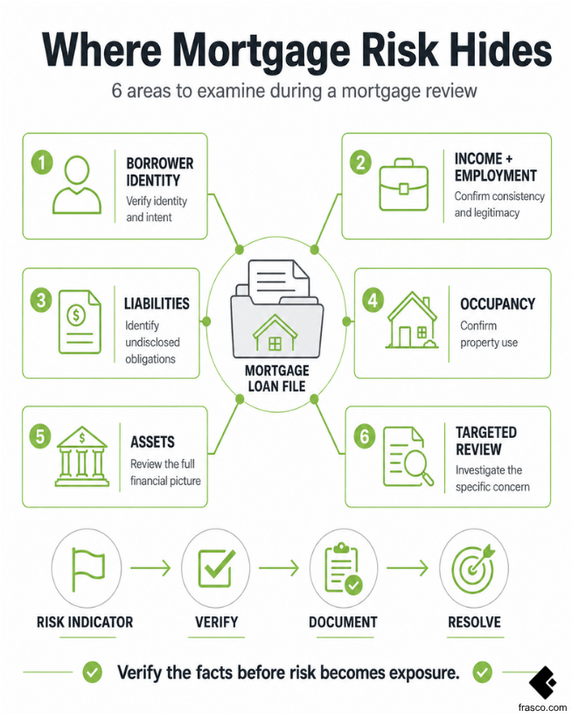
Where Mortgage Risk Commonly Hides
A strong mortgage review should focus on the areas most likely to affect loan quality, eligibility, and defensibility.
1. Borrower Identity and Intent
The first question is whether the borrower’s representations align with available evidence.
Risk teams should look for inconsistencies involving borrower identity, property relationships, stated intent, and information provided throughout the loan process.
For example, occupancy deserves particular attention. Fannie Mae identified misrepresentation of primary occupancy as the leading significant defect in its recent random loan sample.
A borrower may state that a property will serve as a primary residence while other information suggests investment or rental use. Identifying that inconsistency early gives the lender an opportunity to investigate the facts before the issue develops into a larger eligibility concern.
2. Income and Employment
Income and employment remain central to mortgage loan quality.
A mortgage review should evaluate whether employment appears legitimate, whether reported income aligns with documentation, and whether information across the loan file tells a consistent story.
Questions may include:
- Does the employer appear active and legitimate?
- Does the borrower’s role support the reported income?
- Are there inconsistencies between income documents and other available information?
- Does employment status appear to have changed around closing?
Fannie Mae continues to identify income misrepresentation, incorrect income calculations, missing income documentation, and borrower employment concerns among significant loan defects.
Independent verification can help clarify these issues when standard documentation leaves unanswered questions.
3. Undisclosed Liabilities and Financial Relationships
A borrower may have financial obligations that do not appear clearly in the original underwriting information.
These may include undisclosed mortgages, recurring payments, liens, financial relationships, or other obligations that could affect the borrower’s debt-to-income calculation or loan eligibility.
Fannie Mae identified undisclosed liabilities as the leading defect in its targeted and discretionary review sample for late 2025 and early 2026. Its current guidance also emphasizes reviewing source documents to verify that underwriting information is true, correct, and complete.
Risk teams should therefore look beyond a single credit report when other file information suggests additional obligations may exist.
4. Occupancy and Property Use
Occupancy risk can affect pricing, underwriting, eligibility, and investor confidence.
A mortgage review may need to determine whether a property is being used as represented in the loan file. Relevant information used for occupancy verification can include property records, rental activity, insurance information, public data, address relationships, and field observations when appropriate.
Fannie Mae has consistently identified occupancy misrepresentation as a major defect. Its recent guidance specifically encourages lenders to evaluate whether the proposed purchase makes sense in the context of the borrower’s existing property ownership, employment location, and overall circumstances.
When documentation and real-world property use do not align, additional review may be necessary.
5. Assets and the Full Financial Picture
A loan file should tell a consistent financial story.
Risk professionals should evaluate whether reported assets, transaction activity, liabilities, income, and property relationships make sense when viewed together.
Potential concerns can include unexplained financial changes, inconsistent asset documentation, unusual timing of transactions, undisclosed sources of funds, or financial relationships that require additional clarification.
Fannie Mae’s current defect reporting continues to identify asset documentation and financial obligation issues among important loan quality concerns.
The goal is not simply to collect more data. It is to determine whether the available information supports the borrower’s representations.
6. Use Targeted Mortgage Reviews When Risk Is Specific
Not every file requires a full forensic review.
In many cases, a lender may already know the area of concern. The question may involve employment, occupancy, an undisclosed liability, property use, borrower identity, or another specific issue.
A targeted mortgage review allows risk teams to investigate that concern without expanding the assignment unnecessarily.
Fannie Mae recognizes targeted and discretionary review strategies as part of effective quality control. Freddie Mac likewise requires targeted sampling as part of the post-closing QC process.
For lenders, a targeted approach can provide several operational benefits:
- Faster resolution of specific concerns
- More predictable investigative costs
- Reduced disruption to existing QC workflows
- Clear documentation focused on the identified risk
- Easier escalation when additional concerns emerge
When multiple risk areas require investigation, the scope can expand into a more comprehensive review.
Why Mortgage Review Matters Before a Repurchase Demand
Repurchase risk does not begin when a demand arrives.
It begins when a material defect enters the loan file and remains unresolved.
Fannie Mae’s March 2026 Quality Insider emphasized that incomplete loan files can create delays, quality concerns, and potential repurchase risk. The agency encourages lenders to investigate why information is missing rather than treating document requests as routine administrative issues.
That distinction matters.
A mortgage review can help a lender identify whether an issue reflects a simple documentation gap, a data inconsistency, a borrower misrepresentation, or a more significant eligibility concern that could increase mortgage repurchase risk.
The earlier the facts become clear, the more options risk and QC teams have to respond.
Data Should Guide the Review, Not End It
Mortgage technology continues to improve the industry’s ability to identify inconsistencies and automate verification.
However, data points still require context.
A system may flag an address discrepancy, employment issue, or unusual financial relationship. The next question is whether the indicator reflects legitimate circumstances or a material risk.
That is where fact-based investigation becomes valuable.
Independent research, field verification, document review, public-record research, borrower or third-party contact, and other investigative methods can help resolve questions that automated tools identify but cannot fully explain.
The most effective process combines technology with professional judgment.
How Investigative Support Fits Into Mortgage Risk Mitigation
Mortgage organizations do not always need a broad, expensive review of every aspect of a loan.
Often, the most efficient approach is to investigate the single risk area creating uncertainty.
Frasco Mortgage Risk Mitigation supports lenders, servicers, and risk teams with targeted, fact-based investigations focused on specific areas of concern at a predictable flat rate. When multiple research areas require deeper analysis, the review can expand on an hourly basis.
This approach can help address questions involving borrower representations, employment, income, property use, occupancy, financial relationships, liabilities, and other loan-level concerns.
The objective is straightforward: provide clear, defensible documentation that helps mortgage professionals understand the facts without disrupting existing underwriting or QC processes.
What Risk Leaders Should Ask During a Mortgage Review
Before closing a review, lenders and QC professionals should be able to answer several fundamental questions.
Does the evidence support the borrower’s representations? Are income, employment, assets, liabilities, and occupancy consistent across available sources? Have unusual relationships or discrepancies been investigated? Does the documentation clearly explain how the issue was resolved? Finally, does the file support the original underwriting and eligibility decision?
If the answer to any of these questions remains unclear, additional verification may be warranted.
Mortgage Review and Repurchase Risk: The Key Takeaway
Mortgage review is most valuable when it helps a lender act before uncertainty becomes exposure.
The mortgage industry continues to invest heavily in automation, data quality, and underwriting technology. At the same time, Fannie Mae and Freddie Mac continue to identify defects involving income, occupancy, liabilities, collateral, assets, and documentation.
That creates a clear role for targeted verification.
Lenders do not need to investigate every file at the same depth. Instead, risk and QC teams can focus investigative resources on files where the facts do not fully align.
A disciplined mortgage review can help uncover those facts, strengthen documentation, and reduce the likelihood that a preventable issue becomes a repurchase problem later.
Frequently Asked Questions About Mortgage Review
1. What is a mortgage review?
A mortgage review evaluates information within or related to a mortgage loan to identify inconsistencies, defects, missing information, or risk concerns. Depending on the purpose, the review may focus on underwriting data, borrower representations, income, employment, liabilities, occupancy, assets, property information, or other areas that affect loan quality.
2. Why do lenders conduct mortgage reviews?
Lenders use mortgage reviews to strengthen quality control, verify loan information, identify defects, support compliance, and reduce financial exposure. Reviews may occur before funding, after closing, during targeted QC, or when a specific risk indicator requires additional investigation.
3. Can a mortgage review reduce repurchase risk?
A mortgage review cannot eliminate repurchase risk, but it can help identify defects or inconsistencies before they create larger problems. Early verification gives lenders more opportunity to document facts, correct issues when possible, and determine whether a loan remains eligible.
4. When should a lender use a targeted mortgage review?
A targeted review is useful when the lender has identified a specific concern, such as employment, occupancy, an undisclosed liability, borrower identity, property use, or another isolated risk factor. The investigation can remain focused on that issue unless additional concerns emerge.
Verify the Facts Before Risk Becomes Exposure
Strong mortgage quality control depends on more than complete documentation. It depends on confidence that the information behind the loan is accurate and supportable.
When a loan file raises questions, a focused mortgage review can help lenders, servicers, and risk teams move from assumptions to verified facts.
Frasco Mortgage Risk Mitigation provides targeted investigative support designed to help mortgage professionals clarify borrower representations, property use, financial relationships, and other areas of loan-level risk.
When the facts are clear, risk teams can make stronger decisions before uncertainty becomes exposure.
Want to Learn More?
At Frasco, we believe knowledge is the foundation of stronger, smarter lending practices. That’s why we provide resources to help lenders deepen their understanding of risk mitigation and compliance.
📄 Download our white paper:
Unlocking Success: 3 Keys for Maximizing Occupancy Verification in Mortgage Lending
Stay Updated: Get real-time insights, the latest blogs, and updates on upcoming industry events.
👉 Follow Frasco on LinkedIn
Contact Us Today
Frasco® Mortgage Risk Mitigation delivers ethical and efficient solutions tailored to your needs. Have questions or want to discuss your investigative needs further? Schedule a call with one of our experts today to find the answers you’re looking for.
If you know a company that could benefit from our investigative services, Submit a Referral Here to help them make informed decisions and prevent costly risks.
Disclaimer: This blog post is for informational purposes only and should not be considered legal advice. Please consult your general counsel for specific legal guidance. Frasco investigators are licensed, and our operations comply with US industry, federal, state, and local laws.