

Claim Validation: Your Executive Guide to Safeguarding Self-Insured Assets During Peak Claims Season
Claim validation has become an executive priority, and August is a pivotal point in the claims cycle for getting it right. For risk leaders managing self-insured claims, this period sits between mid-year portfolio reviews and year-end financial forecasting. It is also a stretch marked by elevated claims activity across multiple sectors. At the center of this tension sits one fundamental question: how confident are you that your claims are legitimate and defensible?
That question is why claim validation has become an executive priority. Investigative rigor is no longer a reactive function. Instead, it is a proactive safeguard for self-insured assets, and August is exactly when that safeguard matters most.
Why August Raises the Stakes for Claim Validation
Late summer brings a convergence of higher claim volume, higher exposure, and higher fraud risk, which makes claim validation more important than at almost any other point in the year.
Seasonal Trends That Shape Investigative Demand
Several consistent seasonal patterns influence claims activity during late summer:
- Construction and manufacturing injuries increase due to peak operational volume
- Transportation claims rise from elevated freight movement and travel
- Hospitality liability incidents expand during the summer travel season
These patterns line up with broader industry data:
- The US construction industry records its highest injury rates in summer months, according to OSHA reporting cycles
- Freight shipment volume climbs mid-year, which drives higher exposure to cargo loss and transportation claims
- In addition, the National Highway Traffic Safety Administration reports that summer months consistently show higher accident fatality rates than winter months
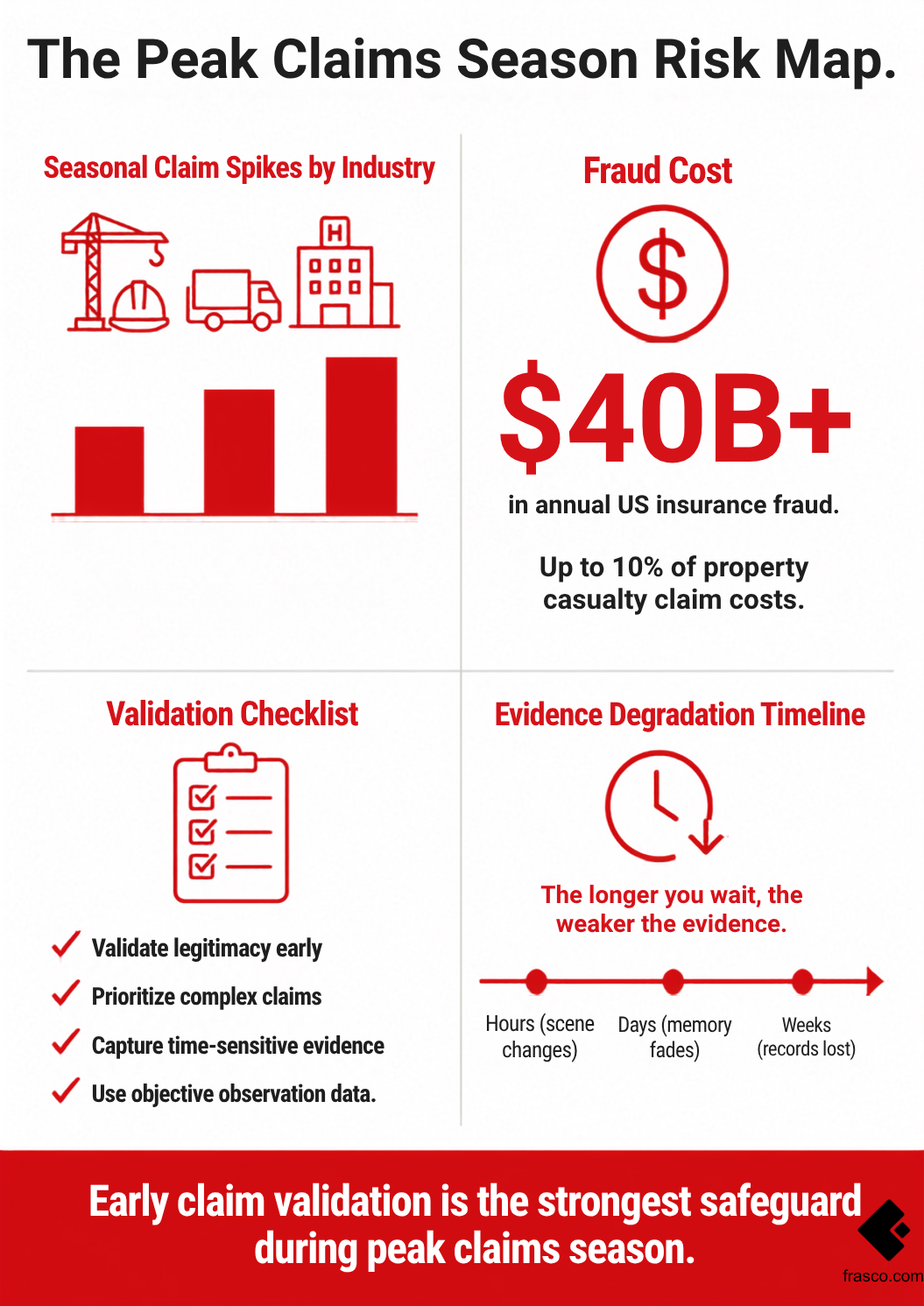
At the same time, fraud pressure rises. The FBI estimates that insurance fraud costs the US more than 40 billion dollars annually, which translates to higher loss ratios for carriers and self-insured organizations.
In practical terms, August represents a convergence of higher claim volume, higher exposure, and higher fraud risk. Consequently, strong claim validation becomes the difference between controlled costs and quiet financial leakage.
The Core Risk: Unvalidated Claims
For enterprise organizations, the greatest financial risk is not claim volume alone. It is claim uncertainty.
Leadership teams often face incomplete information at critical decision points, delayed or insufficient evidence, and inconsistent validation across claim types.
According to the Coalition Against Insurance Fraud:
- Fraud can account for up to 10 percent of total claims costs in property casualty lines
When multiplied across enterprise portfolios, even small validation gaps create measurable financial leakage. Therefore, claim validation is not simply a claims-handling detail. It is a direct lever on the organization’s bottom line.
For a deeper look at how unnecessary losses accumulate, see our guide on self-insured workers compensation and stopping unnecessary losses →
https://frasco.com/self-insured-workers-compensation-stop-unnecessary-losses/.
Your Claim Validation Checklist for Peak Season
Use these five steps to build a claim validation process that protects self-insured assets when claim activity peaks.
1. Validate Claim Legitimacy Early
The earlier you establish legitimacy, the lower the financial risk. Effective claim validation includes claimant activity confirmation, verification of timelines and documented facts, and independent corroboration through interviews and field investigation. As a result, early validation prevents downstream costs tied to litigation, reserve inflation, and delayed settlement cycles.
2. Prioritize High-Value and Complex Claims
Not all claims require the same investigative depth. Focus your resources on high-dollar claims, multi-party liability cases, and psychological or subjective injury claims. These categories often carry higher fraud rates, greater financial impact, and increased litigation risk.
3. Capture Time-Sensitive Evidence
Evidence degrades quickly. Witness memory fades, physical environments change, and digital records can be altered or lost. Consequently, timely investigation ensures accurate scene reconstruction, reliable documentation, and stronger defensibility in disputes. For more on acting fast during high-volume periods, see our guide on claims risk management and the summer surge →
https://frasco.com/claims-risk-management-how-insurers-control-the-summer-surge/.
4. Use Objective Observation Data
One of the most effective ways to reduce uncertainty is direct documentation of behavior and activity. Observation-based investigation enables a clear comparison between claimed limitations and observed activity. Moreover, it produces video and photographic evidence that supports claims decisions and delivers neutral, fact-based insights that withstand scrutiny.
5. Align Claim Validation With Financial Outcomes
Claim validation should not exist as a separate function. Rather, it should support measurable business results, including reduced loss leakage, more accurate reserves, and improved claim cycle time. Organizations that integrate validation into financial decision-making consistently achieve more predictable outcomes.
Why Claim Validation Matters More in 2026
Several emerging trends are raising expectations for claim validation across the industry.
First, scrutiny of claim decisions is increasing. Regulatory and legal environments continue to demand clear, defensible documentation. Second, complex claim types are growing. Psychological claims and multi-jurisdiction claims require deeper investigation than routine cases. Third, resource constraints inside claims teams are tightening. Because many organizations now operate with leaner internal teams, reliance on external investigative partners continues to rise.
The Role of Specialized Investigative Providers
For enterprise organizations, the scale and complexity of modern claims require more than internal capabilities.
An effective investigative partner provides national coverage and scalability, consistent methodology across claim types, and access to specialized expertise including surveillance, interviews, and scene analysis. Providers such as Frasco Investigative Services support these needs by delivering structured, evidence-based insights that enable confident claim validation decisions.
What Sets an Effective Investigation Partner Apart
When evaluating investigative providers, enterprise leaders should weigh four qualities:
1. Tailored Solutions
Every organization has unique risk exposures, and investigation must align with those realities.
2. Technology Enabled Insight
Modern investigation requires the integration of data, documentation, and reporting tools.
3. Consistency and Reliability
Standardized processes ensure defensibility and repeatability across every case.
4. Long Term Partnership Approach
A family-owned structure often supports continuity, accountability, and lasting relationships.
From Claims Processing to Asset Protection
The shift underway in the industry is clear. Claims management is no longer just about processing claims efficiently. It is about protecting financial outcomes through verified truth. In periods of elevated activity such as August, this shift becomes even more important.
Organizations that invest in thorough, timely claim validation are better equipped to reduce unnecessary payouts, accelerate resolution, and strengthen decision confidence. Ultimately, every claim represents both a potential liability and an opportunity to protect your organization. The difference lies in how quickly and effectively you establish the truth.
Frequently Asked Questions About Claim Validation
Q1. What is claim validation?
Claim validation is the process of confirming that a claim is legitimate, accurate, and defensible before it is paid. It combines early legitimacy checks, timeline verification, evidence capture, and independent investigation to reduce financial leakage and support confident claims decisions.
Q2. Why is claim validation important for self-insured organizations?
Self-insured organizations absorb claim costs directly, so every unvalidated claim is a direct hit to their assets. Because fraud can account for up to 10 percent of property casualty claim costs, strong claim validation protects the organization’s budget and financial outcomes.
Q3. When should claim validation happen?
Claim validation works best early, before evidence degrades and before a claim advances toward settlement. The earlier legitimacy is established, the lower the risk of litigation, reserve inflation, and delayed resolution.
Q4. How does claim validation reduce financial leakage?
By confirming legitimacy and capturing reliable evidence early, claim validation prevents improper payments, supports accurate reserves, and shortens claim cycle time. Across an enterprise portfolio, closing even small validation gaps produces measurable savings.
Contact Us Today
Frasco® Investigative Services delivers ethical and efficient solutions tailored to your needs. Have questions or want to discuss your investigative needs further? Contact one of our experienced experts today to find the answers you’re looking for.
Disclaimer: This blog post is for informational purposes only and should not be considered legal advice. Please consult your general counsel for specific legal guidance. Frasco investigators are licensed, and our operations comply with US industry, federal, state, and local laws.