
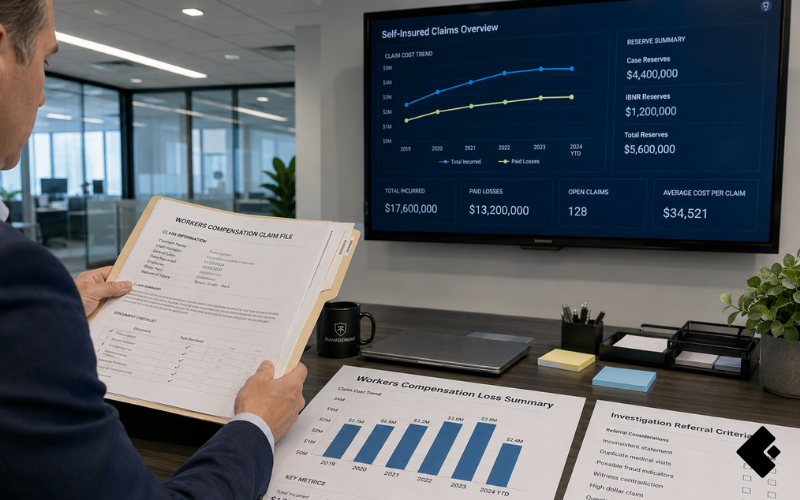
Self-insured workers’ compensation programs place direct financial responsibility on every employer that operates them. Unlike fully insured models, every dollar paid on a claim comes directly from operating budgets and long-term reserves. As of 2024, U.S. employers reported approximately 2.5 million nonfatal workplace injuries and illnesses, with 888,100 cases involving days away from work, job restriction, or transfer. Even as injury frequency declines, claim severity and duration remain the primary cost drivers in self-insured workers’ compensation programs. (Source: bls.gov)
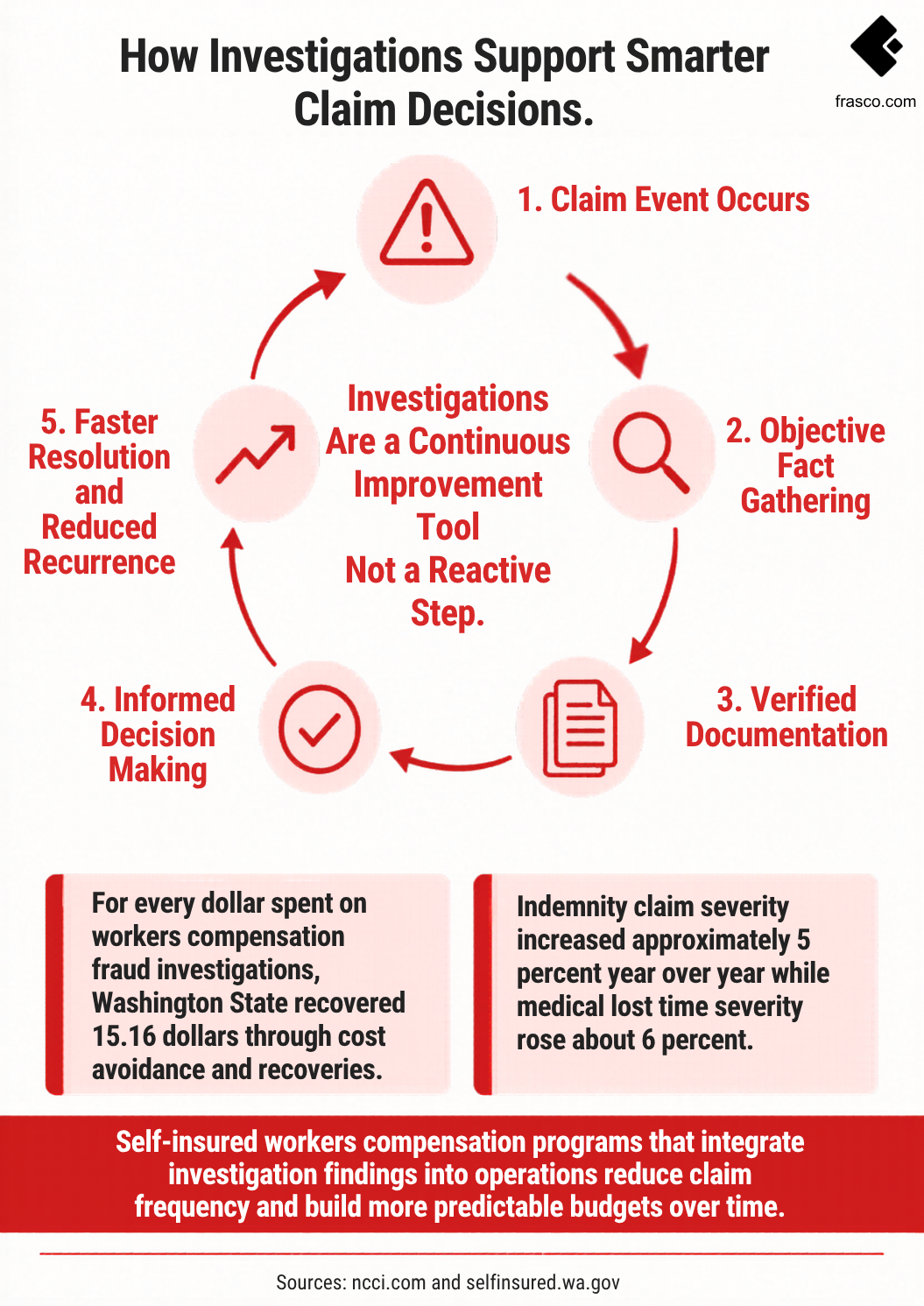
Industry data reinforces the financial stakes. Indemnity claim severity increased approximately five percent year over year while medical lost time claim severity rose about six percent. For self-insured employers these trends amplify the importance of early fact verification, objective documentation, and ongoing claims oversight. Investigations are increasingly used not as a reactive tool but as a structured control that reduces unnecessary losses before they compound. (Source: ncci.com)
Why Unnecessary Losses Remain a Persistent Challenge in Self-Insured Workers’ Compensation Programs
Every unnecessary dollar paid on a self-insured workers’ compensation claim is a direct hit to the employer’s operating budget. Understanding where those losses come from is the first step toward preventing them.
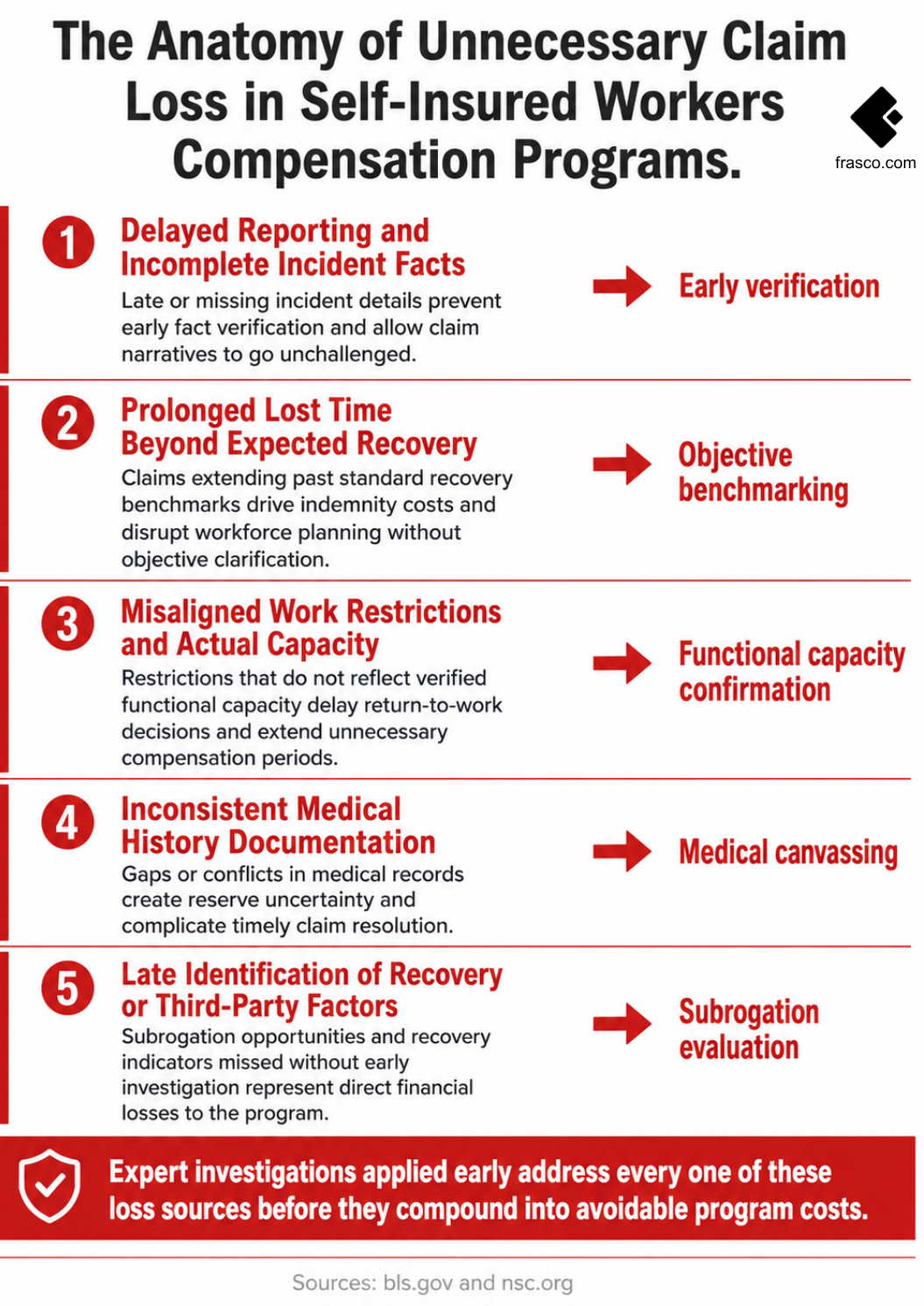
Unnecessary losses in self-insured workers’ compensation often occur without obvious red flags. Common contributors include delayed injury reporting, incomplete incident documentation, mismatches between physical capacity and work restrictions, and prolonged claims with limited reevaluation.
According to federal labor data, the median time away from work for serious injuries is approximately eight days. However many self-insured workers’ compensation claims extend far beyond that baseline when functional recovery remains unclear or unverified. These extended durations drive indemnity costs, disrupt workforce planning, and complicate return-to-work decisions across the program. (Source: nsc.org)
Furthermore, investigations help distinguish between expected recovery patterns and situations where additional clarification is needed. They do not replace medical evaluation or safety programs. Instead they provide the factual context that supports informed and defensible decisions at every stage of the self-insured workers’ compensation claim lifecycle.
2026 Trends Shaping Self-Insured Workers’ Compensation Risk Strategies
Several 2026 trends are directly increasing financial pressure on self-insured workers’ compensation programs. Understanding them helps risk leaders allocate investigative resources where they matter most.
Medical Inflation Is Outpacing General Inflation
Medical cost increases continue to place upward pressure on self-insured workers’ compensation claim costs across all lines and industries. Organizations that do not verify the legitimacy and accuracy of medical claims early face compounding expenses that are difficult to recover through late-stage intervention. (Source: rpsins.com)
Cumulative Trauma and Overexertion Remain Leading Cost Drivers
Cumulative trauma and overexertion injuries remain the leading contributors to lost time claims, accounting for nearly one million cases involving work restrictions or time away in recent reporting periods. These claim types require particularly strong early verification because their onset and causation are difficult to confirm without objective investigation. (Source: nsc.org)
Regulatory and Documentation Requirements Are Expanding
Regulators and labor agencies continue expanding reporting and documentation requirements, increasing the operational burden on self-insured workers’ compensation programs. Consequently, organizations without structured investigative processes face greater compliance exposure alongside rising claim costs. (Source: dir.ca.gov)
The Financial Return on Investigation Is Measurable
State-level data demonstrates the financial value of objective verification in self-insured workers’ compensation programs. In Washington State, labor authorities reported that for every dollar spent on workers’ compensation fraud investigations, $15.16 was returned through recoveries and cost avoidance. While not all unnecessary losses involve fraud, this data confirms that early intervention consistently delivers measurable financial returns. (Source: selfinsured.wa.gov)
How Expert Investigations Reduce Avoidable Self-Insured Workers Compensation Costs
Expert investigations tailored for self-insured workers compensation programs focus on fact-based verification rather than assumptions. The objective is not to deny claims but to confirm circumstances, timelines, and functional capacity with objectivity and precision.
Six investigative services are most commonly used by self-insured organizations to control unnecessary losses:
1. Medical Canvassing
Medical canvassing confirms the completeness and accuracy of a claimant’s medical history. In addition it identifies prior conditions, treatment patterns, and provider relationships that affect self-insured workers compensation claim valuation and reserve accuracy.
2. Workplace Scene Reviews
On-site scene reviews verify the physical conditions and circumstances surrounding the reported incident. These reviews establish factual documentation that protects the self-insured employer when claim details are disputed or unclear.
3. Structured Interviews
Claimant and employer-level interviews capture firsthand accounts early while recollections are accurate. Moreover structured interviews identify inconsistencies between reported circumstances and physical evidence before those inconsistencies become more costly to address.
4. Activity Verification
Activity verification confirms whether a claimant’s reported functional limitations align with observed behavior. This service is particularly valuable in self-insured workers compensation programs where prolonged restrictions drive significant indemnity costs beyond expected recovery timelines.
5. Subrogation Evaluation
Subrogation evaluation identifies third-party liability factors that may allow the self-insured employer to recover claim costs from responsible parties. Early identification of subrogation opportunities is one of the most direct financial recovery tools available in self-insured workers compensation programs.
6. Compliance and Risk Mitigation Reviews
Ongoing compliance reviews confirm that claim handling meets state and federal regulatory requirements. These reviews protect self-insured workers compensation programs from administrative penalties and documentation deficiencies that create downstream exposure.
Industry research confirms that clear documentation and early clarification reduce claim duration and improve reserve accuracy. Furthermore, neutral confirmation from an objective investigation often supports earlier closure and return-to-work planning even when no adverse findings result.
(Source: frasco.com)
A Practical Investigation Referral Checklist for Self-Insured Workers Compensation Programs
Self-insured workers compensation programs benefit most when investigations are guided by defined decision points rather than reactive judgment calls. Use this checklist to identify when and how to deploy investigative resources.
When to Consider an Investigation
- Injury details are unclear, inconsistent, or cannot be independently confirmed through available documentation
- Lost time extends beyond expected recovery benchmarks for the reported injury type
- Functional capacity is uncertain and restrictions cannot be objectively verified
- Incident circumstances require independent confirmation before reserve decisions are finalized
- Reserve accuracy depends on objective clarification of medical history or activity levels
What to Define Before Assigning an Investigation
- The specific question the investigation should answer so findings remain focused and actionable
- The timeline for deliverables to ensure results inform decisions at the right point in the claim lifecycle
- Required documentation formats so findings integrate directly into the self-insured workers compensation claim file
- How investigation results will inform the next step in claim handling or return-to-work planning
How Data-Driven Oversight Improves Long-Term Outcomes
Federal and research institutions confirm that claims data is most valuable when used to prevent future losses rather than simply respond to current ones.
The CDC’s Center for Workers Compensation Studies highlights how claims data supports prevention, trend analysis, and improved program design across self-insured workers compensation programs. (Source: cdc.gov) Self-insured employers that integrate investigative findings into safety planning, operations, and workforce decisions are better positioned to reduce claim recurrence over time.
As a result this approach supports three measurable long-term outcomes across self-insured workers compensation programs:
- Lower claim frequency as investigation findings reveal systemic safety or operational factors that drive repeat incidents
- Faster claim resolution as verified documentation accelerates return-to-work planning and reduces prolonged uncertainty
- More predictable budgeting as reserve accuracy improves and claim duration aligns more closely with expected recovery benchmarks
What Self-Insured Leaders Should Prioritize in the Second Half of 2026
As injury frequency continues to decline while severity rises, self-insured workers compensation programs are shifting from volume management to precision management.
Regulatory updates, medical cost pressures, and workforce complexity all point toward the need for stronger factual foundations in self-insured workers compensation claim handling. Investigations tailored for self-insured employers align with this shift. When used strategically they support transparency, accountability, and cost control without undermining employee trust.
Five practical priorities for self-insured leaders entering the second half of 2026:
- Declining injury frequency does not eliminate financial risk — severity and duration remain the primary cost drivers requiring active management
- Claim severity and duration require structured early response — objective investigations at defined trigger points reduce unnecessary spend before it compounds
- Objective investigations provide clarity not confrontation — fact-based verification supports fair and defensible decisions for both the employer and the employee
- Data-driven oversight builds long-term program performance — integrating investigation findings into safety and operations reduces recurrence and improves reserve accuracy
- Early verification reduces unnecessary spend — structured controls applied before claims escalate consistently deliver better financial outcomes than reactive intervention after costs have already grown
By grounding decisions in verified facts, self-insured employers can better protect both their workforce and their balance sheet.
Want to Learn More?
Dive deeper into how investigations can help self-insured companies cut costs and manage risk more effectively?
📄Download our Free White Paper:
The Investigator Advantage — 3 Tips to Reduce Claims Costs for Self-Insured Companies
Stay Updated: Get real-time insights, the latest blogs, and updates on upcoming industry events.
👉Follow Frasco on LinkedIn
Contact Us Today
Frasco® Investigative Services delivers ethical and efficient solutions tailored to your needs. Have questions or want to discuss your investigative needs further? Contact one of our experienced experts today to find the answers you’re looking for.
Disclaimer: This blog post is for informational purposes only and should not be considered legal advice. Please consult your general counsel for specific legal guidance. Frasco investigators are licensed, and our operations comply with US industry, federal, state, and local laws.