

Audit Readiness for Mortgage Lenders: Your Checklist Before Year-End Reviews
Audit readiness is one of the most overlooked drivers of loan quality, largely because most mortgage quality and compliance gaps are not discovered during underwriting. Instead, they surface after loans are closed and sold, when they are far more expensive to fix.
As lenders and servicers move through August and into peak late summer production cycles, audit exposure increases. Loan volume accelerates, underwriting timelines compress, and risk teams are expected to maintain accuracy under pressure. At the same time, investors and regulators expect complete, defensible documentation for every loan decision.
According to the Mortgage Bankers Association, independent mortgage banks report higher average production volume during seasonal peaks, which adds to the strain placed on underwriting and quality control operations. In parallel, Fannie Mae has consistently emphasized that data accuracy and representation remain top drivers of loan defects and repurchase risk.
This creates a critical reality: audit readiness does not happen at the audit stage. Strong lenders build it into every loan file. The checklist below outlines the six core areas lenders, servicers, and risk teams must validate now to strengthen audit readiness and investor confidence through the remainder of 2026.
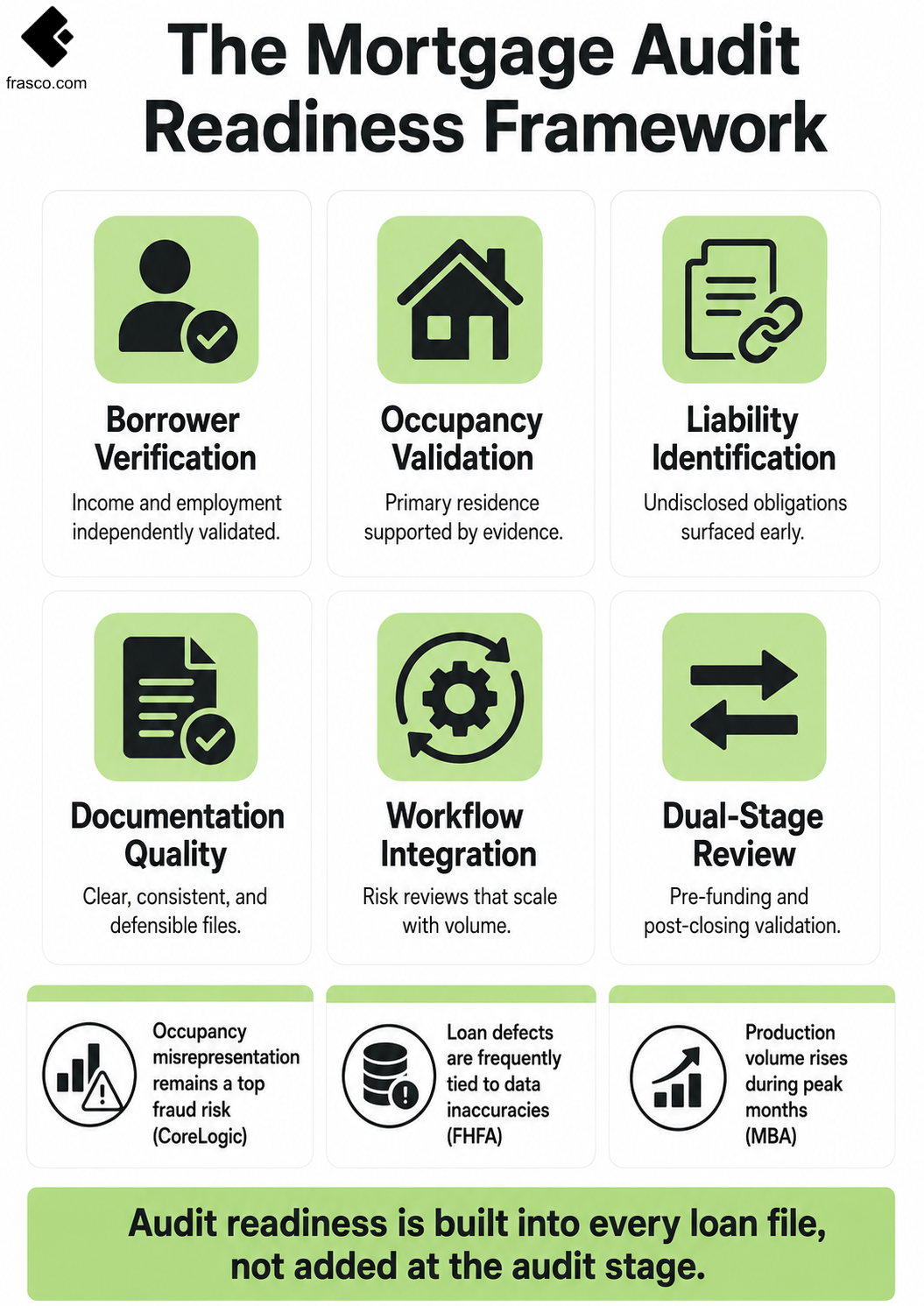
1. Independently Validate Borrower Data
Borrower misrepresentation remains one of the most persistent risk factors in mortgage portfolios, which makes it the first priority for audit readiness. Common gaps include inflated or unverifiable income, misrepresented employment, and incomplete financial disclosures.
Late summer trends increase this risk. For example, higher application volumes, faster underwriting decisions, and greater reliance on borrower-submitted data all raise the odds of a defect slipping through. The Federal Housing Finance Agency has repeatedly highlighted that loan quality defects are strongly tied to inaccuracies in borrower income and employment data.
Audit Readiness Check:
- Do you independently verify income and employment beyond documents?
- Is there documentation supporting the verification methods used?
- Does your documentation support the verification methods you used?
Where Independent Investigations Add Value
Structured employment and income verification through independent research confirms employer existence, validates income context, and identifies gaps early. As a result, it creates audit-ready evidence rather than assumptions. To catch these issues before they reach an audit, see our guide on mortgage fraud detection and how lenders catch risk early →
https://frasco.com/mortgage-fraud-detection-how-lenders-catch-risk-early/.
2. Support Occupancy With Real Evidence
Occupancy fraud continues to be one of the most difficult risks to detect and one of the most costly when missed. It is also a frequent audit finding, so it deserves close attention during audit readiness reviews. In fact, peak summer purchase activity increases the risk of false claims, particularly around primary residence versus investment property claims.
The CoreLogic Mortgage Fraud Report has identified occupancy misrepresentation as a consistent leading indicator of fraud risk in mortgage applications.
Audit Readiness Check
- Do documented indicators support the occupancy claim?
- Do you use multiple data sources to confirm property usage?
- Can you defend the findings if someone challenges them?
Where Independent Investigations Add Value
Evidence-based occupancy verification combines utility and public record review, field observation where needed, and matching across multiple data points. Consequently, it transforms occupancy from a simple declaration into a documented conclusion.
3. Surface Undisclosed Liabilities and Relationships
Unfortunately, undisclosed financial obligations or relationships can dramatically alter a borrower’s risk profile, and they often surface at the worst possible moment. Common examples include hidden business affiliations, undisclosed co-borrower obligations, and interconnected financial relationships. These issues frequently appear in post-closing audits and investor reviews, which is exactly why audit readiness must address them upfront.
Audit Readiness Check
- Are borrower financial relationships fully transparent?
- Is there a process for identifying undisclosed obligations?
- Can you trace and document the supporting evidence?
Where Independent Investigations Add Value
Targeted liability and relationship research includes public and commercial record verification, cross-referencing of borrower disclosures, and identification of red flags. Therefore, it reduces the downstream audit surprises that damage investor confidence.
4. Keep Documentation Clear and Defensible
Audit success is not just about what was done. It is about what you can prove. That distinction sits at the heart of audit readiness. During late summer, increased loan pipelines often lead to inconsistent documentation practices, and QC teams struggle to standardize outputs across volume spikes.
The Consumer Financial Protection Bureau emphasizes the importance of clear documentation to support compliance with mortgage regulations and borrower representations.
Audit Readiness Check
- Do you document findings in a consistent format?
- Can an external party understand and defend the conclusions?
- Is the documentation sufficient for investor review?
Where Independent Investigations Add Value
Standardized reporting provides a clear method, documented findings, and a consistent structure. As a result, files are audit-ready without costly rework. For more on preventing defects at the source, see our guide on mortgage quality control and stopping defects before they start →
https://frasco.com/mortgage-quality-control-stop-defects-before-they-start/.
5. Integrate Risk Reviews Without Slowing Production
The biggest obstacle to effective risk mitigation is workflow disruption. In practice, teams constantly balance speed, accuracy, and compliance requirements, and audit readiness must respect all three. The August reality of high production volume and pressure to maintain turnaround times makes this balance even harder.
According to the Mortgage Bankers Association, productivity pressures remain one of the top concerns for lenders during peak origination periods.
Audit Readiness Check
- Are risk reviews integrated into existing workflows?
- Do they scale with loan volume?
- Is the turnaround time predictable?
Where Independent Investigations Add Value
Targeted investigations focus on specific risk areas, offer predictable scope and timing, and align with underwriting and QC processes. This allows teams to maintain speed while strengthening compliance.
6. Use Pre-Funding and Post-Closing Reviews Strategically
Ultimately, true audit readiness requires both pre-funding risk identification and post-closing validation. Increasingly, lenders rely on post-closing QC to detect issues missed earlier, and investors now expect both stages. A strong mortgage loan audit strategy uses each stage deliberately rather than treating them as duplicate steps.
Audit Readiness Check
- Do you flag high-risk loans for deeper review?
- Is there a process for both pre-funding and post-closing validation?
- Did the findings combined into one clear record?
Where Independent Investigations Add Value
Flexible review options allow full forensic review for high-risk loans, targeted reviews for specific concerns, and combined reporting across stages. Together, these support a complete, end-to-end risk management strategy.
Why Audit Readiness Should Be a Continuous Process
As the industry moves through August and into year-end planning, audit readiness should be treated as a continuous process, not a periodic exercise. Lenders, servicers, and risk teams that invest in independent verification, structured documentation, and integrated risk workflows will be best positioned to reduce audit findings, strengthen investor confidence, and protect loan quality.
The takeaway is simple. Above all, audit readiness is built on evidence, and independent, documented investigations provide that evidence. Organizations that prepare each file for review long before a mortgage loan audit begins are the ones that pass with confidence.
If your team wants to strengthen audit readiness before year-end reviews, Frasco Mortgage Risk Mitigation provides the independent verification and structured documentation that make loan files defensible from the first review to the last.
Frequently Asked Questions About Audit Readiness
1. What is audit readiness in mortgage lending?
Audit readiness is the practice of preparing every loan file to withstand review before an audit begins. It means borrower data, occupancy, liabilities, and documentation are independently verified and clearly recorded, so the file can be defended during a mortgage loan audit or investor review.
2. Why does audit readiness matter more during peak season?
During peak season, loan volume rises and underwriting timelines compress, which increases the chance of defects and inconsistent documentation. As a result, strong audit readiness protects loan quality when teams are under the most pressure, reducing repurchase risk and audit findings.
3. What are the most common mortgage audit weaknesses?
The most common weaknesses include unverified borrower income and employment, unsupported occupancy claims, undisclosed liabilities, and inconsistent documentation. Each of these is a frequent finding in a post-closing mortgage loan audit, and each is preventable with early verification.
4. How can lenders improve audit readiness before a mortgage loan audit?
Lenders can improve audit readiness by validating borrower data independently, supporting occupancy with evidence, surfacing undisclosed liabilities, standardizing documentation, integrating scalable risk reviews, and using both pre-funding and post-closing reviews strategically.
Want to Learn More?
At Frasco, we believe knowledge is the foundation of stronger, smarter lending practices. That’s why we provide resources to help lenders deepen their understanding of risk mitigation and compliance.
📄 Download our white paper:
Unlocking Success: 3 Keys for Maximizing Occupancy Verification in Mortgage Lending
Stay Updated: Get real-time insights, the latest blogs, and updates on upcoming industry events.
👉 Follow Frasco on LinkedIn
Contact Us Today
Frasco® Mortgage Risk Mitigation delivers ethical and efficient solutions tailored to your needs. Have questions or want to discuss your investigative needs further? Schedule a call with one of our experts today to find the answers you’re looking for.
If you know a company that could benefit from our investigative services, Submit a Referral Here to help them make informed decisions and prevent costly risks.
Disclaimer: This blog post is for informational purposes only and should not be considered legal advice. Please consult your general counsel for specific legal guidance. Frasco investigators are licensed, and our operations comply with US industry, federal, state, and local laws.