

When Should a School District Investigate Student Residency?
A student residency investigation becomes necessary when routine verification no longer resolves a district’s questions about whether a student truly resides within attendance boundaries. In those situations, a fair and consistent residency investigation helps school districts review facts objectively, document decisions clearly, and protect enrollment integrity.
For superintendents, registrars, school business officials, and enrollment teams, the challenge is not simply collecting proof of residency. The real challenge is knowing when document review is enough and when unresolved concerns require a more structured response.
If districts wait too long, inaccurate enrollment can affect funding, planning, class sizes, transportation, and public trust. However, if districts escalate too quickly, they may create unnecessary administrative burden and frustration for families. The right approach is a balanced one: verify first, investigate when facts still do not align.
When Student Residency Verification is No Longer Enough
Most school districts begin with standard residency verification. Families submit required documents, staff review the information, and the district determines whether enrollment requirements are met.
In many cases, that process works.
However, a district may encounter situations where records, observations, or follow-up information do not fully support the reported address. At that point, the issue moves beyond routine verification.
A student residency investigation may be appropriate when:
- documentation appears inconsistent
- multiple records point to different addresses
- follow-up does not resolve the concern
- new information raises additional questions
- the district needs stronger facts for a defensible determination
The purpose of the investigation is not to assume fraud. Instead, the purpose is to establish facts fairly and consistently when standard verification leaves unresolved questions.
7 Signs a Student Residency Investigation May Be Needed
1. Address Conflicts That Can Trigger a Residency Investigation
One of the clearest indicators is when credible records do not align. For example, a family may provide one address during enrollment, while other records suggest another residence.
A single inconsistency does not prove ineligibility. Still, conflicting records often justify additional review.
2. Documentation remains inconsistent after follow-up
Sometimes the district asks for clarification, but the follow-up documents still leave unanswered questions. In that case, staff may need more than another paperwork request.
When documentation does not resolve the issue, a residency investigation can help determine whether the reported address reflects the student’s true residence.
3. A reported address changes repeatedly
Frequent address changes can happen for legitimate reasons. However, repeated changes in a short period may also indicate that the district needs a closer look at the residency claim.
This is especially important when the changes affect school assignment, transportation eligibility, or enrollment status.
4. Daily travel patterns raise unresolved questions
In some cases, district staff may receive information suggesting that a student’s actual day-to-day living pattern does not match the reported address.
That does not automatically confirm a violation. However, it may justify moving beyond document review and into a more structured student residency investigation.
5. Information from multiple sources does not align
A district may notice that addresses, emergency contacts, custody records, transportation details, or other information tell different stories.
When multiple sources conflict, the issue is no longer simply a paperwork question. It becomes a fact-finding question.
6. A prior residency concern remains unresolved
If a student has already gone through a verification concern and similar questions arise again, the district may need a more thorough response.
A repeated issue often signals that a standard follow-up approach is no longer sufficient.
7. The district needs stronger facts for a defensible decision
Sometimes the key issue is not suspicion. It is defensibility.
If district leadership may need to explain or support a decision related to enrollment, funding, attendance boundaries, or audit readiness, a student residency investigation can help provide clearer and better-documented information.
What Districts Should Review Before Opening a Student Residency Investigation
Before escalating a case, districts should complete a reasonable internal review. This helps ensure the process stays fair, proportional, and consistent.
That review may include:
- checking the documents already submitted
- confirming whether information is missing or outdated
- reviewing whether district policy requires additional follow-up
- comparing available records for consistency
- documenting what questions remain unresolved
- confirming whether the concern affects eligibility or compliance
This step matters because not every discrepancy requires a full investigation. In some cases, a follow-up request for clarification may resolve the matter quickly.
However, when a district completes this review and still lacks confidence in the reported residency, escalation becomes much more appropriate.
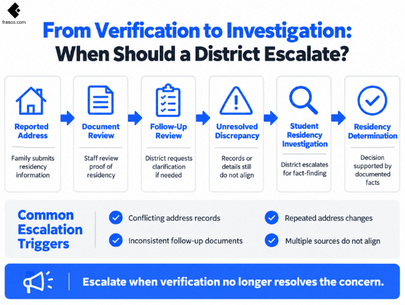
From Verification to Investigation: A Practical Escalation Framework
A strong district process should clearly distinguish routine verification from formal investigation.
A practical framework often looks like this:
Reported Address
Family provides residency documents during enrollment or follow-up.
Follow-Up Review
If information is incomplete or inconsistent, the district requests clarification or additional documentation.
Unresolved Discrepancy
Questions remain after follow-up, or new concerns arise.
Student Residency Investigation
The district escalates the case for a more structured fact-finding review.
Residency Determination
District leadership uses documented facts to make a consistent and defensible decision.
This kind of framework helps staff respond consistently rather than case by case without clear standards.
What a Student Residency Investigation Can Establish
A student residency investigation helps districts gather facts that are more complete than paperwork alone.
Depending on district policy and the nature of the concern, an investigation may help establish:
- whether the reported address appears consistent with available records
- whether the household connection appears credible
- whether follow-up information supports or weakens the residency claim
- whether observed patterns align with the reported residence
- whether the district has enough information to support an enrollment decision
This process gives administrators stronger information for decisions while helping maintain fairness and consistency across cases.
Why Consistent Criteria Matter in a Residency Investigation
Districts benefit when they use clear and consistent criteria to decide when to escalate a residency concern.
Consistent escalation criteria help districts:
- treat families fairly
- reduce claims of inconsistent treatment
- support enrollment integrity
- improve documentation
- protect funding accuracy
- strengthen audit readiness
- maintain community trust
Without clear criteria, one case may receive close scrutiny while another similar case may not. That creates operational risk and weakens confidence in the district’s process.
Common Student Residency Investigation Mistakes to Avoid
Even well-intentioned districts can create unnecessary problems if they do not manage escalation carefully. Common mistakes include:
Assuming every discrepancy is fraud
Not every inconsistency indicates intentional misrepresentation. Family moves, custody changes, temporary living arrangements, and outdated records can all create confusion.
Escalating every case too quickly
Districts should not treat every small paperwork issue as a full investigation. A structured review should come first.
Relying on only one data point
One document or one concern rarely tells the entire story. Districts should assess the full picture.
Waiting too long to act
If the district delays too long, questions may become harder to resolve and records may become more difficult to interpret clearly.
Applying different standards across cases
Consistency matters. Districts should use the same escalation logic across families and situations.
Failing to document why the case was escalated
If a district cannot clearly explain why it moved from verification to investigation, the process becomes harder to defend later.
Student Residency Investigation Scenario
A registrar reviews a returning student’s file and notices that the reported address differs from other records associated with the household. The district requests updated documentation, but the follow-up materials still do not fully resolve the discrepancy.
Rather than making assumptions, the district documents the concern, completes an internal review, and escalates the matter for a student residency investigation. The investigation helps clarify the student’s actual residency status and gives district leaders a stronger factual basis for their determination.
By acting before the issue grows larger, the district protects both enrollment integrity and fairness in the review process.
When Outside Investigative Support Makes Sense
Some cases can be resolved internally. Others benefit from outside support.
A district may consider outside investigative support when:
- documentation review does not resolve the concern
- multiple sources point to inconsistent residency information
- the case may affect funding or compliance exposure
- staff need more objective fact-finding
- leadership wants stronger documentation for a final decision
- the district is handling a sensitive or high-stakes case
- internal resources are limited
Outside support can help administrators move beyond uncertainty and make decisions based on documented facts rather than assumptions.
Frequently Asked Questions About Student Residency Investigations
Q1. What can trigger a residency investigation?
Common triggers include conflicting address records, repeated address changes, unresolved documentation concerns, inconsistent household information, or the need for stronger facts before making an enrollment decision.
Q2. What is the difference between residency verification and a residency investigation?
Residency verification is the routine review of required documents. A residency investigation begins when routine verification does not fully resolve the concern and the district needs additional fact-finding.
Q3. Does an address discrepancy automatically mean residency fraud?
No. A discrepancy may result from outdated records, family transitions, temporary living arrangements, or other legitimate circumstances. Districts should investigate to establish facts rather than assume wrongdoing.
Q4. When should a district use an outside investigator?
A district may use an outside investigator when the issue remains unresolved after follow-up, when the stakes are higher, or when leadership wants more objective and defensible fact-finding.
Better Decisions Begin with the Right Escalation Point
School districts do not need to investigate every residency question. However, they do need to know when routine verification is no longer enough.
A well-timed student residency investigation helps districts address unresolved concerns fairly, document decisions consistently, and protect enrollment integrity before small issues turn into larger operational or compliance problems.
When districts use clear escalation criteria, they strengthen both fairness and defensibility. That is what makes the process more effective for administrators, families, and the district as a whole.
Want to Learn More?
See how school districts use investigations to protect resources and keep enrollment fair.
📄 Download our white paper: Protecting Educational Resources: 4 Ways to Address Residency Fraud
Stay Updated: Get our latest posts, school-district fraud trends, and upcoming events—right in your feed 👉 Follow Frasco on LinkedIn
Contact Us Today
Frasco® District Residency Investigations delivers ethical and efficient solutions tailored to your needs. Have questions or want to discuss your investigative needs further? Schedule a call with one of our experts today to find the answers you’re looking for.
If you know a school district that could benefit from our investigative services, Submit a Referral Here to help them protect their resources and strengthen community trust.
Disclaimer: This blog post is for informational purposes only and should not be considered legal advice. Please consult your general counsel for specific legal guidance. Frasco investigators are licensed, and our operations comply with US industry, federal, state, and local laws.