

School enrollment verification is one of the most important steps districts can take to protect their funding and stay compliant heading into spring. As districts enter the spring enrollment period in March and April, many face two challenges at once: ongoing enrollment pressures and growing scrutiny on residency compliance.
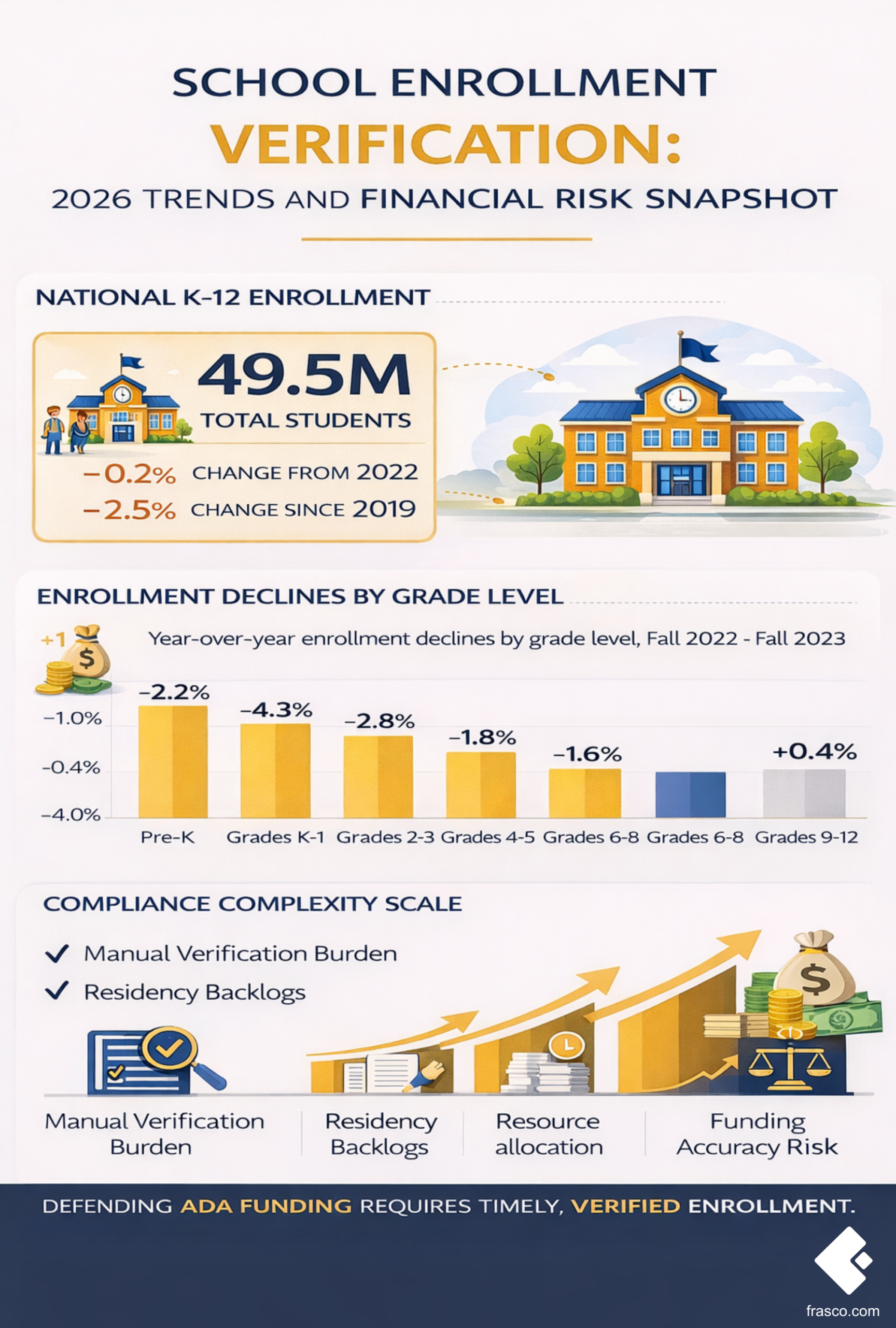
Public school enrollment remains below pre-pandemic levels, with total fall 2023 K-12 enrollment at 49.5 million students, down slightly from the prior year and down 2.5% from 2019 levels according to the National Center for Education Statistics
At the same time, demographic shifts and school choice options continue to shape where families enroll their children. For districts, confirming accurate residency information during spring enrollment planning is essential to protecting funding formulas based on average daily attendance and enrollment counts.
This guide gives district leaders a clear approach to spot trends, identify common risk indicators, and build a readiness plan for spring residency verification.
Why School Enrollment Verification Is More Complex Than Ever in 2026
1. Enrollment Trends Are Still Shifting After the Pandemic
Although public school enrollment steadied between fall 2022 and fall 2023, broader trends still point to ongoing challenges for districts:
- Enrollment dropped 0.2% from 2022 to 2023, with lower grades seeing the largest declines. (Source: National Center for Education Statistics)
- Projections show continued K-12 enrollment declines in coming years due to long-term demographic shifts, beginning with lower birth rates a decade ago and moving through successive grade levels. (Source: Stateline)
- These patterns give districts stronger reason to carefully verify who remains within district boundaries as families move, change housing, or explore other education options.
2. Growing School Choice Options Are Changing Enrollment Patterns
While public schools still serve the majority of K-12 students, alternative options play a growing role:
- Charter school attendance has grown over the past decade, increasing its share of the overall public school system. (Source: ERIC)
- These shifts can quietly affect base enrollment counts and the risk profile of unverified students crossing district boundaries, especially in spring when families reconsider placement for the next school year.
3. Manual Verification Processes Are Slowing Districts Down
- Many districts still rely on paper-based or manual residency checks, which use up staff time, delay case resolution, and increase the risk of errors. (Source: CivicBell)
- Without structured school enrollment verification workflows, districts struggle to handle spring volume accurately and on time.
The Biggest Challenges Districts Face During Spring Enrollment Verification
As enrollment shifts grow more common and harder to track, districts run into several recurring problems that make school enrollment verification harder to manage:
1. Residency Verification Backlogs Create Funding Risk
-
Spring enrollments bring large volumes of new registrations, leaving districts with unverified residency forms and documents that stretch staff capacity.
-
These backlogs directly threaten funding timelines when districts cannot confirm residency before key reporting deadlines.
2. Inaccurate Records Put District Funding Under Pressure
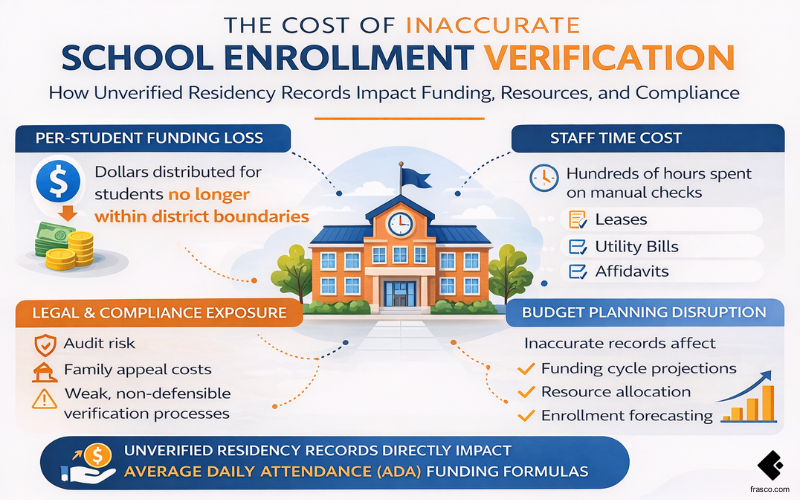
- State and local funding ties directly to average daily attendance and enrollment counts, meaning any inaccuracies carry significant budget consequences.
- Inaccurate residency records can result in funds going to students who no longer live within district boundaries but remain enrolled on paper. (Source: Thomson Reuters Legal)
- Even small errors across multiple cases can add up to meaningful funding losses over a full school year.
3. Manual Processes Are Consuming Valuable Staff Time
- District teams report spending hundreds of hours manually checking leases, utility bills, driver licenses, and affidavits, often with inconsistent outcomes across cases. (Source: CivicBell)
- This time spent on manual school enrollment verification takes staff away from instruction support, student services, and long-term planning priorities.
Why Accurate School Enrollment Verification Matters for District Leadership
District leaders consistently point to three core reasons why getting school enrollment verification right is a strategic priority, not just an administrative task:
1. Protecting District Funding Integrity
- Accurate residency verification confirms that per-pupil funding aligns with actual attendance and location, which strengthens budget planning and builds community trust.
- When verification is thorough and defensible, districts reduce the risk of funding adjustments after reporting deadlines pass.
2. Reducing Legal and Compliance Exposure
- State policy frameworks increasingly require verification processes that can hold up under audit review or family appeals.
- Districts that invest in structured, defensible school enrollment verification workflows protect themselves from legal challenges and compliance penalties.
3. Freeing Staff to Focus on What Matters Most
- Reducing time spent on manual verification frees district teams to focus on instruction quality, student support services, and long-term planning.
- Technology-supported verification workflows allow staff to handle higher case volumes accurately without burning out during peak enrollment periods.
A Five-Step School Enrollment Verification Readiness Checklist for Spring
District administrators can use this checklist to build a stronger school enrollment verification process before spring enrollment peaks:
Step 1: Audit Last Year’s Residency Case Outcomes
- Review unresolved or unclear cases carried over from last fall or spring.
- Focus first on cases with the greatest potential impact on district funding.
- Use these outcomes to identify patterns that can guide this year’s verification priorities.
Step 2: Standardize Required Documentation
- Confirm that the district’s residency documentation list reflects current policy.
- Communicate documentation requirements clearly to families during spring enrollment campaigns so submissions are complete from the start.
Step 3: Identify High-Risk Student Populations
- Use historical data to spot groups more likely to have residency questions, such as families who moved mid-year or students previously enrolled through open or choice programs.
- Prioritizing these groups early reduces the risk of backlogs building up during peak enrollment weeks.
Step 4: Use Technology to Strengthen Verification Accuracy
- Adopt tools and structured investigative workflows that reduce manual work and improve accuracy in address and household verification.
- Technology-supported school enrollment verification processes handle higher volumes more consistently and produce outcomes that are easier to defend during audits.
Step 5: Train Staff for High-Volume Review Periods
- Spring enrollment periods regularly strain staff capacity across districts.
- Provide focused training to confirm that all team members apply policy consistently across every case they review.
- Consistent training reduces errors, speeds up resolution times, and strengthens the overall quality of school enrollment verification outcomes.
Build a Stronger School Enrollment Verification Process Before Spring Deadlines Arrive
Spring enrollment is more than a routine administrative period. It is a high-impact window for districts to align projected versus actual residency data before those numbers shape funding cycles. By understanding current trends, addressing key pain points, and putting structured readiness processes in place, school administrators can reduce risk, stay compliant, and strengthen district governance.
This readiness approach is grounded in current data and built around the real pressures districts face early each year, with a clear focus on identifying and resolving questionable residency cases before budget planning and reporting deadlines arrive.
Want to Learn More?
See how school districts use investigations to protect resources and keep enrollment fair.
📄 Download our white paper: Protecting Educational Resources: 4 Ways to Address Residency Fraud
Stay Updated: Get our latest posts, school-district fraud trends, and upcoming events—right in your feed 👉 Follow Frasco on LinkedIn
Contact Us Today
Frasco® District Residency Investigations delivers ethical and efficient solutions tailored to your needs. Have questions or want to discuss your investigative needs further? Schedule a call with one of our experts today to find the answers you’re looking for.
If you know a school district that could benefit from our investigative services, Submit a Referral Here to help them protect their resources and strengthen community trust.
Disclaimer: This blog post is for informational purposes only and should not be considered legal advice. Please consult your general counsel for specific legal guidance. Frasco investigators are licensed, and our operations comply with US industry, federal, state, and local laws.