

Pre-Litigation Investigation: What Legal Teams Should Verify Before Case Strategy Is Set
A pre-litigation investigation helps legal teams verify facts, identify information gaps, and make stronger decisions before case strategy is finalized. When a matter requires independent fact development, a litigation support investigator can help legal teams verify critical information before filing, negotiation, discovery, or other major decisions.
This becomes even more important when matters involve financial exposure, reputational risk, disputed facts, or limited time to act. A well-structured pre litigation investigation can help legal teams evaluate the strength of a matter early, reduce avoidable surprises, and move forward with a clearer understanding of the facts.
What a Pre-Litigation Investigation Should Establish Before Strategy Moves Forward
Strong legal strategy depends on strong information. If a legal team begins building a case around incomplete facts, the result may be wasted time, weak positioning, missed evidence, or unnecessary risk.
A pre-litigation investigation can help legal teams:
- Identify factual gaps before they affect strategy
- Verify key claims before positions harden
- Assess witness credibility and relevance
- Uncover public records, affiliations, and background details
- Clarify financial exposure or asset relationships
- Support informed decisions before litigation costs increase
For matters that proceed in federal court, Federal Rule of Civil Procedure 11 also reinforces the importance of a reasonable inquiry into the factual basis of claims before factual contentions are presented to the court.
In other words, the earlier a legal team understands the true fact pattern, the better positioned it is to advise the client and determine the most appropriate next step.
Broader Legal Investigation Services can also help legal teams select the appropriate investigative methods when a matter contains several unresolved factual questions.
1. Identify the Facts That Could Change the Case
The first step in an effective pre litigation investigation is identifying what the legal team does not yet know.
Legal teams often begin with client statements, preliminary documents, and early allegations. However, those materials rarely tell the full story. Before strategy is set, teams should ask:
- Which facts have been verified
- Which facts still rely on assumptions
- What information could materially change the matter
- Where the biggest credibility or documentation gaps exist
This step helps prioritize the investigation and keeps resources focused on facts that may actually influence the legal outcome.
2. Verify Parties, Businesses, and Key Relationships
Many legal matters become more complex once the full picture of the parties involved begins to emerge.
A pre-litigation investigation may need to confirm:
- Individual identities
- Business ownership or affiliations
- Corporate relationships
- Prior litigation history
- Professional licensing or status
- Connections between witnesses, subjects, or entities
These details can significantly influence strategy. Undisclosed relationships or previously unknown business ties may affect credibility, liability, negotiation leverage, or the scope of the dispute.
3. Evaluate Witnesses Before Their Accounts Shape the Case
Witness information can shape the direction of a matter before formal litigation begins. That is why witness evaluation should happen early whenever appropriate.
Legal teams may need to determine:
- Who has first-hand knowledge
- Whether statements are consistent
- Whether additional witnesses exist
- Whether a witness may have bias or conflicting interests
- Whether a witness account is supported by other evidence
Early witness work can help legal teams evaluate which facts are supported, which require more development, and where additional interviews or corroboration may be necessary.
4. Use Public Records and Digital Research to Test the Known Facts
Publicly available information can help clarify facts that remain uncertain in the early stages of a matter.
Depending on the case, a pre litigation investigation may involve reviewing:
- Court records
- Property records
- Business filings
- Corporate registrations
- Professional records
- Social media activity
- News archives
- Online references tied to parties or events
This type of review can help legal teams identify inconsistencies, establish timelines, uncover previously unknown details, or confirm whether a claim is supported by independently available information.
The goal is not simply to collect more data. Investigative research should remain focused on information that is relevant to the case and the decisions the legal team needs to make.
5. Assess Assets and Financial Relationships When They Could Affect Strategy
In many legal matters, facts about assets and financial relationships are essential to evaluating risk and case value.
A pre-litigation investigation may help legal teams explore:
- Property ownership
- Business interests
- Potentially relevant financial connections
- Undisclosed relationships between parties
- Indicators of exposure that may affect strategy or settlement posture
In business disputes, transactions, or other risk-sensitive matters, Legal Due Diligence can provide additional insight into ownership, relationships, background information, and potential exposure before an important decision is made.
This type of intelligence can be particularly valuable in disputes involving due diligence, business litigation, judgments, fraud concerns, or high-stakes negotiations.
6. Escalate to Field Investigation When Research Leaves Material Questions Unresolved
Not every matter requires field work. In many cases, records research and digital investigation may be enough to answer the legal team’s core questions.
However, some matters require more direct fact development.
That may include:
- Locating difficult-to-find individuals
- Conducting site or neighborhood research
- Interviewing witnesses
- Observing relevant activity
- Verifying addresses or business operations
- Gathering factual context that cannot be resolved through records alone
The decision to expand into field work should always connect back to the legal objective. A strong pre litigation investigation stays proportional to the questions that need to be answered.
When Should Legal Teams Bring in a Litigation Support Investigator?
A litigation support investigator can add value when a legal team needs verified facts before making a major strategic decision.
That may be especially useful when:
- A matter involves conflicting accounts
- Important information is missing
- A client’s position depends on facts that have not been independently verified
- Witnesses need to be located or assessed
- Public records reveal possible inconsistencies
- Asset or business relationships need clarification
- The legal team needs additional fact development before filing or negotiation
The goal is not simply to outsource research. It is to strengthen case assessment with targeted investigative support that aligns with the legal team’s strategy.
A well-scoped assignment should identify the factual question to resolve, the relevant parties, the information already known, and any timing or reporting requirements. Counsel should also determine how confidentiality, privilege, work-product considerations, and applicable professional rules affect the assignment.
Depending on the stage and complexity of the matter, broader Litigation Support Services may also help legal teams coordinate investigative research and evidence development around case strategy.
Pre-Litigation Investigation Mistakes That Can Weaken Case Preparation
Waiting Too Long to Investigate
The longer a legal team waits, the harder it can become to locate people, confirm timelines, or recover useful context.
When an unresolved fact could influence case strategy, earlier investigation may leave the team with more options.
Building Strategy on Unverified Assumptions
Early assumptions can quietly shape a case in the wrong direction. Independent verification helps reduce that risk.
Overlooking Relationships Between People and Businesses
Connections between parties, witnesses, businesses, or assets can materially affect how a matter should be approached.
Ignoring those relationships can leave meaningful gaps in the factual picture.
Gathering Information Without a Defined Legal Objective
More information does not automatically produce a stronger case.
A pre litigation investigation should answer defined legal questions, not simply produce more data.
Failing to Organize Findings for Legal Use
Even strong findings lose value if they are not documented in a way that helps legal teams understand what was examined, what was found, and how the information relates to the matter.
As a case develops, maintaining Defensible Evidence and clearly documented investigative findings can also help legal teams understand the source and context of important information.
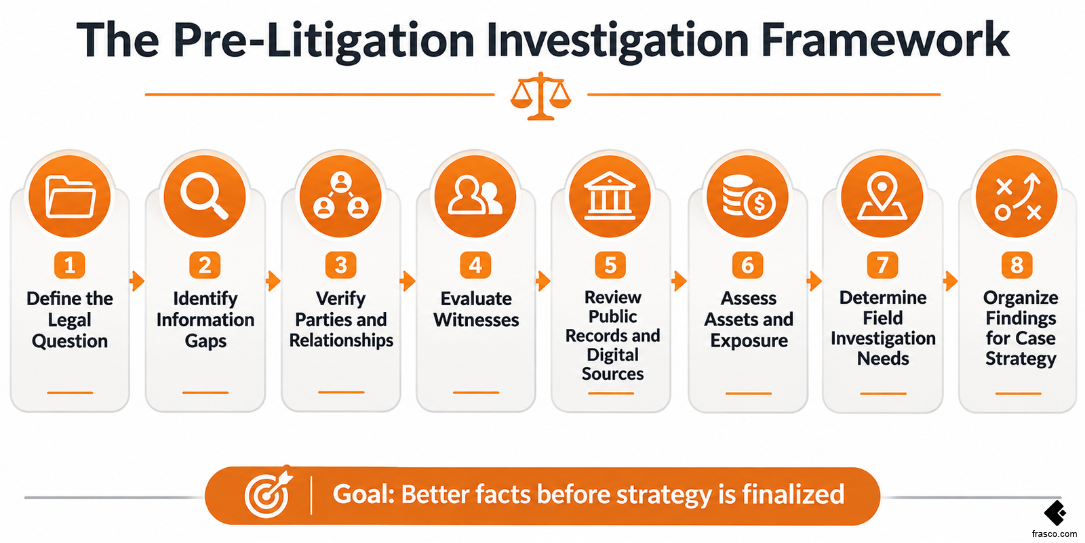
Pre-Litigation Investigation Checklist for Legal Teams
A structured checklist can help legal professionals conduct a pre-litigation investigation more effectively.
1. Define the Legal Question
Clarify what decision the investigation is intended to support.
2. Identify the Key Factual Gaps
Determine which unknowns could materially affect strategy, filing, negotiation, or exposure.
3. Verify the Parties and Relationships
Review identities, affiliations, business interests, and potentially relevant connections.
4. Evaluate Witnesses and Supporting Information
Confirm who has relevant knowledge and whether available statements align with other evidence.
5. Review Public Records and Digital Sources
Use appropriate available information to confirm, challenge, or expand the factual record.
6. Assess Assets and Exposure Issues Where Relevant
Identify financial, ownership, or business details that may influence legal decisions.
7. Decide Whether Field Work Is Needed
Determine whether interviews, locates, site work, observations, or additional factual development are necessary.
8. Organize Findings Around the Legal Objective
Present the results clearly so the legal team can use them in strategy discussions and client recommendations.
This checklist helps keep the investigation disciplined, useful, and aligned with the needs of the matter.
How a Pre-Litigation Investigation Can Strengthen Case Strategy
When legal teams have stronger facts early, they can make better decisions about how to proceed.
A pre-litigation investigation can support:
- Earlier risk assessment
- More informed client guidance
- Better preparation for negotiation
- Stronger filing decisions
- More focused discovery planning
- Better alignment between facts and legal theory
That is where investigative support becomes more than a background task. It becomes a practical tool for improving legal judgment before the matter advances.
When Outside Investigative Support Can Fill Critical Information Gaps
Legal teams can resolve many early case questions internally.
Outside investigative support becomes more useful when a matter requires specialized research, witness development, asset information, field work, background intelligence, or additional capacity beyond what the legal team can efficiently develop on its own.
Frasco® Integrated Research provides customized investigative support designed to answer case-specific questions for legal, business, and financial professionals.
Depending on the matter, that support may include public-record research, witness development, background intelligence, social media review, asset-related information, field investigation, and other forms of targeted fact development.
Rather than applying the same investigative approach to every case, the scope can be aligned with the facts, risks, and strategic needs of the matter.
Frequently Asked Questions About Pre-Litigation Investigation
Q1. What Is a Pre-Litigation Investigation?
A pre-litigation investigation is the process of gathering and verifying facts before litigation strategy is finalized. It helps legal teams assess claims, evaluate risk, and make more informed decisions before filing, negotiating, or escalating a matter.
Q2. What Does a Litigation Support Investigator Do?
A litigation support investigator helps legal teams develop facts relevant to a legal matter. This may include records research, witness location, background review, asset-related intelligence, social media research, interviews, field investigation, or other targeted investigative work.
Q3. When Should Legal Teams Use a Pre-Litigation Investigation?
Legal teams may consider a pre-litigation investigation when key facts remain unclear, witness information needs verification, public records raise questions, financial exposure must be assessed, or important legal decisions depend on information that has not yet been confirmed.
Q4. What Types of Cases Can Benefit From Pre-Litigation Investigation?
Pre-litigation investigation can be valuable in business disputes, employment matters, fraud-related matters, asset and recovery issues, due diligence matters, civil litigation, white-collar matters, intellectual property disputes, and other cases where early fact development may influence legal strategy.
Want to Learn More?
Strong case strategy starts with better evidence, clearer context, and the right tools. If you want a practical next step, we created a resource built for legal teams who need faster, more reliable evidence gathering.
📄 Download our white paper:
Precision in Practice:5 Steps to Efficient Evidence Gathering for Legal Professionals
Stay Updated: Get the latest insights, new blog posts, and updates on resources designed for legal professionals.
👉 Follow Frasco on LinkedIn
Contact Us Today
Frasco® Integrated Research delivers ethical and efficient solutions tailored to your needs. Have questions or want to discuss your investigative needs further? Schedule a call with one of our experts today to find the answers you’re looking for.
Disclaimer: This blog post is for informational purposes only and should not be considered legal advice. Please consult your general counsel for specific legal guidance. Frasco investigators are licensed, and our operations comply with US industry, federal, state, and local laws.