

Your Summer Defensible Evidence Checklist: How Legal Teams Gather Evidence That Withstands Challenge
Summer creates a unique operating environment for legal teams. Court schedules shift. Case timelines compress. Activity rises across claims, disputes, and investigations. At the same time, legal teams must move quickly while holding to strict evidentiary standards. In 2026, that expectation is harder to meet, and defensible evidence has become the deciding factor.
Two forces are reshaping how teams gather evidence. First, privacy and compliance requirements are expanding across states. Second, scrutiny of how evidence is obtained, not just what is presented, is rising sharply. Recent developments show that twenty states have enacted comprehensive privacy laws, and each one carries distinct requirements that affect data collection and use. Meanwhile, regulatory frameworks remain fragmented, with no unified federal standard, which increases complexity for teams working across jurisdictions. (Source: americanbar.org)
The result is clear. Evidence can now be challenged on methodology before anyone evaluates it on merit. Therefore, this checklist outlines how legal teams can work with third parties to keep evidence defensible under these evolving conditions. (Source: justia.com)
1. Confirm That Investigative Methods Support Defensible Evidence
Evidence-gathering practices must now account for a patchwork of state regulations. As a result, what was acceptable three years ago may introduce risk in certain jurisdictions today.
Legal teams should recognize three shifts. First, privacy obligations are expanding at the state level. Second, enforcement increasingly focuses on how information is collected. Third, clear documentation of investigative practices is becoming a real differentiator for defensible evidence.
What to review with third parties:
- Whether data collection methods comply across jurisdictions
- How investigators document consent, observation, and sourcing
- Whether processes stay standardized rather than case-dependent
Why it matters in summer: Increased case activity often accelerates timelines, and rushed timelines raise the risk of non-compliant shortcuts.
2. Validate the Source and Chain of All Evidence
Defensibility depends on traceability. Increasingly, courts and opposing counsel examine three things closely. They look at where information originated, how someone obtained it, and whether anyone altered or interpreted it without verification.
This shift aligns with broader enforcement trends. Fraud-related cases are not only persistent but growing in financial scope and complexity, and that growth calls for stronger supporting evidence.
What to review with third parties:
- Source validation protocols
- Chain of custody documentation
- Evidence handling procedures
Why it matters in summer: High-volume periods increase reliance on third-party investigators. Without clear safeguards, inconsistencies can slip in. For more on building court-ready case support, see our guide on litigation support services for legal and corporate teams →
https://frasco.com/litigation-support-services-for-legal-and-corporate-teams/.
3. Evaluate Entity-Level Risk, Not Just Individuals
Modern litigation rarely centers on a single subject. Instead, investigations increasingly uncover connections across vendors, affiliated entities, and financial relationships.
Industry findings reinforce this shift. Vendor fraud remains one of the most common risk categories, and ninety-eight percent of businesses report concern about vendor-related fraud exposure. Consequently, legal teams face broader discovery scope, a greater need for comprehensive background intelligence, and higher expectations for diligence.
What to review with third parties:
- Ability to conduct entity-level research
- Access to asset and financial intelligence
- Capability to identify relationships across parties
Why it matters in summer: Increased transactional activity often surfaces connections that were not visible before. For a deeper look at how research reduces this risk, see our guide on legal due diligence and how investigative research reduces risk →
https://frasco.com/legal-due-diligence-how-investigative-research-reduces-risk/.
4. Ensure Investigative Methods Are Documented and Repeatable
Defensible evidence is not only accurate. It is also explainable. Increasingly, legal professionals must demonstrate how they reached conclusions, whether their processes stay consistent, and whether another team could reproduce the results.
This matters more each year as investigative practices evolve alongside technology and data access.
What to review with third parties:
- Standard operating procedures
- Documentation standards
- Consistency across cases
Why it matters in summer: Compressed timelines raise the chance of inconsistent approaches when processes are not standardized.
5. Balance Speed With Evidentiary Integrity
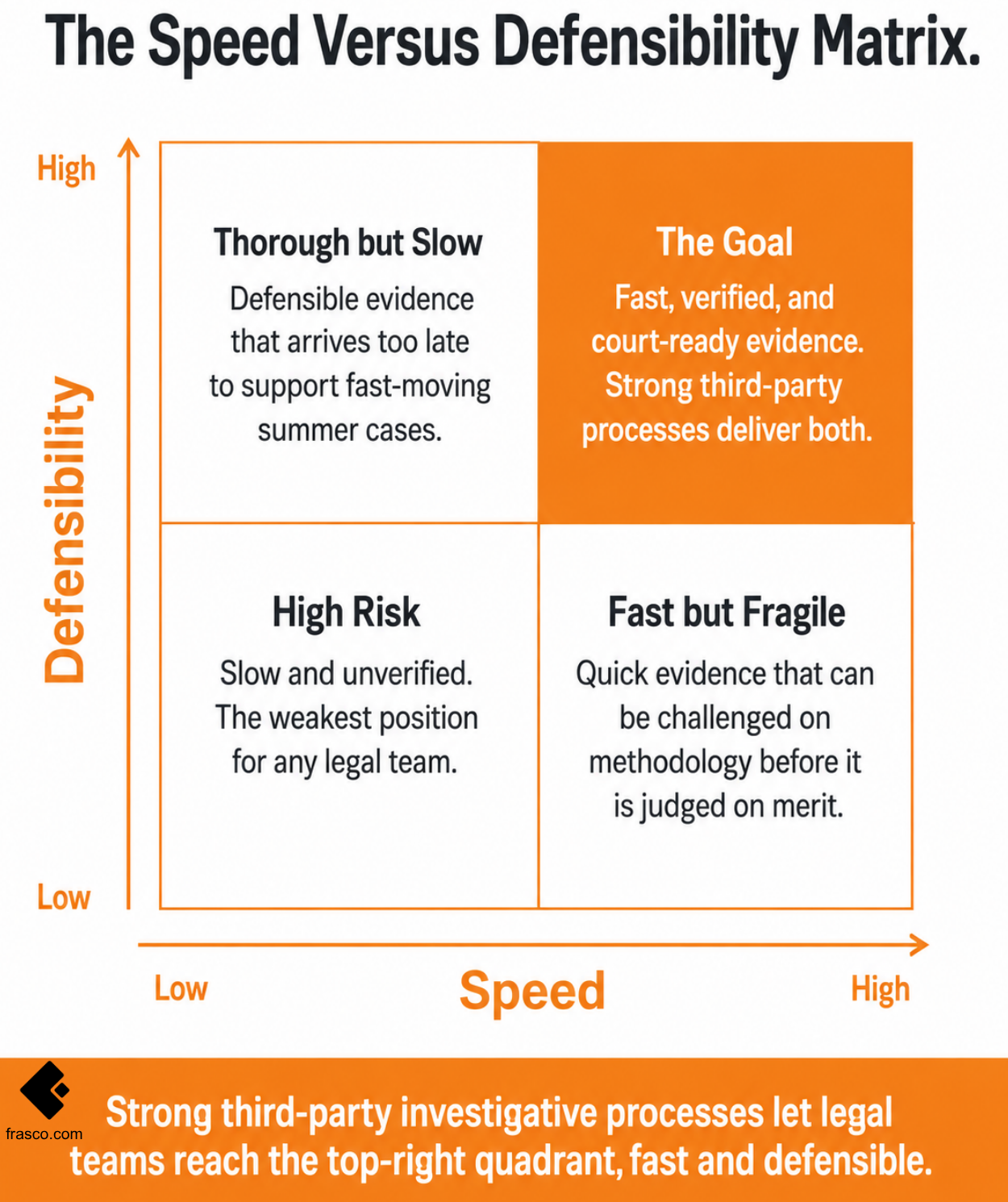
Summer demands efficiency. Legal teams must move cases forward quickly, provide timely insights to stakeholders, and respond to emerging claims and disputes. However, speed without validation introduces risk.
Fraud enforcement data reflects this tension. While the number of cases fluctuates, the size and impact of cases have grown, and larger cases demand stronger supporting evidence.
What to review with third parties:
- Turnaround expectations aligned with quality standards
- Verification processes that hold up under time constraints
- Escalation protocols when someone identifies an inconsistency
Why it matters in summer: More activity and shorter timelines increase the pressure to prioritize speed over thoroughness.
6. Work With Partners That Provide Integrated Investigative Insight
Legal teams increasingly need more than isolated data points. They need context, verification, and cross-source intelligence that together support defensible evidence.
Integrated research solutions are built to meet this need. They combine background and asset research, investigative observation and documentation, and case-specific analysis. As a result, these approaches deliver more complete information, greater confidence in findings, and stronger support for legal decision-making.
What to look for:
- Tailored investigation strategies
- Integrated data and field insight
- Ability to align with your legal objectives
For more on how integrated intelligence supports legal strategy, see our investigative intelligence guide for legal teams → https://frasco.com/investigative-intelligence-guide-for-legal-teams/.
Defensible Evidence Begins Before the Courtroom
Summer 2026 is not defined by a single risk. Instead, it is defined by convergence. Disputes are more complex, compliance obligations are expanding, and scrutiny on evidence gathering is rising at the same time.
For legal teams, the takeaway is clear. Defensible evidence begins long before it reaches the courtroom. Third-party investigators are not just a resource. They are an extension of legal strategy. Ultimately, the difference between usable evidence and challenged evidence often comes down to methodology, documentation, and compliance.
Legal teams that apply this checklist can reduce evidentiary risk, strengthen case positioning, and make more informed decisions under pressure.
Frequently Asked Questions About Defensible Evidence
Q1. What is defensible evidence?
Defensible evidence is evidence gathered through methods that can withstand legal challenge. It is accurate, properly sourced, clearly documented, and collected in compliance with applicable privacy rules. In short, defensible evidence holds up when opposing counsel examines how it was obtained.
Q2. Why is defensible evidence harder to maintain in 2026?
Twenty states have enacted comprehensive privacy laws, and each carries distinct requirements. Because no unified federal standard exists, legal teams working across jurisdictions face more complexity. As a result, methodology and documentation now matter as much as the evidence itself.
Q3. How do third parties help legal teams gather defensible evidence?
Third-party investigators bring standardized methods, clear chain of custody documentation, and compliant collection practices. Consequently, they help legal teams gather evidence quickly during high-volume periods without sacrificing the integrity that keeps it defensible.
Q4. What makes evidence vulnerable to challenge?
Evidence becomes vulnerable when its source is unclear, its chain of custody has gaps, or its collection method does not comply with current privacy rules. Therefore, strong documentation and consistent processes are the foundation of defensible evidence.
Want to Learn More?
Strong case strategy starts with better evidence, clearer context, and the right tools. If you want a practical next step, we created a resource built for legal teams who need faster, more reliable evidence gathering.
📄 Download our white paper:
Precision in Practice:5 Steps to Efficient Evidence Gathering for Legal Professionals
Stay Updated: Get the latest insights, new blog posts, and updates on resources designed for legal professionals.
👉 Follow Frasco on LinkedIn
Contact Us Today
Frasco® Integrated Research delivers ethical and efficient solutions tailored to your needs. Have questions or want to discuss your investigative needs further? Schedule a call with one of our experts today to find the answers you’re looking for.
Disclaimer: This blog post is for informational purposes only and should not be considered legal advice. Please consult your general counsel for specific legal guidance. Frasco investigators are licensed, and our operations comply with US industry, federal, state, and local laws.