
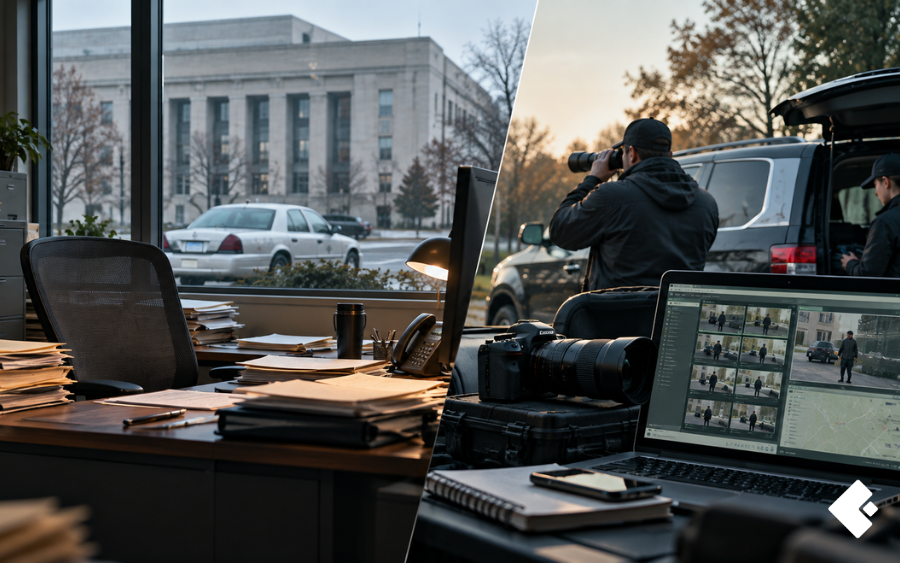
Why Outsourcing Administrative Investigations Makes Sense for Federal Agencies
Outsourcing administrative investigations has become a practical answer for federal agencies facing hiring freezes and tight budgets, where adding full-time investigative positions is often impractical.
When you compare what many agencies think they need, an on-staff federal investigator, against the true cost of that position and the measurable return on investment (ROI) of contracting the work, the case becomes clear. Contracting now, rather than waiting to fund an internal hire, delivers immediate and long-term benefits.
The Case for Outsourcing Administrative Investigations
Before weighing dollars, it helps to see why so many agencies reach the same conclusion. In practice, outsourcing administrative investigations delivers four clear advantages.
Cost Control and Predictability
Contracted services remove fixed overhead, so agencies can scale resources to match case volume.
Enhanced Effectiveness
Contractors bring specialized expertise, advanced technology, and proven methodologies that strengthen agency investigations.
Flexibility and Speed
Because contractors respond quickly to scheduling demands, they reduce delays and improve turnaround times.
Superior Deliverables
High-quality video, comprehensive reports, and actionable insights help investigations meet the highest standards.
In short, outsourcing is not merely a workaround. Rather, it is a strategic advantage when budgets tighten and expectations for quality stay high.
What Federal Workers’ Compensation Costs Agencies
Federal workers’ compensation costs range from hundreds of thousands to hundreds of millions of dollars each year for individual agencies. In chargeback year 2025 alone, agencies paid more than $3.13 billion to roughly 173,000 injured federal employees, their survivors, and medical providers.
The Office of Workers’ Compensation Programs (OWCP) serves as the sole administrator of the Federal Employees’ Compensation Act (FECA). OWCP holds exclusive authority over FECA records, and that authority includes control of access and disclosure. Moreover, it extends to all FECA-related information, even records that the employing federal agencies hold about their own claimants.
Against costs of this scale, outsourcing surveillance to a contracted firm works less like an added expense and more like a control on spending.
Where Internal Agency Investigators Fall Short
Except for the United States Postal Service, which employs Postal Inspectors within the Postal Inspection Service, most federal agencies do not staff dedicated investigators to observe claimants’ activities of daily living (ADLs) that may conflict with documented medical restrictions.
Even agencies that do employ internal investigators usually prioritize criminal cases, which leaves little time for workers’ compensation surveillance. When these investigators are available, they still face hard constraints:
– Insufficient resources or technology to manage every request.
– Restricted training and access for background checks.
– Delays in producing usable video evidence and reports on time.
Without effective surveillance and thorough background research, workers’ compensation staff lack the actionable information they need to manage claims. As a result, claimants may keep receiving benefits even when they can return to work. This gap also makes it harder to identify abuse or FECA fraud. Frequently, agencies receive tips from coworkers or social media about possible fraud, yet they lack the means to follow up. In these situations, contracted investigative services close the gap by supplying the surveillance and documentation that agency staff cannot produce alone. Even when an agency has its own investigator, limits in capacity and documentation often stop workers’ compensation specialists from securing OWCP action or developing fraud cases for OIG referrals.
Hidden Productivity Losses
Beyond direct claim costs, agencies also absorb hidden productivity losses, including overtime for other staff to cover workloads, a higher risk of injury from overwork, and lower morale, none of which appear in standard workers’ compensation reporting.
How FTEE Limits Create Staffing Risk
Across the federal government, agency departments operate within strict Full-Time Equivalent Employee (FTEE) allotments. An agency investigator typically counts against this FTEE cap, which in turn increases the workload for workers’ compensation staff. While that impact may seem minor, during periods of downsizing it can quickly become unmanageable.
Most agencies employ only one investigator, so they remain vulnerable whenever multiple surveillance requests arrive at once. If that investigator leaves, surveillance often halts entirely. Filling the vacancy can take weeks or even months. Meanwhile, ongoing investigations stall, new requests go unanswered, costs climb, and case resolution slips.
By contrast, contracted surveillance services remove these vulnerabilities. Contractors maintain a reliable pool of investigators, which ensures continuity and responsiveness. In addition, outsourcing frees up FTEE allocations, so agencies can dedicate more staff to managing workers’ compensation claims rather than investigative duties.
Equipment, Vehicles, and Procurement Delays
Supporting an internal agency investigator carries recurring costs that belong in the total expense of the position. Required equipment often includes remote cameras, covert cameras, handheld digital video cameras, computer hardware, video editing software, and data-source subscriptions.
Unfortunately, the government procurement process for these items is frequently slow, complex, and impractical for real operational needs. Obtaining essential equipment can take weeks, which leaves investigators unable to perform surveillance. When equipment breaks, replacement often lags because of requirements such as invoicing and returning damaged items before approval of new purchases. These delays stall surveillance and slow report creation. On top of that, spending freezes can suspend purchases for equipment, supplies, and travel.
Transportation adds another hurdle. Leasing vehicles through the General Services Administration (GSA) creates problems that go well beyond cost:
Government Identifiers
GSA vehicles often carry markers such as government plates, which makes them easy to recognize and compromises surveillance.
Plate Registration
Securing special plates to mask government affiliation takes time and can delay operations.
Maintenance and Repairs
Breakdowns or routine servicing pull vehicles out of circulation, so agencies miss surveillance opportunities.
Additional Modifications
Privacy measures like window tinting require extra approvals.
Spending freezes
Budget restrictions can halt vehicle expenses, including fuel and lodging for overnight assignments.
How Contracted Surveillance Removes the Barriers
Contracted firms avoid these limitations entirely. They supply their own fleet, already equipped for discreet surveillance, with no government identifiers and no delays. Because contractors register and maintain their own vehicles, operations continue without interruption. If a vehicle needs repair, they swap it out immediately. Their vehicles also arrive with built-in privacy features, and spending freezes never stop the work because contractors absorb equipment and travel costs. Agencies keep full oversight while gaining efficiency and uninterrupted capability.
The True Cost of Hiring an Internal Investigator
Cost is often the most compelling reason to contract investigative services rather than hire internally, because the expense of an agency investigator reaches far past salary.
Consider a GS-11, Step 4 investigator in 2025. On the general schedule without locality pay, that position earns $70,176 a year. With the Boston locality adjustment of 32.58%, the salary alone rises to $93,309. You can confirm current rates through the OPM salary and locality tables. Even so, salary is only part of the picture. Additional costs include Federal Employee Group Life Insurance (FEGLI), Medicare contributions, Federal Employees Retirement System (FERS) matching, Thrift Savings Plan (TSP) employer contributions, Federal Employee Health Benefits (FEHB), and Old Age, Survivors, and Disability Insurance (OASDI). Once you factor in these benefits, the total cost at the Boston pay rate approaches $120,000 a year, and that figure still excludes overtime, which agencies may not authorize, leaving surveillance opportunities missed.
After the investigator clears the probationary period, this becomes a fixed cost that only grows over time while it continues to count against the agency’s FTEE allotment. In many cases, agencies never achieve program savings equal to the combined salary and benefits of the position.
Contracted services, by comparison, offer a variable, scalable cost structure with clear advantages
What Outsourcing Administrative Investigations Costs Instead
– Pay for what you use. Agencies incur costs only for actual surveillance assignments.
– No contracting delays. The Government Purchase Card, within the $15,000 micro-purchase threshold, keeps engagements fast.
– No FTEE impact. Outsourcing frees internal staffing for critical roles such as workers’ compensation specialists.
– No equipment or vehicle costs. Contractors supply their own technology, vehicles, and tools.
– No training or administrative burden. Contractors handle onboarding, certifications, and compliance.
– Flexibility and scalability. Resources deploy quickly across multiple cases without overtime or hiring delays.
– Predictable ROI. Because costs tie directly to assignments, agencies can measure savings from avoided FECA chargeback, shorter claim duration, and fraud identification.
Outsourcing Administrative Investigations and Predictable ROI
The cost of an agency investigator extends well beyond salary and benefits. Once you add equipment, transportation, and administrative overhead, the annual cost ranges between $120,000 and $150,000. These numbers rarely hold still either, because they escalate over time through scheduled pay raises, Cost of Living Adjustments (COLA), annual GSA vehicle lease increases, and regular salary step increases. Over a 10-year period, the cumulative cost can exceed $1 million, with continued obligations until the investigator retires or separates.
Financial escalation is not the only risk. Operational and liability exposure matters too. Surveillance work can be dangerous, so investigators face a real risk of injury. If an investigator is hurt on duty, the agency then absorbs additional costs for medical care, indemnity payments, and lost productivity. Worse, injuries or extended absences disrupt active investigations and reduce program ROI.
Private contracting is typically more cost-effective because the agency controls the contract structure, terms, length, and renewal options. Most contracts run year to year, which provides predictable costs tied to a defined scope of work and removes the long-term commitment of an internal hire. Beyond that predictability, outsourcing administrative investigations delivers steady operational savings: contractors supply timely, high-quality reports and video with minimal lag, they speed case development so agencies identify work capacity sooner, they accelerate FECA fraud cases for intervention and cost recovery, and they field a dedicated team rather than a single investigator. Together, these gains lower direct costs while improving investigative speed, quality, and ROI.
How Outsourcing Administrative Investigations Ensures Coverage
Agency investigators generally work a fixed schedule with limited flexibility. Because they must report to a duty station daily and store government vehicles at the agency rather than at home, they also lose time returning vehicles at shift’s end, which further limits surveillance windows. Surveillance on weekends or outside standard hours of 6:00 PM to 6:00 AM may require premium pay, and payroll restrictions or spending freezes often cut exactly when claimants are most active.
Leave adds another gap. In-house investigators take vacation and sick leave, and extended health-related absences can strip an agency of investigative capability for weeks or months. During those gaps, agencies lose critical chances to capture evidence that could help staff assess disability levels, verify activities of daily living, and spot inconsistencies with medical documentation.
Continuous Contracted Coverage
Contractors close every one of these gaps. They offer maximum scheduling flexibility, so surveillance happens whenever needed, including nights, weekends, and holidays. Because they field a full team, vacations, sick leave, and long-term absences never interrupt operations. They also scale easily, surveilling multiple claimants with known activity at the same time. This matters because missed surveillance is often the biggest risk with in-house staff. When OWCP schedules a claimant for a medical exam, years may pass before the next one. Missing that window can let a claimant keep collecting benefits far longer than necessary, at significant cost to the agency.
Why Outsourcing Administrative Investigations Strengthens Research
In-house investigators usually work without dedicated support staff. As a result, background development falls on the agency’s workers’ compensation staff and the investigator, and neither has the time or specialized training for thorough investigative research. Critical tasks, such as canvassing social media, applying advanced search techniques, or using a claimant email address to locate profiles without compromising security, often go unaddressed. An investigator skilled in physical surveillance is not necessarily adept at comprehensive social media mining, background research, and records analysis. Contracted firms, however, usually maintain entire teams dedicated to each specialization.
The workload does not end at surveillance, either. Afterward, investigators must author reports and edit video footage, and that conversion and editing takes time and technical skill. Deliverables frequently need secure formatting, such as embedding video in password-protected documents or creating DVDs, which may require software that agency firewalls or approval processes restrict. Every one of these delays slows timely, actionable information to workers’ compensation staff and OWCP, which in turn costs return-to-work actions, benefit terminations, and FECA overpayment recovery.
Data Access and Social Media Mining
Data access is the sharpest divide. Because an agency’s administrative investigators are not criminal investigators, they do not receive the same access to data sources, and they typically lack advanced tools. Contractors face no such limits. They draw on proprietary databases, modern technology, and specialized expertise to deliver comprehensive research and surveillance. Their advantages include:
– Access to extensive data sources, including vehicle-locator databases, business filings such as UCC filings and corporate affiliations, financial records such as bankruptcies, liens, and judgments, licensing records such as hunting permits, professional credentials, and pilot licenses, and proprietary investigative databases.
– The ability to combine static observation with dynamic surveillance techniques.
– Ongoing training in investigative best practices and emerging technologies.
– The freedom to upgrade equipment quickly as surveillance needs evolve.
Ultimately, contractors combine cutting-edge technology, specialized training, and unrestricted access to investigative resources. Therefore, they deliver faster, more thorough results that support agency objectives and reduce risk.
Want to Learn more?
Explore how leading government agencies and risk managers are using our investigative services to strengthen oversight of legacy claims.
📄 Download our white paper: FECA Claims Investigations by the Numbers
Stay Updated: Get our latest posts, FECA Trends, and upcoming trainings—right in your feed
👉Follow Frasco on LinkedIn
Contact Us Today
Frasco® Government Services delivers ethical and efficient solutions tailored to your needs. Have questions or want to discuss your investigative needs further?
Schedule a call with Craig DeMello, a nationally recognized expert in Federal Workers’ Compensation. With over 30 years of experience in public service, Craig provides practical insight and proven expertise to help clients navigate complex federal claims. As a Government Services Specialist at Frasco, he is dedicated to delivering clear answers and effective strategies to support your agency’s goals.
Disclaimer: This blog post is for informational purposes only and should not be considered legal advice. Please consult your general counsel for specific legal guidance. Frasco investigators are licensed, and our operations comply with US industry, federal, state, and local laws.