

Insurance Fraud Detection: Your SIU Readiness Checklist for Q4
As Q4 approaches, insurance fraud detection becomes even more important for Special Investigation Unit teams and claims leaders. Claim complexity is rising, catastrophe activity can increase workloads, and year-end performance goals put additional pressure on already busy teams.
At the same time, fraud continues to create significant financial exposure. According to the
Coalition Against Insurance Fraud, insurance fraud costs American consumers at least $308.6 billion each year. Industry estimates suggest that fraud occurs in about 10% of property and casualty insurance losses.
For SIU leaders, the challenge is not simply identifying suspicious claims. The larger challenge is detecting meaningful fraud indicators early, referring the right claims for investigation, maintaining compliance, and using limited investigative resources where they can have the greatest impact.
This Q4 readiness checklist can help insurance organizations identify gaps and strengthen their fraud detection strategy before year-end.
Why Insurance Fraud Detection Matters Before Q4
Claims organizations are managing a more difficult operating environment.
Gallagher Bassett’s 2026 Carrier Perspective research found that 64% of North American carriers experienced rising claims complexity during the previous 12 months. Medical inflation, litigation pressures, workforce challenges, and evolving fraud tactics are contributing to that complexity.
For SIU teams, greater complexity can make suspicious activity more difficult to separate from legitimate claim behavior. It can also increase the amount of information that adjusters and investigators need to evaluate before making a decision.
Effective insurance fraud detection requires more than looking for obvious red flags. It requires a coordinated process that connects claims professionals, SIU teams, data, investigative resources, and clear referral standards.
Before Q4 begins, consider the following seven areas.
1. How Can SIU Teams Improve Insurance Fraud Detection Through Early Triage?
One of the most important parts of insurance fraud detection is recognizing risk early in the claim lifecycle.
Not every claim needs an investigation. However, SIU and claims teams should evaluate claims with meaningful inconsistencies, unusual patterns, questionable documentation, or conflicting information before important evidence disappears or teams make major payment decisions.
What to assess:
Does your organization train adjusters to recognize relevant fraud indicators?
- Does your team identify high-risk claims early in the claims process?
- Has your organization clearly documented its referral criteria?
- Does SIU become involved before critical claim decisions when appropriate?
- Are potential red flags evaluated together rather than in isolation?
Early triage can also help prevent investigative resources from being spent on claims that do not require deeper review.
The goal is not to investigate more claims. The goal is to identify the right claims earlier.
2. Can Your SIU Scale Fraud Investigations During Claim Surges?
Catastrophes, severe weather events, and other seasonal loss events can quickly increase claim volume.
When workloads rise, SIU teams may face competing priorities. Routine referrals continue while new high-risk claims require immediate attention.
This creates an important Q4 readiness question: Can your organization increase investigative capacity without sacrificing quality?
What to assess:
- Do you have additional investigative capacity available when referrals increase?
- Has your organization established investigation partners before a surge occurs?
-
Can your team assign cases across different geographic markets quickly?
-
Has your team already defined service expectations and escalation procedures?
-
Can additional resources be added without disrupting existing SIU workflows?
Waiting until a backlog has already developed can slow investigations and create additional pressure on claims teams.
Preparing capacity in advance gives SIU leaders greater flexibility when claim activity changes unexpectedly.
3. Are Investigations Structured for Compliance and Defensibility?
Fraud detection is only valuable when the investigation that follows can support a sound claim decision.
Documentation should clearly explain what was investigated, what evidence was obtained, and how the findings relate to the claim.
What to assess:
- Are investigation reports consistent and easy to review?
- Does your team document and preserve evidence systematically?
- Do investigative activities follow applicable requirements?
- Can another claims professional understand how the investigator reached the findings?
- Has your organization established clear SIU and fraud reporting procedures?
SIU compliance requirements can vary by jurisdiction. For that reason, organizations should maintain processes that support applicable fraud plans, reporting obligations, claim file reviews, referrals, and anti-fraud training.
Frasco’s SIU program management services, for example, include state fraud plan support, required fraud filings, claim file review for fraud indicators, and SIU anti-fraud training.
Strong documentation does more than support compliance. It also helps claims professionals make faster and more defensible decisions.
4. How Data and Technology Strengthen Insurance Fraud Detection
Technology continues to change insurance fraud detection.
Claims organizations can now evaluate information across claim files, documents, public records, social media, images, prior activity, and other data sources. Advanced analytics can also help identify patterns that may be difficult to recognize when claims are reviewed individually.
However, technology should support investigative judgment rather than replace it.
What to assess:
- Does your team use relevant external data sources consistently?
- Can your team identify patterns across multiple claims or entities?
- Is social media intelligence used when appropriate?
- Does your team review questionable documents for inconsistencies or manipulation?
- Can investigators validate digital findings through field investigation when needed?
- Do experienced professionals review technology-generated fraud indicators?
The National Insurance Crime Bureau has also highlighted the growing role of identity crime and synthetic identities in insurance fraud schemes. That development makes identity verification, document review, data analysis, and human investigative judgment increasingly important.
A strong fraud detection process connects digital intelligence with investigative evidence.
5. How Claims and SIU Alignment Improve Fraud Detection
Insurance fraud detection often begins before a claim reaches SIU.
Frontline claims professionals may be the first people to notice inconsistencies in a statement, treatment history, timeline, document, reported activity, or loss description.
That makes alignment between claims and SIU essential.
What to assess:
- Are SIU referral criteria easy for adjusters to understand?
- Do adjusters know which fraud indicators should trigger additional review?
- Is there a clear process for escalating questionable claims?
- Does SIU provide feedback on referral quality?
- Does SIU communicate recurring fraud patterns back to claims teams?
When these teams operate separately, important information can be missed.
A feedback loop creates a stronger process. Adjusters learn which indicators matter, while SIU gains better context before an investigation begins.
6. Can You Reduce Backlog Without Sacrificing Investigation Quality?
A growing backlog can create risk for both SIU and claims operations.
As cases wait for review, evidence may become more difficult to obtain. Witness recollection can weaken. Social media content can disappear. Physical conditions can change. In addition, unresolved claims continue to consume internal resources.
What to assess:
- How many SIU referrals are currently pending?
- What is the average time from referral to investigative action?
- Which cases have the highest financial or fraud exposure?
- Where are investigators experiencing capacity constraints?
- Which investigative functions could an external investigation partner support?
Backlog management should focus on risk, not simply age.
A high-exposure claim with strong fraud indicators may require attention before an older but lower-risk referral.
Prioritizing cases by potential impact can help SIU teams use investigative resources more effectively.
7. Are You Measuring the Right Fraud Detection Outcomes?
SIU leaders should not measure performance only by the number of investigations completed.
Activity metrics are useful, but they do not show whether investigations are improving claim outcomes.
SIU metrics to consider:
- Fraud savings and cost avoidance
- Referral acceptance or accuracy rate
- Investigation turnaround time
- Time from fraud indicator to SIU referral
- Backlog volume
- Case resolution outcomes
- Investigator productivity
- Referral trends by claim type or fraud indicator
These measurements can help SIU leaders determine where fraud detection is working and where the process needs improvement.
They can also reveal broader trends. For example, rising referrals from one claim category may indicate the need for additional adjuster training, revised screening criteria, or deeper analysis.
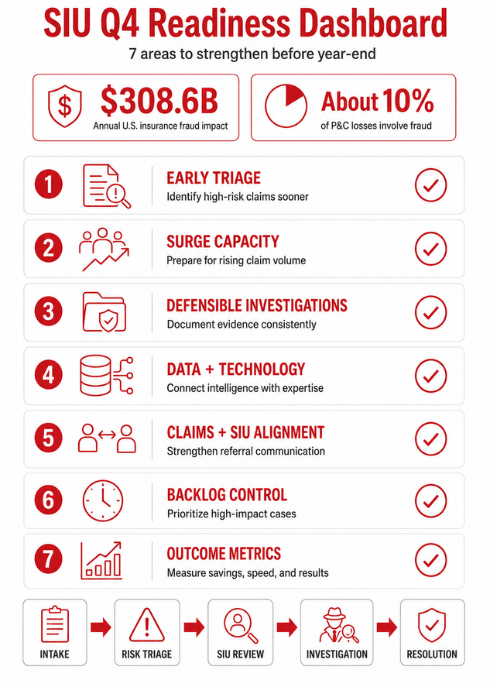
SIU Q4 Readiness Dashboard for Insurance Fraud Detection
A simple readiness review can help teams identify priorities before year-end.
Evaluate your organization across these seven areas:
- Early Claim Triage: High-risk claims are identified quickly.
- Surge Capacity: Additional investigative resources are available when volume increases.
- Defensible Investigations: Evidence and reporting support clear claim decisions.
- Data and Technology: Digital intelligence is combined with investigative expertise.
- Claims and SIU Alignment: Referral criteria and feedback processes are clearly established.
- Backlog Control: High-impact investigations receive timely attention.
- Outcome Measurement: SIU performance is tied to meaningful business results.
A weakness in one area does not necessarily mean the entire fraud program is ineffective. However, it can show where additional resources or process improvements may create the greatest value.
How Investigation Partners Can Strengthen Insurance Fraud Detection
Even mature SIU programs can encounter situations where internal capacity or specialized expertise is limited.
An experienced investigation partner can extend the reach of an internal SIU by providing access to services such as surveillance, investigative interviews, background research, social media investigations, scene investigations, document authentication, medical canvasses, and other claim-specific investigative resources.
Frasco provides nationwide Insurance Claims Investigative services for carriers, TPAs, and other organizations, along with SIU Program Management support. Its FIS capabilities include surveillance, interviews, research investigations, fraud investigations, and specialty services.
External support can be particularly valuable when organizations need to:
- Increase capacity during claim surges
- Investigate claims in multiple geographic markets
- Address specialized or complex referrals
- Reduce SIU backlog
- Gather independent evidence
- Support internal fraud detection with field and research capabilities
The strongest model is not simply outsourcing cases. It is creating an investigative extension of the internal SIU that can respond when additional capacity or specialized resources are needed.
Year-End Priorities for Stronger Insurance Fraud Detection
Before entering the final months of the year, SIU and claims leaders should have a clear understanding of their current risk.
Review referral criteria. Identify high-priority backlog. Confirm investigative capacity. Evaluate reporting quality. Assess fraud detection tools. Review SIU metrics. Most importantly, determine where gaps could delay a decision on a high-risk claim.
Small improvements made before Q4 can reduce operational pressure later.
They can also help claims teams act on suspicious activity earlier, allocate investigation resources more effectively, and make decisions with stronger evidence.
Frequently Asked Questions About Claim Validation
Q1. What is insurance fraud detection?
Insurance fraud detection is the process of identifying patterns, inconsistencies, behaviors, documents, or other indicators that may suggest fraudulent activity within an insurance claim or transaction. Effective detection can combine claims expertise, defined fraud indicators, data analysis, technology, and investigation.
Q2. What role does SIU play in insurance fraud detection?
An SIU evaluates suspicious claims, develops investigative strategies, gathers and reviews evidence, supports required fraud reporting, and helps claims professionals make informed decisions. SIU teams also play an important role in fraud training and improving referral quality.
Q3. When should a claim be referred to SIU?
Claim validation works best early, before evidence degrades and before a claim advances toward settlement. The earlier legitimacy is established, the lower the risk of litigation, reserve inflation, and delayed resolution.
Q4. How can insurers improve fraud detection before Q4?
Start by reviewing referral criteria, high-risk claim triage, SIU backlog, investigative capacity, data resources, documentation standards, and performance metrics. Organizations should also confirm that additional investigative resources are available if claim volume increases.
Build a Stronger SIU Before Q4
Insurance fraud detection is most effective when technology, claims expertise, SIU strategy, and investigation work together.
As claims become more complex, waiting for fraud indicators to become obvious can increase cost and reduce investigative options. Identifying concerns early gives SIU teams more time to gather evidence, validate information, and support stronger claim decisions.
Q4 readiness starts with understanding where your current fraud detection process is strong and where your team may need additional support.
Contact Us Today
Frasco® Investigative Services delivers ethical and efficient solutions tailored to your needs. Have questions or want to discuss your investigative needs further? Contact one of our experienced experts today to find the answers you’re looking for.
Disclaimer: This blog post is for informational purposes only and should not be considered legal advice. Please consult your general counsel for specific legal guidance. Frasco investigators are licensed, and our operations comply with US industry, federal, state, and local laws.