
FECA Chargeback Year 2027: Why Q1 Is the Most Important Quarter for Federal Agency Savings
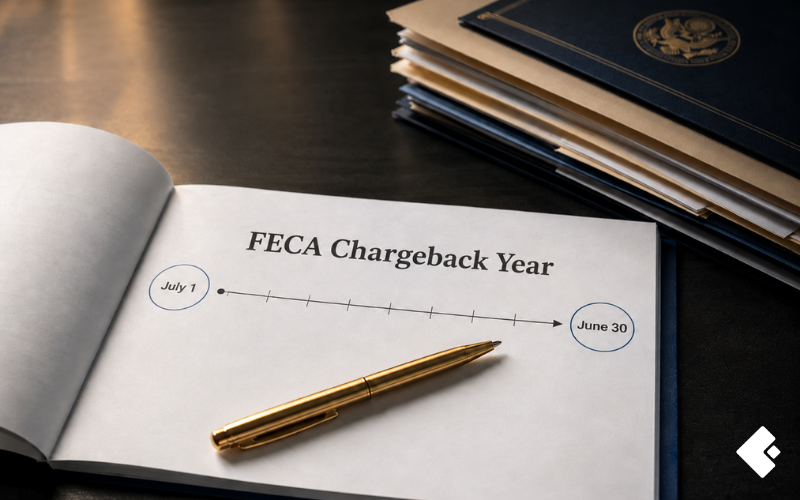
The FECA chargeback year does not follow the fiscal or calendar year. Instead it runs from July 1 to June 30. As chargeback year 2026 closes, federal agencies now stand at one of the most important planning moments of the entire cycle. On July 1, 2026, every agency enters FECA chargeback year 2027. The actions your program takes in the first quarter of that year will determine the trajectory of your total costs for the next twelve months.
This post explains why Q1 actions create the largest compounding savings, what outliers to watch for, and exactly what agency managers should do right now to set year 2027 up for success.
What the FECA Chargeback Year Means for Federal Agencies
Understanding the structure of the FECA chargeback year is the first step toward controlling your agency’s workers compensation costs.
Unlike the federal fiscal year which runs from October 1 to September 30, the FECA chargeback year runs from July 1 through June 30. This means the savings your program generates in any given month accumulate across the remaining months of that chargeback cycle.
As a result, the timing of every return-to-work action, compensation termination, and medical decision directly affects your agency’s final chargeback figure. Acting early in the FECA chargeback year creates more savings. Acting late compresses the window and limits the financial impact of the same effort.
Why Q1 of the FECA Chargeback Year Drives the Biggest Savings
The first quarter of the FECA chargeback year runs from July through September. Actions taken during this window have the greatest financial impact of any quarter.
The math is straightforward. When your program returns an employee to work or terminates compensation in July, your agency saves twelve months of payments for the remainder of the chargeback year. The same action taken in March saves only three months.
Here is how the compounding savings compare across quarters:
- Q1 action in July: Saves 12 months of payments across the full FECA chargeback year
- Q2 action in October: Saves 9 months of payments
- Q3 action in January: Saves 6 months of payments
- Q4 action in April: Saves only 3 months of payments
Early victories build momentum throughout the FECA chargeback year. Furthermore they create a financial buffer that helps offset later surprises such as retroactive schedule awards or overturned denials that agencies cannot always predict or prevent.
Common Outliers That Spike FECA Chargeback Year Costs
Even well-run workers compensation programs face sudden cost increases. Knowing the most common outliers helps agencies build the Q1 savings needed to absorb them.
Three outliers most often create unexpected spikes within the FECA chargeback year:
- Large schedule awards paid as lump sums: These awards can arrive at any point and significantly raise a chargeback figure that was otherwise tracking well
- Retroactive schedule awards requested after maximum medical improvement: These requests add back costs that agencies believed were already resolved, creating an unexpected reversal
- Overturned denials requiring back pay and medical reimbursements: When a denied claim is later approved on appeal, agencies must cover all costs retroactively
Consequently, building strong Q1 savings in the FECA chargeback year is not just about reducing costs. It is about creating a financial cushion that protects your program when these outliers arrive.
How to Use Q4 of Year 2026 to Set Up Q1 Wins in Year 2027
The final months of FECA chargeback year 2026 are the launch pad for year 2027 savings. Actions started now can land results in July when they matter most.
The steps that drive Q1 returns-to-work and terminations often take weeks or even months to complete. Starting them in Q4 of the current FECA chargeback year ensures the outcomes arrive in July rather than September or October when their compounding value is already reduced.
Agency managers should complete three key actions before June 30, 2026:
1. Push open second opinions and independent medical examinations to completion
Open SECOPs and IME exams that remain unresolved create uncertainty about medical status. Completing them before the FECA chargeback year resets gives your program a clear picture of each employee’s condition at the start of Q1.
2. Issue light-duty or permanent job offers for employees able to return with restrictions
Employees who have reached a level of recovery that allows modified duty represent an immediate Q1 savings opportunity. Issuing job offers now means returns-to-work can be completed in July rather than months into the new FECA chargeback year.
3. Pursue timely terminations when medical evidence supports recovery
When the medical record shows that an employee has recovered sufficiently to return to full duty, initiating termination now means the effective date falls in Q1. That timing produces the maximum savings impact across the full FECA chargeback year 2027.
How the 2.6% CPI Increase Affects FECA Chargeback Year 2027 Costs
On March 1, 2026, OWCP applied a 2.6 percent Consumer Price Index increase to all periodic-roll payments. This increase carries directly into FECA chargeback year 2027 and raises every agency’s baseline cost.
Because this CPI boost applies to all ongoing compensation payments, agencies cannot reduce or avoid it through program management alone. It adds a fixed cost increase to every open claim on the periodic roll entering year 2027.
Furthermore this increase makes timely returns-to-work and terminations even more financially valuable than in prior years. Every case that closes before year 2027 begins removes that claim from the periodic roll entirely. As a result the 2.6 percent increase never applies to it at all. Specifically agencies that close the most cases before July 1 will see the smallest impact from the CPI increase on their total FECA chargeback year 2027 costs.
Your Q1 2027 Action Checklist for the FECA Chargeback Year
Use this checklist to ensure your agency enters FECA chargeback year 2027 with clear priorities, measurable targets, and leadership visibility into early savings.
- Review every open termination and return-to-work case from year 2026 — Identify which cases are closest to resolution and prioritize them for Q1 action
- Set weekly targets for job offers, second opinions, and decision letters — Weekly targets keep your team moving at a pace that produces July results rather than Q2 or Q3 outcomes
- Track savings quarterly to measure compounding value — Quarterly tracking shows leadership the financial impact of Q1 actions and builds the case for continued program investment
- Report early wins to leadership — Communicating Q1 savings reinforces program momentum and demonstrates the return on proactive FECA chargeback year management
Make Q1 Count in FECA Chargeback Year 2027
The first quarter of the FECA chargeback year sets the tone for your agency’s total costs across the next twelve months. Acting early creates compounding savings that grow with every passing month. It also builds the financial buffer your program needs when outliers like schedule awards or overturned denials arrive unexpectedly.
The 2.6% CPI increase entering year 2027 makes this Q1 even more important than previous ones. Every case your agency closes before July 1 removes that claim from a more expensive periodic roll. In addition every return-to-work completed in Q1 generates twelve months of savings rather than the compressed value of a later action.
Start now. The 2027 FECA chargeback year report will reflect the decisions your program makes in the weeks ahead.
Want to Learn more?
Explore how leading government agencies and risk managers are using our investigative services to strengthen oversight of legacy claims.
📄 Download our white paper: FECA Claims Investigations by the Numbers
Stay Updated: Get our latest posts, FECA Trends, and upcoming trainings—right in your feed
👉Follow Frasco on LinkedIn
Contact Us Today
Frasco® Government Services delivers ethical and efficient solutions tailored to your needs. Have questions or want to discuss your investigative needs further?
Schedule a call with Craig DeMello, a nationally recognized expert in Federal Workers’ Compensation. With over 30 years of experience in public service, Craig provides practical insight and proven expertise to help clients navigate complex federal claims. As a Government Services Specialist at Frasco, he is dedicated to delivering clear answers and effective strategies to support your agency’s goals.
Disclaimer: This blog post is for informational purposes only and should not be considered legal advice. Please consult your general counsel for specific legal guidance. Frasco investigators are licensed, and our operations comply with US industry, federal, state, and local laws.