

Workers’ Compensation Risk Management: Year-End Myths That Could Be Hiding Risk
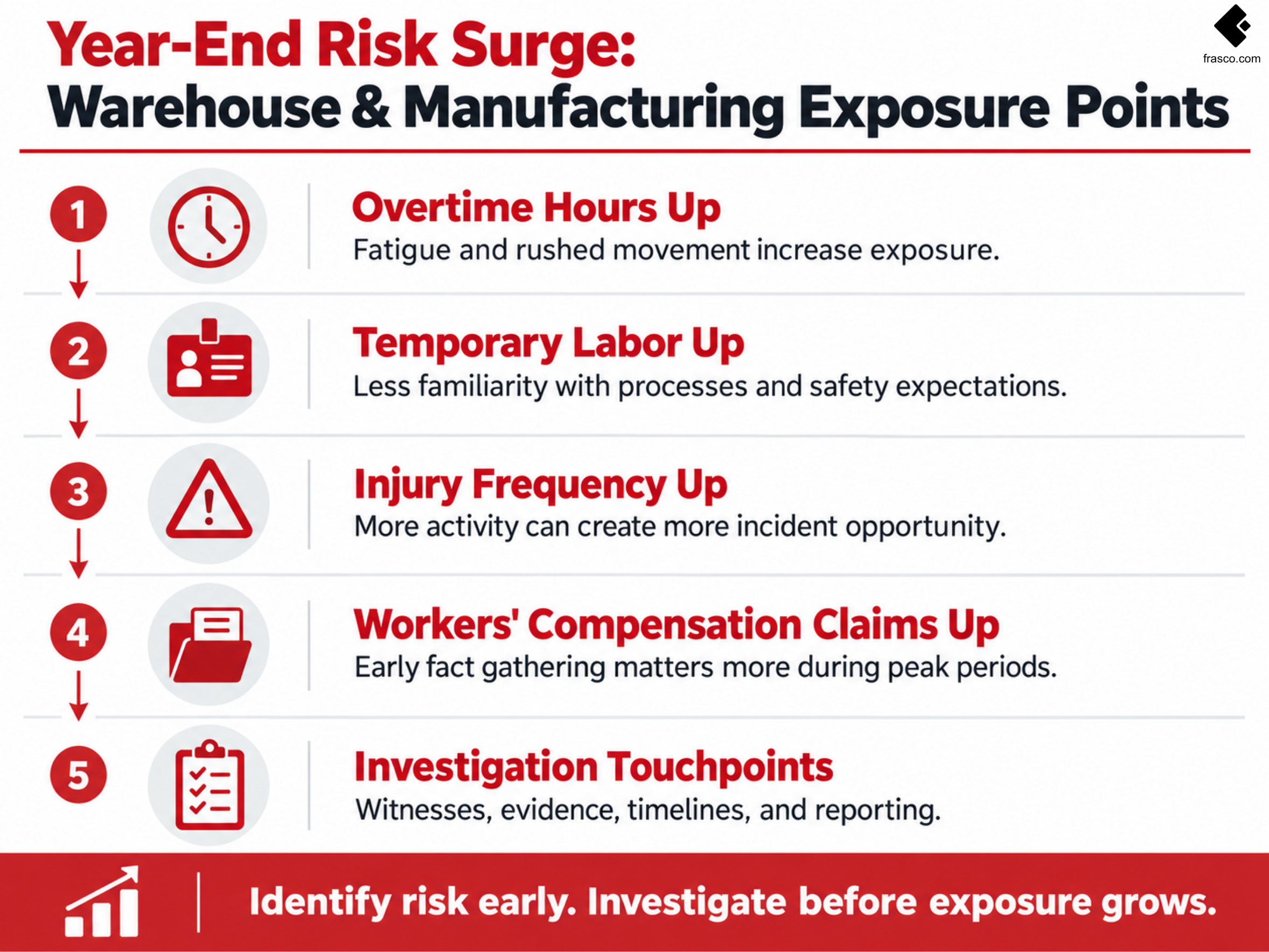
As warehouse and manufacturing operations accelerate to meet year-end production goals, workers’ compensation risk management becomes even more important. Overtime hours increase, seasonal labor expands, and production pressure can make small safety issues turn into larger claim exposures.
For risk managers, claims professionals, and safety leaders, the challenge is not only preventing injuries. It is also identifying hidden risks early enough to protect claim outcomes, support fair decisions, and reduce unnecessary costs.
That is why year-end planning should include more than production targets. It should also include a closer look at the assumptions that may be shaping how workplace incidents and liability events are handled.
In warehouse and manufacturing environments, strategic investigations can help uncover facts that are easy to miss when operations are moving quickly. Those facts can influence workers’ compensation claims, general liability claims, and broader operational risk.
Year-End Workers’ Compensation Risks in Warehouse and Manufacturing
Year-end production periods often create the exact conditions that increase claim complexity.
Common pressure points include:
- More overtime and fatigue
- Higher use of temporary or seasonal labor
- Faster production timelines
- More movement of materials and equipment
- Greater visitor, vendor, and contractor traffic
- Less time to document incidents thoroughly
OSHA identifies material handling, powered industrial trucks, slips and falls, and ergonomic risks among common warehouse hazards.
These conditions do not automatically lead to poor outcomes. However, they can increase the likelihood that important facts are overlooked during the early stages of a claim.
That is why strong workers’ compensation risk management requires a proactive approach. The earlier organizations identify inconsistencies, preserve evidence, and document what actually happened, the better positioned they are to make informed decisions later.
Myth #1: If an Injury Is Reported, the Claim Is Legitimate
Fact: Early investigation often reveals critical details
A reported injury should always be taken seriously. However, a reported injury does not automatically mean the initial account tells the full story.
In warehouse and manufacturing claims, early investigation may uncover:
- conflicting witness statements
- unclear timelines
- pre-existing conditions
- gaps between the reported incident and available evidence
- inconsistencies in how the event is described
For example, a warehouse employee may report a lifting injury during an overtime shift. At first, the claim appears straightforward. However, witness interviews and video review may reveal a different timeline or show that the reported mechanism of injury does not fully align with the available facts.
That does not automatically make the claim illegitimate. It does mean the file may require a closer review before claim decisions are finalized.
Key takeaway: early fact development helps claims teams make decisions based on evidence rather than assumption.
Myth #2: General Liability Incidents Are Usually Straightforward
Fact: Small details can significantly affect liability exposure
Warehouse and manufacturing operations involve frequent movement of employees, visitors, vendors, and contractors. A slip-and-fall, property-damage incident, or third-party injury may appear routine at first, but the details gathered in the first stage of the investigation can significantly influence liability evaluation.
Important questions often include:
- Who was present at the time of the incident?
- What was the condition of the area?
- Were warning signs or barriers in place?
- Was the injured party authorized to be there?
- Did witness accounts align with the reported facts?
- Was there video or photographic evidence available?
In many cases, quick evidence preservation and timely witness outreach can make the difference between uncertainty and a more defensible claim position.
This is why general liability claims should be part of the broader conversation around workers’ compensation risk management, especially in busy production environments where multiple parties may be interacting on-site.
Workers’ Compensation Risk Management Takeaways for Claims Teams
When a workplace injury or liability event occurs, a few early actions can improve claim clarity significantly:
- Preserve evidence as quickly as possible
- Document witness statements early
- Identify video or surveillance opportunities
- Clarify the timeline before memories fade
- Review whether operational conditions may have contributed to the event
These simple steps support stronger investigations and better claim outcomes.
Myth #3: Investigations Are Only Necessary After Suspicion Arises
Fact: Proactive investigations help uncover risk before claims escalate
One of the most costly assumptions in workers’ compensation risk management is waiting until a claim becomes problematic before beginning an investigation.
By that point, important evidence may already be lost. Witness memory may fade. Video may no longer be available. Operational context may be harder to recreate.
A proactive approach allows organizations to identify issues earlier, such as:
- repeated safety noncompliance
- reporting delays
- inconsistent injury narratives
- gaps in incident documentation
- patterns across departments or shifts
- elevated year-end risk tied to production pressure
This approach is especially useful in warehouse and manufacturing settings, where increased activity can create operational blind spots. Investigative insights can help organizations uncover hidden exposure before claims become more expensive or difficult to manage.
How Investigations Support Workers’ Compensation Risk Management
Investigations are most valuable when they are used to establish facts early and support fair decision-making.
At Frasco Investigative Services, warehouse and manufacturing investigations are designed to help organizations validate claim information, uncover hidden risks, and strengthen outcomes through fact-based reporting. A strong investigation may include:
Witness interviews and fact development
Early witness outreach can clarify what happened, when it happened, and whether different accounts align.
Surveillance and activity review
When appropriate, surveillance can provide objective context that helps claims professionals better understand a reported loss.
Background and public-record research
Relevant history may add useful context to the file and help claims teams evaluate complexity and exposure.
Pattern identification across claims
Investigative findings may also reveal recurring operational issues that can affect future workers’ compensation and general liability exposure.
Together, these approaches support more effective workers’ compensation risk management by helping organizations move from assumption to evidence.
A Practical Year-End Checklist for Warehouse and Manufacturing Risk Teams
As production ramps up, risk and claims professionals should ask:
- Are we documenting incidents quickly and consistently?
- Are witness statements being captured early?
- Are we preserving video and scene evidence when incidents occur?
- Are overtime and temporary labor creating additional exposure?
- Are we identifying patterns across claims or departments?
- Are we investigating early enough to prevent unnecessary escalation?
If the answer to several of these questions is unclear, the organization may have hidden risk that deserves closer review.
Why Tailored Claims Investigations Matter
Warehouse and manufacturing environments are not all the same. The operational risks in a distribution center differ from those in a fabrication facility or production plant.
That is why a one-size-fits-all approach often falls short.
Tailored investigations help organizations:
- validate reported claim facts
- identify hidden operational risk
- support fair claim decisions
- reduce uncertainty
- strengthen documentation
- improve readiness during high-volume production periods
For year-end operations, this kind of targeted support can be especially valuable because it helps organizations stay ahead of claim exposure instead of reacting after costs increase.
Frequently Asked Questions About Workers’ Compensation Risk Management
Q1. What is workers’ compensation risk management?
Workers’ compensation risk management is the process of identifying, evaluating, and reducing workplace injury exposure that can lead to claims, increased costs, and operational disruption. It often includes safety controls, documentation practices, and investigations that help organizations respond effectively when incidents occur.
Q2. Why is workers’ compensation risk management important in warehouse and manufacturing operations?
Warehouse and manufacturing environments often involve heavy materials, repetitive movement, equipment use, contractor traffic, and production pressure. These conditions can increase injury exposure and make strong claim management especially important.
Q3. Are investigations only useful when fraud is suspected?
No. Investigations are not limited to fraud concerns. They are also useful for clarifying incident details, verifying timelines, identifying contributing factors, and improving claim documentation.
Q4. Can investigations also help with general liability exposure?
Yes. In warehouse and manufacturing settings, investigations can help clarify third-party incidents, visitor injuries, contractor claims, and other liability events where facts need to be documented early.
Better Facts Strengthen Workers’ Compensation Risk Management
Year-end production pressure does not have to lead to greater claim exposure.
With a stronger approach to workers’ compensation risk management, warehouse and manufacturing organizations can uncover hidden risk, strengthen claim outcomes, and make better decisions when production demands are highest.
The most effective strategy is not to wait until a claim becomes more difficult. It is to investigate early, preserve facts, and build decisions on evidence.
When facts are uncovered early, risk becomes easier to manage.
Contact Us Today
Frasco® Investigative Services delivers ethical and efficient solutions tailored to your needs. Have questions or want to discuss your investigative needs further? Contact one of our experienced experts today to find the answers you’re looking for.
Disclaimer: This blog post is for informational purposes only and should not be considered legal advice. Please consult your general counsel for specific legal guidance. Frasco investigators are licensed, and our operations comply with US industry, federal, state, and local laws.