

Insurance Claims Management in 2026: How Evidence-Driven Investigations Reduce Costs and Improve Accuracy
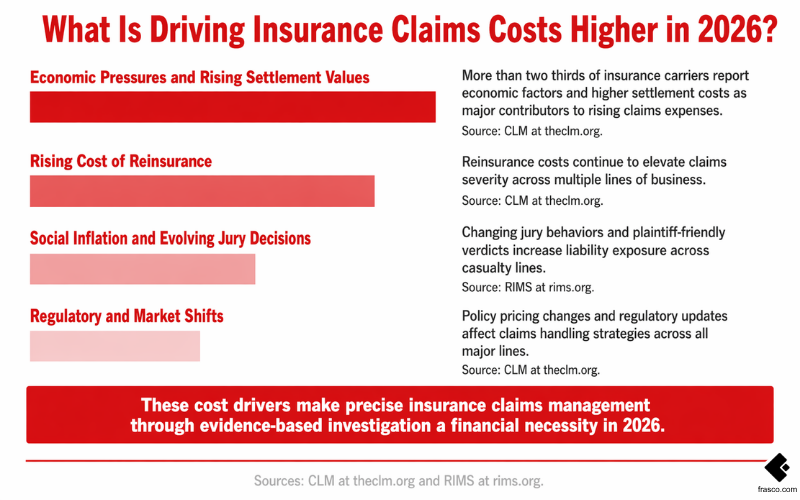
Insurance claims management has never been more challenging or more important than it is in 2026. Claims costs continue to climb, driven largely by economic factors and increasing settlement values. More than two thirds of insurance carriers report that economic pressures and higher settlement costs are major contributors to growing claims expenses. As a result, this creates a business environment where accuracy, verification, and timely investigative insight are essential for maintaining financial stability (Source: theclm.org)
For insurers, TPAs, and self-insured entities, the ability to verify every claim with precision is no longer optional. It is central to effective insurance claims management, cost control, improved decision quality, and reduced exposure to unnecessary loss. Additionally, as the market shifts, risk and claims leaders are relying more heavily on evidence-based processes, using structured investigative support to validate information early and thoroughly.
This guide explores practical, data-driven ways organizations can use investigative services to strengthen insurance claims management, control rising costs, and build more defensible claims outcomes throughout 2026.
Industry Trends Shaping Claims Costs in 2026
Three connected trends are driving claims costs higher in 2026 and creating urgency for claims organizations to strengthen their investigative frameworks.
1. Economic Pressures on Claim Settlements
The cost of reinsurance, regulatory shifts, and increasing settlement values continue to push claims severity higher across multiple lines. Claims departments now manage more complexity under tighter budgets, making investigative accuracy essential for effective insurance claims management and avoiding unnecessary payouts. (Source: theclm.org)
2. Soft Market Conditions Create a Strategic Opportunity
As the 2026 property and casualty environment shows signs of softening, risk managers have a window to strengthen internal processes before conditions tighten again. The 2026 Property Renewal Playbook emphasizes that a soft market is a strategic moment where better risk controls and disciplined claims practices deliver long-term performance gains. (Source: rims.org) Furthermore, organizations that invest in structured insurance claims management processes during this period will be better positioned when market conditions shift.
3. Litigation Costs and Social Inflation Drive Casualty Claims Higher
Organizations continue to face higher exposure due to increased litigation costs, changing jury decisions, and the growing influence of social inflation. These conditions make documentation, verified evidence, and early factual clarity more important than ever in insurance claims management. (Source: rims.org)
Takeaway: These industry shifts reinforce one clear conclusion. Clearly,verifying every claim with precise investigative support is not just a best practice. It is a practical and necessary strategy for insurance claims management cost control in 2026.
Why Verification Is the Foundation of Effective Insurance Claims Management
Verification is not a step in the claims process. It is the foundation that determines whether every other step produces accurate, defensible, and cost-effective outcomes.
Early fact-finding directly influences whether claims are accepted, denied, escalated, taken to court, or resolved efficiently. In addition, organizations that build verification into every phase of their insurance claims management workflow consistently outperform those that treat investigation as an optional or reactive step.
Key cost-saving benefits of verified claims include:
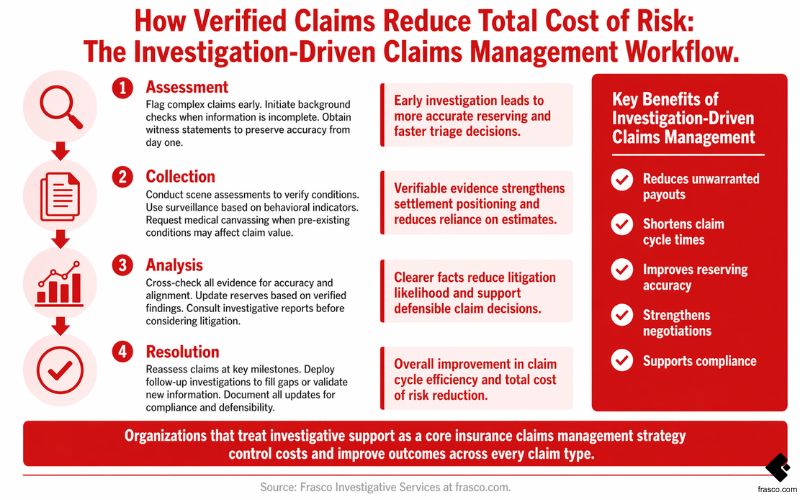
- Reducing unwarranted payouts by identifying problems and unsupported allegations early before reserves are committed
- Shortening claim cycle times by preventing administrative waste and avoiding unnecessary legal escalation
- Improving reserving accuracy so financial leaders understand real exposure and respond with precision rather than estimates
- Strengthening negotiations through verified evidence and stronger factual baselines that support defensible settlement positions
- Supporting compliance by ensuring all decisions are grounded in objective data and thorough documentation
How Professional Investigative Services Strengthen Insurance Claims Management
Frasco Investigative Services brings decades of experience in insurance claims investigations, providing structured and evidence-focused support across workers compensation, liability, and disability claims.
Their approach centers on uncovering verified facts behind each claim, enabling organizations to make insurance claims management decisions based on evidence rather than assumptions.
(Source: frasco.com)
Six Investigative Service Categories That Drive Claims Accuracy
1. Surveillance and Activity Verification
This service confirms levels of activity, functional ability, and potential false reporting in a structured and defensible manner. Notably, it is particularly valuable in workers compensation and disability claims where physical capability claims require objective verification.
2. Background and Social Research
Moreover, this category provides useful intelligence including prior claims history, known associates, and lifestyle indicators that inform more accurate insurance claims management decisions.
3. Witness Statements and Interviews
Similarly, this service clarifies the factual narrative and identifies gaps or support through firsthand accounts before memories fade or circumstances change.
4. Medical Canvassing and Record Collection
This step ensures organizations have complete and accurate medical histories necessary for fair and accurate claim evaluation across all claim types.
5. Field Investigations
Specifically, on-site inquiries validate environments, conditions, and contributing factors related to an alleged incident, providing ground-level intelligence that desk-based reviews cannot match.
6. Liability and Incident Scene Reviews
These reviews are critical for determining cause,responsibility, and whether an incident could have been prevented in general liability and casualty claims where scene conditions directly affect coverage decisions.
A Four-Phase Checklist for Integrating Investigation Into Insurance Claims Management Workflows
Use this practical checklist to build consistent, cost-focused investigative practices into every phase of your insurance claims management process.
Phase 1 — Early Claim Assessment
- Flag claims with signs of complexity or potential exaggeration at first notice of loss
- Initiate background checks when submitted information is incomplete, inconsistent, or raises red flags
- Obtain witness statements early to preserve accuracy before recollections change or witnesses become unavailable
Phase 2 — Evidence Collection
- Conduct scene checks to verify the conditions described in the claim submission
- Use surveillance carefully based on specific behavioral signs rather than as a default response
- Request medical canvassing when pre-existing conditions may influence claim value or treatment patterns
Phase 3 — Analysis and Decision Making
- Cross-check all collected evidence for accuracy and alignment with reported claim details
- Update reserves based on verified investigative findings rather than initial estimates or assumptions
- Review investigative reports before making litigation decisions to ensure all factual clarity has been established
Phase 4 — Ongoing Monitoring
- Reassess claims at key milestones throughout the insurance claims management lifecycle
- Deploy follow-up investigations to fill information gaps or validate newly submitted information
- Document all updates thoroughly for compliance requirements and litigation defensibility
Applying Investigative Support Across High-Cost Insurance Claims Areas
Different claim types require different investigative approaches. Here is a practical guide for applying investigative support where it delivers the highest return in insurance claims management.
Workers Compensation Claims
-
Use surveillance to confirm physical capabilities when allegation severity contradicts observed behavior patterns
-
Apply medical canvassing when multiple providers might have relevant treatment history that affects claim value
-
Conduct employer and coworker interviews to establish accurate timelines and verify incident details
General Liability Claims
- Confirm premises conditions immediately when slip and fall allegations arise before environmental conditions change
- Use witness interviews to identify behavioral and environmental factors that affect liability decision
- Reconstruct events when photographic or video evidence exists to establish a complete and defensible factual record
Disability Claims
- Verify claimants’ stated physical limits with structured activity monitoring over defined observation periods
- Investigate potential overlapping employment or undisclosed income sources that affect benefit eligibility
- Review medical records for gaps related to treatment patterns, provider history, and reported restrictions
What Insurance Claims Leaders Should Prepare for in the Second Half of 2026
Importantly, the claims environment will not stabilize on its own. Organizations that invest in smarter insurance claims management strategies now will be better positioned as costs and scrutiny continue to rise.
Drawing from industry guidance and risk management insights, claims leaders should expect continued emphasis on performance tracking, litigation management, and loss control best practices throughout the rest of 2026. The push for evidence-based strategies will grow stronger as claims costs stay high and review of claims decisions increases. (Source: rims.org)
Specifically risk and claims leaders can expect:
-
More reliance on independent data sources for validating loss conditions and supporting defensible claim decisions
-
Continued rise in liability-related costs due to changing jury behaviors and the sustained influence of social inflation (Source: rims.org)
-
Strategic opportunities during soft market conditions where organizations with disciplined insurance claims management processes gain a competitive edge when leverage is higher (Source: rims.org)
As a result, the organizations that thrive will be those that treat investigative support as a core part of insurance claims management strategy rather than an optional or reactive resource.
Build a Stronger Insurance Claims Management Strategy With Evidence-Driven Investigations
In a period marked by rising settlement values and increased litigation pressure, verifying every claim with precise investigative support is a financial necessity for every insurance claim management organization. Industry data confirms that economic factors, social inflation, and liability pressure will continue shaping the claims landscape throughout 2026. (Source: theclm.org, rims.org)
By integrating structured investigative methods into every phase of the claims lifecycle, insurers, TPAs, and self-insured entities can control costs, improve accuracy, and strengthen defensibility across all claim types. Consequently, verification enables objective, confident insurance claims management decision-making and positions organizations to navigate ongoing market challenges with clarity and strength.
Contact Us Today
Frasco® Investigative Services delivers ethical and efficient solutions tailored to your needs. Have questions or want to discuss your investigative needs further? Contact one of our experienced experts today to find the answers you’re looking for.
Disclaimer: This blog post is for informational purposes only and should not be considered legal advice. Please consult your general counsel for specific legal guidance. Frasco investigators are licensed, and our operations comply with US industry, federal, state, and local laws.