

Fleet Claims Management: How Verified Data Helps You Navigate the Summer Claims Surge
Each summer, transportation and delivery networks face predictable but complex pressure. Road congestion increases. Delivery routes expand. New and seasonal drivers enter fleets. Weather shifts without warning. At the same time, claims teams must process a higher volume of incidents while holding on to accuracy and speed.
This seasonal pattern is not anecdotal. It is structural. As e-commerce grows, more commercial vehicles move onto already crowded roads, and that raises both accident frequency and claims complexity. For risk managers, claims leaders, and SIU teams, the challenge is not only managing volume. It is maintaining confidence in claim accuracy when speed is non-negotiable. Strong fleet claims management, built on verified data, is how leading organizations meet that challenge. (Source: theclm.org)
Summer Trends That Drive Fleet Claims Complexity
Several seasonal forces converge each summer to make fleet claims management harder and higher-stakes.
Increased Vehicle Density and Route Volume
During summer, delivery networks expand capacity. They add routes, bring on temporary drivers, and increase delivery frequency. As a result, more vehicles share the road at once, especially in urban and residential zones. As e-commerce demand grows, this trend keeps driving higher exposure to accidents and liability events.
Rising Claims Severity and Litigation Risk
Transportation claims are no longer routine. They often involve multiple vehicles, third-party liability, and both bodily injury and cargo damage. Even minor incidents can escalate into complex claims. Consequently, risk leaders must produce documentation that holds up in litigation environments where the financial stakes keep climbing.
Persistent Fraud and Suspicious Activity
Fraud continues to threaten claim accuracy:
- Insurance fraud accounts for at least $308.6 billion annually in the United States
- Fraud appears in as much as 10 percent of property and casualty claims losses
(Source: insurancefraud.org)
In transportation specifically, staged accidents are increasing. Reports show:
- A 23 percent increase in staged accidents year over year
- A 38 percent increase involving commercial vehicles (Source: insurancefraud.org)
For fleet operators, this creates a dual challenge of volume and vigilance. To see how these schemes play out in delivery operations, read our related guide on delivery claims theft and damage → https://frasco.com/delivery-claims-in-2026-theft-damage-and-the-evidence-that-matters-most/.
Operational Strain From Labor Gaps
The industry still faces driver shortages, greater reliance on less experienced staff, and high turnover in operational roles. Together, these factors raise the likelihood of inconsistent reporting, incomplete documentation, and variability in incident accounts, all of which complicate fleet claims management.
The Core Problem in Fleet Claims Management: Speed Without Certainty
In high-volume periods, fleet claims management teams are measured on cycle time, resolution speed, and cost containment. Yet faster decisions often mean working with incomplete or conflicting information.
Common operational gaps include unverified driver timelines, limited third-party witness validation, missing or inconsistent documentation, and delayed evidence capture. Over time, these gaps lead to claim leakage, overpayment risk, greater litigation exposure, and real difficulty defending decisions months later.
The fundamental issue is not speed itself. Rather, it is a lack of confidence in the information used to move quickly. That is the problem verified fleet claims management is built to solve.
The Value of Verified Claims Data in Fleet Claims Management
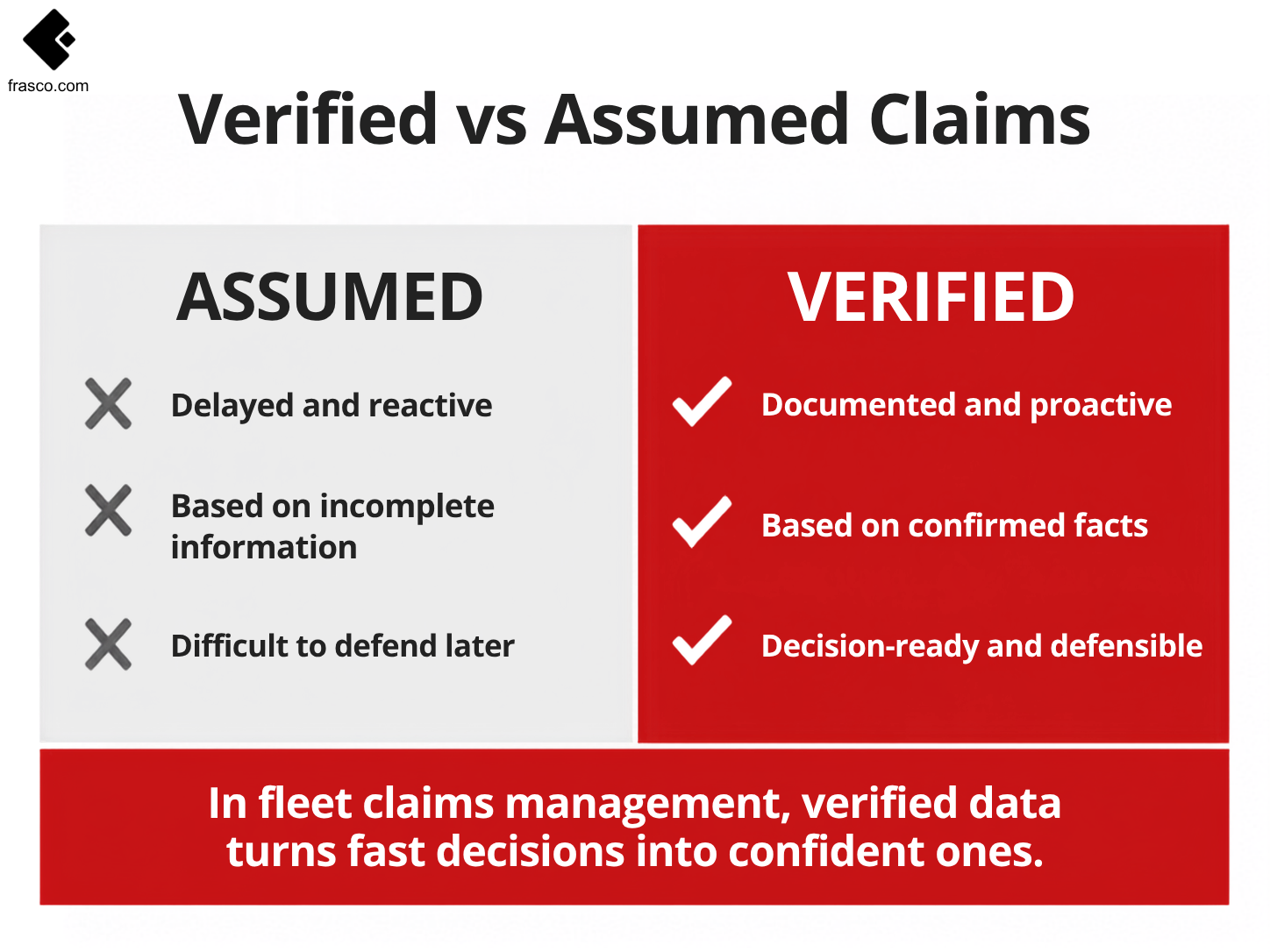
To manage summer claim surges well, leading organizations shift from assumption toward verification.
Verification strengthens fleet claims management in four specific ways:
- Timeline accuracy — Confirms where a vehicle was and when
- Driver accountability — Documents actions and key decision points
- Liability clarity — Separates contributing factors so fault is clear
- Fraud detection — Identifies inconsistencies early, before payment
In practice, this creates measurable impact. Verified data reduces financial leakage, improves claim defensibility, and supports faster resolution with greater confidence. As a result, teams move quickly without sacrificing accuracy.
Why Summer Amplifies the Need for Early Investigation
In transportation claims, timing directly affects accuracy, which makes early investigation a core part of summer fleet claims management.
During summer, evidence degrades quickly as traffic and environments change. Witness memory fades fast. Digital data may be overwritten or lost. When investigations are delayed, organizations lose access to the most reliable version of events.
Early-stage verification, by contrast, enables accurate reconstruction of events, clear documentation for internal decisions, and stronger positioning in potential litigation. Therefore, acting early is one of the highest-value moves a fleet claims team can make.
Technology’s Role in Modern Fleet Claims Management
Technology has become a valuable input for fleet claims management, though it is only the starting point.
The transportation industry has widely adopted telematics, GPS tracking, and vehicle data systems. These tools generate useful information, including vehicle location, speed, and route activity. In turn, that real-time data can support claims evaluation and improve decision accuracy in complex scenarios.
However, raw data alone is not enough. The real value comes from interpreting that data, validating it against real-world conditions, and integrating it into a complete investigative picture. In other words, technology supports fleet claims management, but human verification turns data into defensible decisions.
Operational Outcomes That Matter Most
For risk managers and claims leaders, the goal of fleet claims management is not simply investigation. It is outcomes.
The key performance drivers are a reduced total cost of risk, shorter claim cycle times, increased claim accuracy, and improved litigation outcomes. Organizations that combine timely investigation, reliable verification, and actionable insights are better positioned to manage both volume and complexity throughout the summer surge.
Aligning Your Fleet Claims Management Strategy With Business Reality
In enterprise environments, investigative partners must align with the real conditions of fleet claims management.
That means aligning with high claim volume, multi-state operations, internal compliance requirements, and data integration needs. In practice, it calls for scalable investigative models, consistent processes, and tailored solutions rather than one-size-fits-all approaches. Increasingly, organizations prioritize partners that offer flexibility, technology integration, and long-term partnership stability. You can learn more about Frasco’s approach on our transportation and delivery claims investigations page → https://frasco.com/transportation-delivery-claims-investigations/.
A Practical Fleet Claims Management Approach for Summer 2026
Use these five priorities to strengthen fleet claims management before the seasonal surge peaks.
- Prioritize early investigation — Capture facts before information degrades
- Standardize verification workflows — Ensure consistency across claims teams
- Leverage available data sources — Combine telematics, documentation, and interviews
- Escalate suspicious claims quickly — Reduce fraud exposure before payments occur
- Partner with experienced investigators — Ensure complex cases are handled efficiently
Together, these steps help teams manage volume and complexity without losing accuracy.
Clarity Is the Foundation of Speed
Summer will keep bringing increased demand, greater exposure, and rising complexity. For risk leaders, the challenge is not simply keeping pace with volume. It is ensuring that every claim decision rests on verified, defensible information.
By prioritizing accuracy alongside speed, strong fleet claims management helps organizations reduce losses, improve outcomes, and strengthen confidence across the entire claims lifecycle.
Frequently Asked Questions About Fleet Claims Management
Q1. What is fleet claims management?
Fleet claims management is the process transportation and delivery organizations use to report, investigate, verify, and resolve claims involving their vehicles and drivers. Strong fleet claims management combines early investigation, verified data, and consistent workflows to control costs and reduce litigation risk.
Q2. Why does fleet claims management get harder in summer?
Summer brings more vehicles, more routes, and more seasonal drivers, which increases both accident frequency and claim complexity. As volume rises, fleet claims management teams face more pressure to decide quickly, which makes verified data essential for maintaining accuracy.
Q3. How does verification improve fleet claims management?
Verification confirms timelines, documents driver accountability, clarifies liability, and detects fraud early. As a result, it reduces financial leakage and improves claim defensibility, so teams can resolve claims faster and with greater confidence.
Q4. Why is early investigation important in fleet claims?
Evidence degrades quickly after a transportation incident. Witness memory fades and digital data can be lost or overwritten. Therefore, early investigation preserves the most reliable version of events and strengthens the organization’s position in any future litigation.
Contact Us Today
Frasco® Investigative Services delivers ethical and efficient solutions tailored to your needs. Have questions or want to discuss your investigative needs further? Contact one of our experienced experts today to find the answers you’re looking for.
Disclaimer: This blog post is for informational purposes only and should not be considered legal advice. Please consult your general counsel for specific legal guidance. Frasco investigators are licensed, and our operations comply with US industry, federal, state, and local laws.