

Enrollment Projections and Budget Integrity: How to Ensure Only Eligible Residents Are Counted for 2026 to 2027
Enrollment projections built on inaccurate residency data are one of the most preventable sources of budget risk for school districts heading into the 2026 to 2027 planning cycle. Public school districts across the United States are entering this cycle with a heightened focus on accuracy. As funding formulas continue to tie closely to resident student counts, districts face growing pressure to ensure that every projected student is legitimately eligible. With national enrollment fluctuating and residency challenges rising, protecting budget integrity depends on accurate resident verification more than ever before.
In April 2026, this topic sits at the center of strategic planning due to several trends reshaping the K-12 landscape. For district leaders responsible for public communication, this environment demands clear, data-driven messaging that helps communities understand why enrollment accuracy matters and what districts are doing to protect it.
Why Enrollment Projections Are Under More Pressure Than Ever in 2026
Declining enrollment is amplifying the consequences of every inaccuracy in residency data. Districts that do not verify eligibility carefully are building their budgets on an unstable foundation.
Recent data confirms a sustained decline in public school enrollment nationwide:
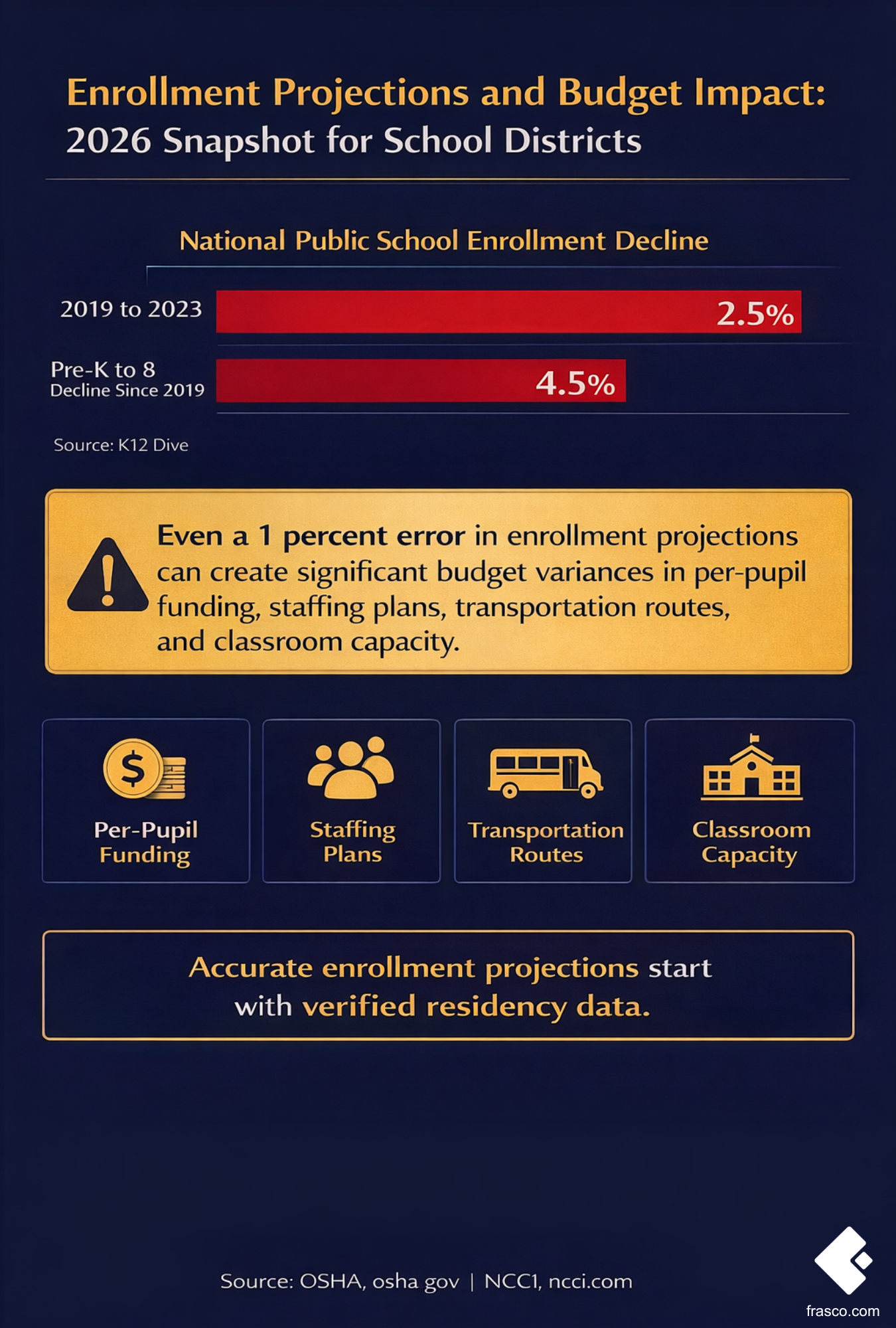
- Public school enrollment dropped 0.2% from fall 2022 to fall 2023 and 2.5% compared to fall 2019. (Source: K12 Dive.com)
- Districts are experiencing the steepest declines at the Pre-K to 8 level, where enrollment has fallen 4.5% since 2019. (Source: K12 Dive.com)
- In early 2026, K-12 leaders cited enrollment concerns, increased school choice competition, and shifting federal priorities as the top factors shaping strategic planning for the coming year.
- Some large districts are closing schools as enrollment falls sharply, with one district reporting a 5% drop totaling nearly 10,000 students between the 2024 to 2025 and 2025 to 2026 school years alone.
(Source: K12 Dive.com)
Declining birthrates, rising competition from school choice programs, and shifts in family mobility patterns continue to apply pressure on public schools. As a result, these dynamics make residency integrity more critical than ever. Even small inaccuracies in enrollment projections can translate into major funding gaps and resource misallocations that affect every area of district operations.
How Inaccurate Enrollment Projections Directly Threaten District Budget Stability
When a district counts students who are not eligible residents, the impact goes far beyond a numerical error in a spreadsheet.
Overinflated enrollment projections affect multiple areas of district planning simultaneously:
1. Per-pupil funding calculations:
State and federal funding formulas allocate money based on enrolled student counts. Projections that exceed actual eligible enrollment lead to funding shortfalls once allocations are finalized.
2. Staffing plans:
Districts hire teachers and aides based on projected student numbers. When actual enrollment comes in lower, districts face difficult staffing decisions that are expensive and disruptive to address.
3. Transportation routes:
Bus routes planned around inflated rosters create unnecessary fuel, driver hours, and maintenance costs that drain already stretched operating budgets.
4. Classroom capacity:
Residency errors strain certain school zones while leaving instructional space unused in others, creating operational imbalances that are hard to correct mid-year.
5. Long-term bond planning:
Overinflated projections distort facility planning assumptions and create risk in capital financing decisions.
Districts that take active steps to verify resident eligibility protect themselves by building next year’s budget on accurate demographic data rather than assumptions. Furthermore, accurate enrollment projections reduce the likelihood of reactive budget cuts later in the school year when funding shortfalls surface.
A Seven-Step Checklist to Ensure Enrollment Projections Include Only Eligible Residents
Use this checklist to confirm your district enters the 2026 to 2027 planning cycle with strong residency verification processes in place:
1. Review and Update Residency Policies Annually
Mobility patterns shift quickly. As early 2026 data confirms, school choice competition continues expanding and demographic shifts are ongoing across most districts. Clear, updated residency policies ensure consistent enforcement across all campuses and reduce the risk of inconsistent application between sites. (Source: K12 Dive.com)
2. Strengthen Documentation Requirements
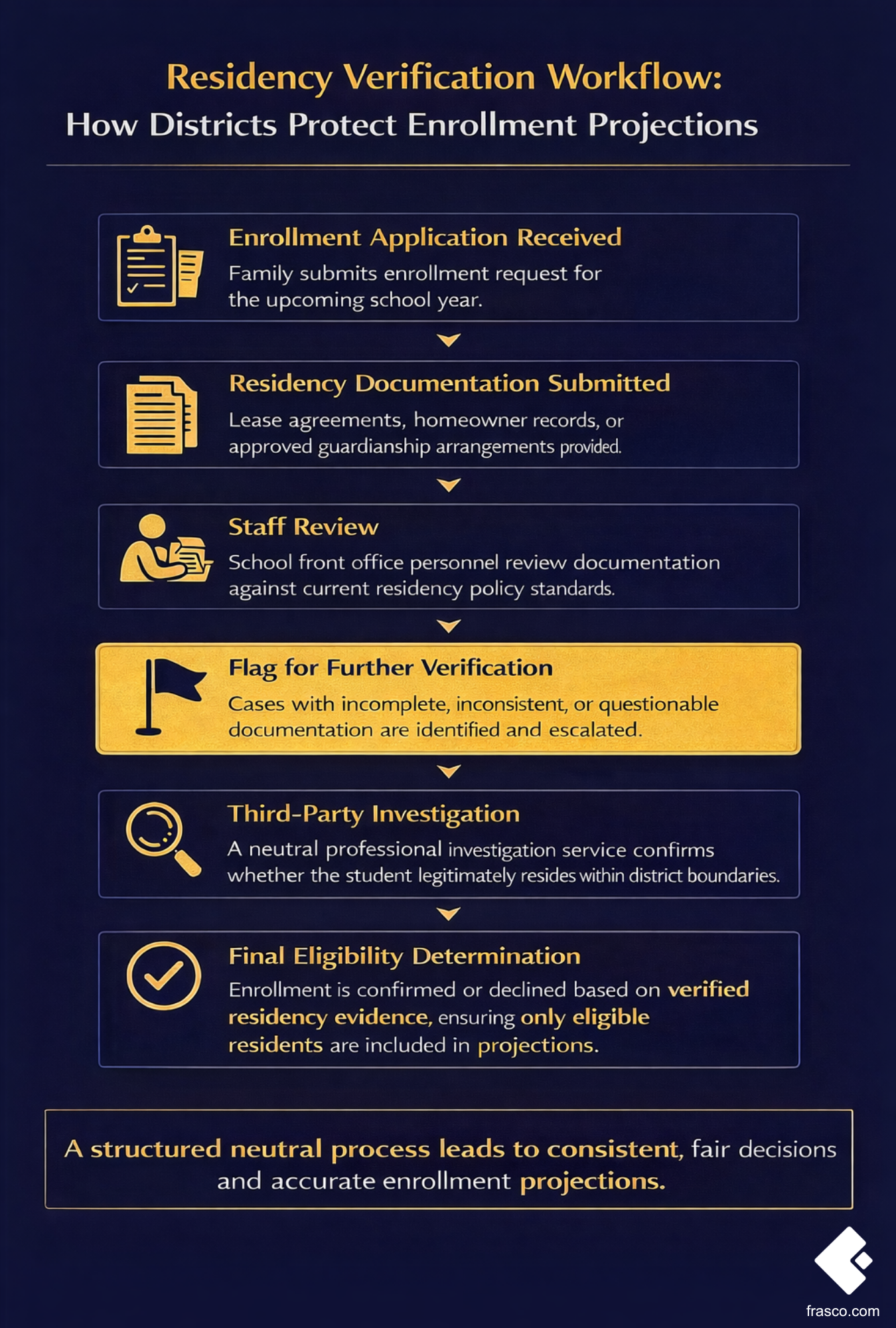
- Verify primary residency documentation including lease agreements, homeowner records, and approved guardianship arrangements.
- Require consistent documentation standards across all enrollment sites.
- Detailed and consistent documentation prevents misunderstandings and reduces the number of family appeals districts must process.
3. Integrate Periodic Audits Into the Planning Cycle
- Conduct mid-year and pre-projection audits to identify irregularities before they affect enrollment projections.
- Districts with declining enrollment are already reviewing staffing and facility consolidation plans, making early accuracy even more essential. (Source: K12 Dive.com)
- Early audit findings allow corrective action before projections are finalized rather than after budgets are set.
4. Train School Site Staff Annually
- School front office and enrollment personnel should receive annual training on acceptable documentation standards.
- Staff training should include clear procedures for referring questionable cases for further review.
- Consistent staff knowledge reduces errors at the point of first contact and strengthens the overall verification process.
5. Use Third-Party Investigators When Needed
- Residency investigations conducted by a neutral, professional service confirm whether a student legitimately resides within district boundaries.
- Third-party investigations also protect district staff from having to conduct sensitive investigations directly, reducing the risk of interpersonal conflict and legal exposure.
- Professional investigators provide objective, defensible documentation that supports consistent eligibility decisions.
6. Establish an Anonymous Tip Process
- Districts often learn of residency concerns from parents, neighbors, and community members.
- An anonymous reporting option increases the likelihood of receiving timely information.
- Anonymous reporting reduces interpersonal conflict and allows community members to support residency integrity without fear of direct confrontation.
7. Communicate Transparently With Families
- Messaging should emphasize that accurate enrollment projections protect class sizes, support services, and funding levels for all students.
- Clear communication builds community trust and reduces resistance when verifications are required.
- Families respond best to factual, neutral explanations of why residency policies exist and how they protect the district’s resources.
Best Practices for Communicating Enrollment and Residency Policies to Your Community
Community support for residency verification increases when district leaders communicate the purpose and process clearly and consistently.
Keep Language Clear and Neutral
- Families respond best to factual explanations of why residency rules exist rather than policy-heavy or legalistic language.
- Districts can share that these policies ensure fairness, protect per-pupil funding, and preserve resources for students who legitimately belong in the district.
- Use these outcomes to identify patterns that can guide this year’s verification priorities.
Share Enrollment Data Publicly
- When community members understand the broader enrollment context, including national declines and local trends, they are more supportive of verification efforts.
- Reports confirm a persistent national decline in enrollment and shifting demographics that directly impact district planning. (Source: K12 Dive.com)
- Sharing this data publicly positions verification as a necessary response to real financial pressure rather than an administrative burden imposed on families.
Offer Step-by-Step Instructions for Families
- Provide readable checklists that help families prepare documentation before their enrollment appointments.
- Clear step-by-step instructions reduce delays and minimize frustration for families arriving unprepared.
- Streamlined documentation preparation speeds up the verification process for both district staff and families alike.
Provide Accessible Support for All Families
- Have staff or interpreters available for families who need assistance completing documentation requirements.
- Accessible support ensures equitable compliance across all community members regardless of language or background.
- Offering this support signals clearly that the district’s goal is accurate enrollment rather than creating barriers for legitimate families.
Accurate Enrollment Projections Protect District Stability for 2026 to 2027
As school districts finalize enrollment projections for the 2026 to 2027 fiscal year, ensuring that only eligible residents are counted is one of the most effective steps leaders can take to protect next year’s budget. With national enrollment continuing to decline and financial pressure spreading across states, the accuracy of residency data has never been more important to long-term planning.
When districts adopt a structured, transparent verification process, they protect financial stability, strengthen community trust, and support sound operational planning throughout the year. The investment in accurate enrollment projections today prevents the reactive budget corrections, staffing disruptions, and community concerns that inaccurate data creates tomorrow.
Want to Learn More?
See how school districts use investigations to protect resources and keep enrollment fair.
📄 Download our white paper: Protecting Educational Resources: 4 Ways to Address Residency Fraud
Stay Updated: Get our latest posts, school-district fraud trends, and upcoming events—right in your feed 👉 Follow Frasco on LinkedIn
Contact Us Today
Frasco® District Residency Investigations delivers ethical and efficient solutions tailored to your needs. Have questions or want to discuss your investigative needs further? Schedule a call with one of our experts today to find the answers you’re looking for.
If you know a school district that could benefit from our investigative services, Submit a Referral Here to help them protect their resources and strengthen community trust.
Disclaimer: This blog post is for informational purposes only and should not be considered legal advice. Please consult your general counsel for specific legal guidance. Frasco investigators are licensed, and our operations comply with US industry, federal, state, and local laws.