

Construction Insurance Claims: 5 Investigation Priorities for Claims Teams
Construction insurance claims can present unique challenges for risk managers, claims professionals, SIU teams, carriers, and TPAs. Job-site conditions change quickly, multiple contractors may share responsibility, and important evidence can disappear as work progresses.
For claims teams, the challenge is not simply determining whether an incident occurred. It is establishing what happened, who was involved, what evidence supports the reported account, and which facts could affect liability, compensability, coverage, or fraud concerns.
The construction industry’s loss environment makes timely investigation particularly important. U.S. Bureau of Labor Statistics data show that private-sector construction recorded approximately 163,600 nonfatal workplace injuries in 2024. Construction workers also experienced falls, slips, and trips resulting in days away from work at a higher rate than private industry overall.
Workers’ compensation also represents more than 70% of construction-industry claims according to Gallagher Bassett, while serious nonfatal workplace injuries contribute nearly $11.4 billion in annual losses.
For organizations handling complex construction claims, one principle matters:
Investigate while the facts are still available.
The following five priorities can help claims and risk teams build stronger evidence, clarify responsibility, and support more defensible claim decisions.
Why Construction Insurance Claims Require a Different Investigation Approach
Construction sites are unlike static workplaces.
Equipment moves. Materials disappear. Access routes change. Crews rotate between projects. Subcontractors complete their assignments and leave. Temporary barriers and safety controls may be removed as work progresses.
Frasco’s construction claims investigation model reflects this reality by focusing on early documentation of job-site conditions, equipment placement, work areas, interviews, surveillance, and other facts that can help clarify how an incident occurred.
A thorough construction claims investigation should answer five fundamental questions:
- What happened?
- Where and when did it happen?
- Who was involved directly or indirectly?
- What evidence supports or contradicts the reported account?
- Which facts matter to liability, compensability, coverage, subrogation, or fraud review?
The objective is not to collect as much information as possible. It is to gather the right evidence before changing conditions make important questions harder to answer.
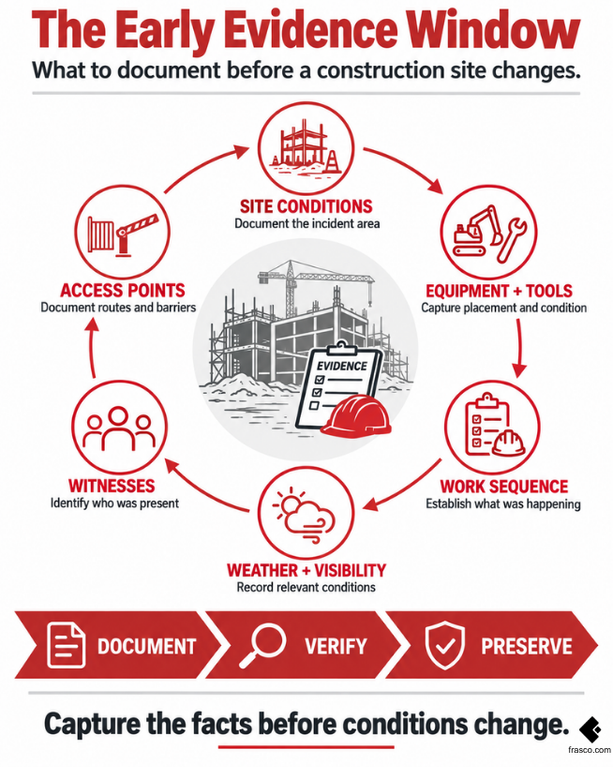
1. Preserve Job-Site Evidence Before Conditions Change
The first priority in many construction insurance claims is documenting the scene.
A job site may look substantially different only days after an incident. Equipment may move, temporary structures may disappear, materials may be removed, and the work itself may advance into another phase.
Claims professionals should therefore consider documenting relevant conditions as early as practical.
Important evidence may include:
- Equipment placement
- Work areas
- Access and exit points
- Temporary barriers and warning signage
- Scaffolding or elevated work areas
- Tools and materials
- Lighting and visibility conditions
- Weather conditions when relevant
- Photographs and video
- Witness locations
- Work occurring at the time of the incident
Frasco’s construction investigation services specifically use scene investigations to document equipment placement, access points, and work areas before conditions change.
Early documentation does not determine liability by itself. However, it provides a factual record that claims teams can compare with statements, records, and other evidence later.
The earlier the scene is documented, the less the investigation must rely on memory and assumptions.
2. Identify Contractors and Potentially Responsible Parties Early
Construction insurance claims frequently involve more than one employer or organization.
Depending on the project, an incident may involve:
- A general contractor
- Multiple subcontractors
- Property owners
- Equipment operators
- Material suppliers
- Site managers
- Staffing companies
- Delivery vendors
- Equipment rental companies
- Other third parties
That makes responsibility more complicated than identifying the injured worker’s employer.
A construction claims investigation should develop a clear picture of who controlled the relevant work, who was present, and how the parties were connected at the time of the loss.
Claims teams may want to document:
- Employment relationships
- Contractor and subcontractor relationships
- Reporting lines
- Scope of work
- Site responsibilities
- Equipment ownership or control
- Relevant contractual relationships
- Sequence of work around the incident
This information can influence liability evaluation and may also identify opportunities for risk transfer or subrogation.
Party mapping early in the claim can prevent major gaps later.
3. Compare the Reported Narrative With the Evidence
The first report of loss is important, but it should not automatically become the final account of what happened.
Construction incidents can be chaotic. Multiple crews may be operating simultaneously. The person reporting the claim may not have witnessed the incident directly. Statements may also be based on incomplete information available immediately after the event.
A strong investigation treats the initial narrative as a starting point and compares it against independent evidence.
That evidence may include:
- Scene photographs
- Witness statements
- Supervisor interviews
- Time records
- Work logs
- Safety documentation
- Equipment records
- Incident reports
- Video footage
- Publicly available information
- Medical or injury information when appropriate
Investigative interviews are particularly valuable when accounts conflict or the sequence of events remains unclear. Frasco uses recorded interviews with injured workers, supervisors, safety managers, and witnesses to clarify what occurred and whether work duties and procedures align with the reported event.
The goal is not to disprove the claim.
The goal is to determine which version of events the available evidence supports.
That distinction helps claims professionals reach fairer and more defensible conclusions.
4. Evaluate Inconsistencies and Potential Fraud Indicators
Claims professionals do not need to assume fraud in order to investigate inconsistencies.
They do need a process for recognizing when information does not align.
The Coalition Against Insurance Fraud estimates that insurance fraud costs American consumers at least $308.6 billion annually and occurs in approximately 10% of property-casualty insurance losses.
Within construction insurance claims, concerns might emerge when:
- Timelines conflict
- Witness accounts differ materially
- Reported activity does not align with available evidence
- Employment relationships are unclear
- Injury circumstances change during the claim
- Scene evidence contradicts the reported sequence
- Relevant prior information emerges
- Public activity raises questions requiring further review
When legitimate concerns exist, additional investigative methods may include:
- Recorded interviews
- Surveillance
- Social media investigation
- Background research
- Medical or pharmacy canvasses
- Scene investigation
- Employment verification
- Additional witness development
A strong SIU or claims investigation should evaluate the evidence objectively.
An inconsistency is a reason to ask another question, not automatically evidence of fraud.
That principle helps protect claim integrity while ensuring legitimate concerns receive appropriate attention.
5. Build the Claim File for the Next Decision
A construction claim investigation should not stop when enough information exists to complete the immediate task.
Claims evolve.
What begins as an initial workers’ compensation review may later involve:
- Reserve changes
- Liability evaluation
- SIU escalation
- Subrogation
- Legal review
- Coverage questions
- Litigation
- Settlement discussions
- Claim denial considerations
That means investigative documentation should remain useful beyond the day investigators complete their assignment.
A strong file should clearly distinguish:
Verified Facts
Information supported by evidence.
Unresolved Questions
Issues that remain unclear or require additional investigation.
Party Relationships
The individuals and organizations connected to the incident.
Evidence Collected
Photographs, interviews, records, research, video, and other supporting material.
Material Inconsistencies
Conflicts that could affect the evaluation of the claim.
Recommended Next Steps
Further investigative activity that may help resolve remaining issues.
This approach allows claims professionals, SIU teams, attorneys, and risk managers to understand the file without reconstructing the entire investigation months later.
The investigation should support both today’s decision and the decisions that may follow.
How Construction Claims Investigations Support Risk Management
A completed investigation can provide value beyond one individual claim.
Patterns identified across multiple construction insurance claims can reveal broader operational risks.
For example, repeated incidents involving the same work activity, subcontractor, access point, equipment type, or reporting breakdown may indicate an underlying risk-management issue.
Investigation findings can therefore help organizations:
- Identify recurring loss patterns
- Improve contractor oversight
- Evaluate site procedures
- Strengthen documentation practices
- Identify potential subrogation opportunities
- Improve referral criteria
- Refine future claim investigation strategies
This creates an important connection between construction claims investigation and broader construction risk management.
Claims intelligence should not disappear when the individual file closes. When appropriate, it can inform decisions that reduce uncertainty across future claims.
What Claims Teams Should Look for in an Investigative Provider
Construction claims can require multiple investigative disciplines within the same matter.
One file may need rapid scene documentation. Another may require witness interviews, surveillance, social media research, background investigation, or a medical canvass.
When evaluating an investigative partner, claims and risk teams should consider whether the provider can deliver:
Rapid Response
Important job-site conditions may change quickly.
Construction Claims Experience
Investigators should understand the complexity of contractor relationships, work activity, job-site conditions, and overlapping claim exposures.
Multiple Investigative Capabilities
The ability to combine scene investigations, interviews, surveillance, research, and other services reduces fragmentation.
Consistent Documentation
Reports should clearly separate established facts, observations, and unresolved information.
Geographic Reach
Organizations managing claims across multiple states benefit from consistent investigative standards across locations.
Scalable Support
Investigation needs may increase after catastrophic events, project surges, or large-loss incidents.
Frasco provides nationwide construction investigation support across workers’ compensation, third-party liability, equipment and vendor-related claims, using scene investigations, interviews, surveillance, background research, social media research, and other investigative services.
Construction Insurance Claims Investigation Checklist
Before moving a construction claim into the next stage, claims professionals should ask:
- Have relevant job-site conditions been documented?
- Do we know every party that may have contributed to the incident?
- Have key witnesses been identified and interviewed?
- Does the reported sequence align with the physical evidence?
- Are contractor and employment relationships clear?
- Have material inconsistencies been investigated?
- Could surveillance, research, or additional interviews clarify unresolved issues?
- Does the file clearly distinguish verified facts from unanswered questions?
- Will the investigation remain useful if the claim escalates 60 or 90 days from now?
If several answers remain unclear, additional investigative work may be appropriate.
Frequently Asked Questions About Construction Insurance Claims
Q1. Why are construction insurance claims difficult to investigate?
Construction claims can involve changing job-site conditions, multiple contractors, serious injuries, equipment, overlapping liability, and witnesses who may move between projects. Early evidence collection can help preserve information before conditions change.
Q2. When should a construction claims investigation begin?
Investigation should be considered as early as practical when liability is unclear, injuries are serious, evidence could change or disappear, multiple contractors are involved, or inconsistencies require further review.
Q3. What evidence is important in a construction claim investigation?
Relevant evidence may include scene photographs, video, equipment placement, witness statements, work logs, safety records, employment relationships, contractor information, time records, and other documentation connected to the incident.
Q4. Can construction investigations support workers’ compensation and liability claims?
Yes. Construction incidents can create overlapping workers’ compensation and liability exposures. Investigative findings can help claims professionals clarify facts and responsibility across both types of claims. Frasco’s construction practice supports both categories.
Stronger Construction Insurance Claims Start With Better Facts
Construction sites will continue to change after an incident occurs. The investigation should not wait for the evidence to change with them.
For risk managers, claims professionals, carriers, TPAs, and SIU teams, effective construction insurance claims handling begins with timely fact development.
Document the scene. Identify the parties. Compare statements with evidence. Investigate meaningful inconsistencies. Build a file that can support the next decision.
A thorough construction claims investigation does more than complete an assignment.
It gives claims teams the verified facts they need to make confident, defensible decisions.
Contact Us Today
Frasco® Investigative Services delivers ethical and efficient solutions tailored to your needs. Have questions or want to discuss your investigative needs further? Contact one of our experienced experts today to find the answers you’re looking for.
Disclaimer: This blog post is for informational purposes only and should not be considered legal advice. Please consult your general counsel for specific legal guidance. Frasco investigators are licensed, and our operations comply with US industry, federal, state, and local laws.