

Claim Investigation: How Claims Teams Verify Facts Before Payout
Claims professionals work under constant pressure to make timely decisions while protecting claim quality. Policyholders expect prompt handling, but speed alone does not lead to the right outcome. When important facts surface late, claims teams may face reserve changes, increased exposure, settlement complications, or unnecessary payouts. That is why claim investigation matters.
A strong claim investigation helps adjusters, SIU teams, carriers, TPAs, and self-insured organizations verify the facts before decisions are finalized. The goal is not to look for reasons to deny a claim. The goal is to reduce uncertainty and support fair, informed decisions with stronger documentation.
In many cases, problematic claims do not begin with obvious red flags. They often look routine at first. Only later does new information reveal inconsistencies, missing context, or facts that change the way the file should be evaluated.
The sooner a claim is investigated, the easier it is to make decisions with confidence.
Why Claim Investigation Matters Before Payout
A claim file is only as complete as the information available at the time of review.
Medical records, witness statements, employer reports, incident summaries, and claimant interviews all provide useful context. However, they do not always tell the full story. Additional investigation may uncover details that affect:
- Claim exposure
- Liability assessment
- Reserving
- Return-to-work planning
- Settlement strategy
- Fraud review
- Documentation quality
Industry Risk Management Institute identifies investigation as a core part of claims management because the evidence gathered helps inform coverage, claim value, reserves, payment decisions, and claim resolution.
This is where insurance claims investigations add value. Early fact verification helps claims teams move beyond assumptions and toward evidence-based decisions.
When facts are verified before payouts are made, organizations are better positioned to avoid avoidable surprises later in the life of the claim.
Known Facts Are Not Always the Full Story
Claims often begin with a reported narrative that appears straightforward. The problem is that early information can be incomplete, inconsistent, or missing important context.
For example, a file may include:
- A claimant’s statement
- Initial medical documentation
- An employer incident report
- Limited witness input
That may be enough to open the claim, but not always enough to fully evaluate it.
A strong claim investigation tests whether the reported facts align with objective information. It helps answer important questions such as:
- Does the timeline make sense?
- Do activities align with the reported injury or loss?
- Are there additional witnesses or records?
- Is there relevant prior history?
- Is public information consistent with the file?
Claim decisions should be based on verified facts, not incomplete assumptions.
Claim Investigation Example: Workers’ Compensation
Consider a workers’ compensation claim involving a reported shoulder injury. The claimant states that the injury prevents them from performing normal daily activities, and the initial medical documentation supports temporary work restrictions.
At first glance, the file may appear clear.
However, additional investigation later identifies publicly available social media content showing the claimant participating in recreational activities that appear inconsistent with the reported limitations.
This does not automatically prove fraud. It does, however, raise legitimate questions that deserve additional review before benefits decisions are finalized.
The lesson is simple:
Early fact verification can prevent claim decisions based on incomplete information.
Four Investigation Tools That Help Reduce Uncertainty
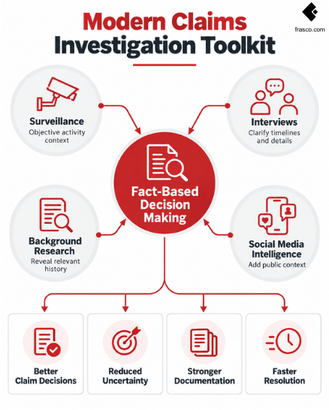
A strong claim investigation uses the right tools to gather objective information. Four of the most effective tools are surveillance, interviews, background research, and social media intelligence.
Surveillance in Claim Investigation
Surveillance Investigations can provide objective context when questions exist about activity level, functional ability, or the accuracy of reported limitations.
Its value is not in creating a “gotcha” moment. Its value is in documenting observed activity that either supports or challenges existing assumptions in the claim file.
When used appropriately, surveillance can help claims teams:
- Better understand functional capacity
- Compare reported limitations with observed activity
- Support further review when inconsistencies exist
- Strengthen documentation for file decisions
Surveillance is most useful when it adds objective context to an unclear claim.
Interviews in Claim Investigation
Interviews Investigations often reveal details that written reports leave out.
Claimants, employers, supervisors, witnesses, and other involved parties may each hold part of the story. When these perspectives are gathered early, claims professionals can better understand how the loss occurred and where additional questions remain.
Interviews can help clarify:
- Incident timelines
- Job duties at the time of loss
- Pre-existing workplace concerns
- Alternative explanations for injuries
- The existence of additional witnesses
- Inconsistencies between accounts
A well-timed interview can move a file forward much faster than waiting for uncertainty to resolve itself.
Background Research in Claim Investigation
Some claims involve factors that extend beyond the reported event itself.
Background research can uncover relevant context such as:
- Prior claims activity
- Litigation history
- Employment history
- Business ownership interests
- Address history
- Public-record information
These findings do not determine claim outcomes by themselves. However, they can help claims teams better understand complexity, exposure, and the broader context surrounding the file.
Background research helps claims professionals see what the initial report may not show.
Social Media in Claim Investigation
Publicly available social media content can provide valuable context in a claim investigation.
Photos, posts, videos, comments, and location check-ins may help validate or challenge reported timelines, activity levels, relationships, or patterns of behavior.
Social Media Investigations should be used thoughtfully and as part of a broader investigative strategy. It works best when paired with interviews, surveillance, or other research methods rather than being treated as a stand-alone conclusion.
When appropriate, social media intelligence can support:
- Timeline verification
- Activity review
- Relationship mapping
- Location context
- Additional leads for investigation
Liability Claim Example: Building a More Complete Evidence Record
Claim investigation is equally important in liability matters.
Consider a slip-and-fall claim at a retail location. Initial reports suggest that poor maintenance caused the incident. Before settlement discussions begin, investigators conduct witness interviews and review publicly available information.
As the file develops, additional evidence reveals weather conditions, pedestrian traffic patterns, and witness observations that provide a more complete understanding of how the incident occurred.
In some cases, that additional evidence may reduce exposure. In other cases, it may confirm legitimacy and support a defensible settlement.
Either outcome is valuable.
The goal of claim investigation is clarity, not simply cost reduction.
Building a Fact-First Claim Investigation Culture
Leading claims organizations understand that investigations are most effective when they begin early and are used strategically.
A proactive approach to claim investigation often includes:
- Early identification of investigative needs
- Timely witness outreach
- Preservation of evidence
- Documentation of public information
- Ongoing validation of claim facts
- Clear escalation when inconsistencies arise
This kind of fact-first approach helps claims teams reduce surprises as the file progresses.
It also supports:
- Better documentation
- More accurate reserving
- Faster claim resolution
- Stronger settlement decisions
- More defensible outcomes
When investigations are delayed, facts become harder to verify. Witness memory fades. Public information changes. Opportunities to preserve context may be lost.
The best time to investigate is before uncertainty becomes exposure.
What Early Investigation Can Help Prevent
A strong claim investigation does more than clarify a single issue. It can help prevent larger downstream problems such as:
- Extended claim duration
- Increased indemnity payments
- Reserve inaccuracies
- Weak documentation
- Delayed resolution
- Unnecessary escalation
- Higher litigation risk
- Poor payout decisions
That is why claim investigation should be viewed as a decision-support function, not just an added step in the process.
Frequently Asked Questions About Claim Investigation
Q1. What is claim investigation?
Claim investigation is the process of gathering and verifying facts related to a reported insurance claim. It helps claims professionals better understand what happened, evaluate exposure, assess credibility, and make more informed decisions before benefits or settlements are finalized.
Q2. Why is claim investigation important before payout?
Claim investigation helps identify missing facts, inconsistencies, or additional context before a payment decision is made. This reduces the risk of inaccurate reserving, unnecessary payouts, weak documentation, and later surprises.
Q3. What tools are commonly used in claim investigation?
Common claim investigation tools include surveillance, interviews, background research, and social media intelligence. Depending on the claim, these tools may be used individually or together.
Q4. How do insurance claims investigations improve decision-making?
Insurance claims investigations give claims teams more complete information before making decisions. That leads to better documentation, improved clarity, reduced uncertainty, and stronger claim outcomes.
Better Facts Lead to Better Claim Decisions
Most claims professionals are not looking for reasons to deny a claim. They are looking for enough reliable information to make the right decision.
The challenge is that important details often emerge late, after reserves have been established, settlement discussions have started, or benefits have already been paid.
That is why effective claim investigation matters.
By using surveillance, interviews, background research, and social media intelligence to uncover relevant facts early, claims teams can reduce uncertainty, improve file quality, and make more defensible decisions before payout.
Better facts lead to better claim decisions.
Contact Us Today
Frasco® Investigative Services delivers ethical and efficient solutions tailored to your needs. Have questions or want to discuss your investigative needs further? Contact one of our experienced experts today to find the answers you’re looking for.
Disclaimer: This blog post is for informational purposes only and should not be considered legal advice. Please consult your general counsel for specific legal guidance. Frasco investigators are licensed, and our operations comply with US industry, federal, state, and local laws.