

Mortgage fraud detection has become one of the most critical priorities for lenders, servicers, and risk professionals heading into mid-2026. Persistent market volatility, fluctuating interest rates, and growing pressure on loan qualification standards have created conditions where misrepresentation and fraud can quietly erode lender margins before anyone catches it. With secondary market purchasers and insurers tightening scrutiny, organizations face mounting pressure to detect issues before a loan ever reaches the point of sale.
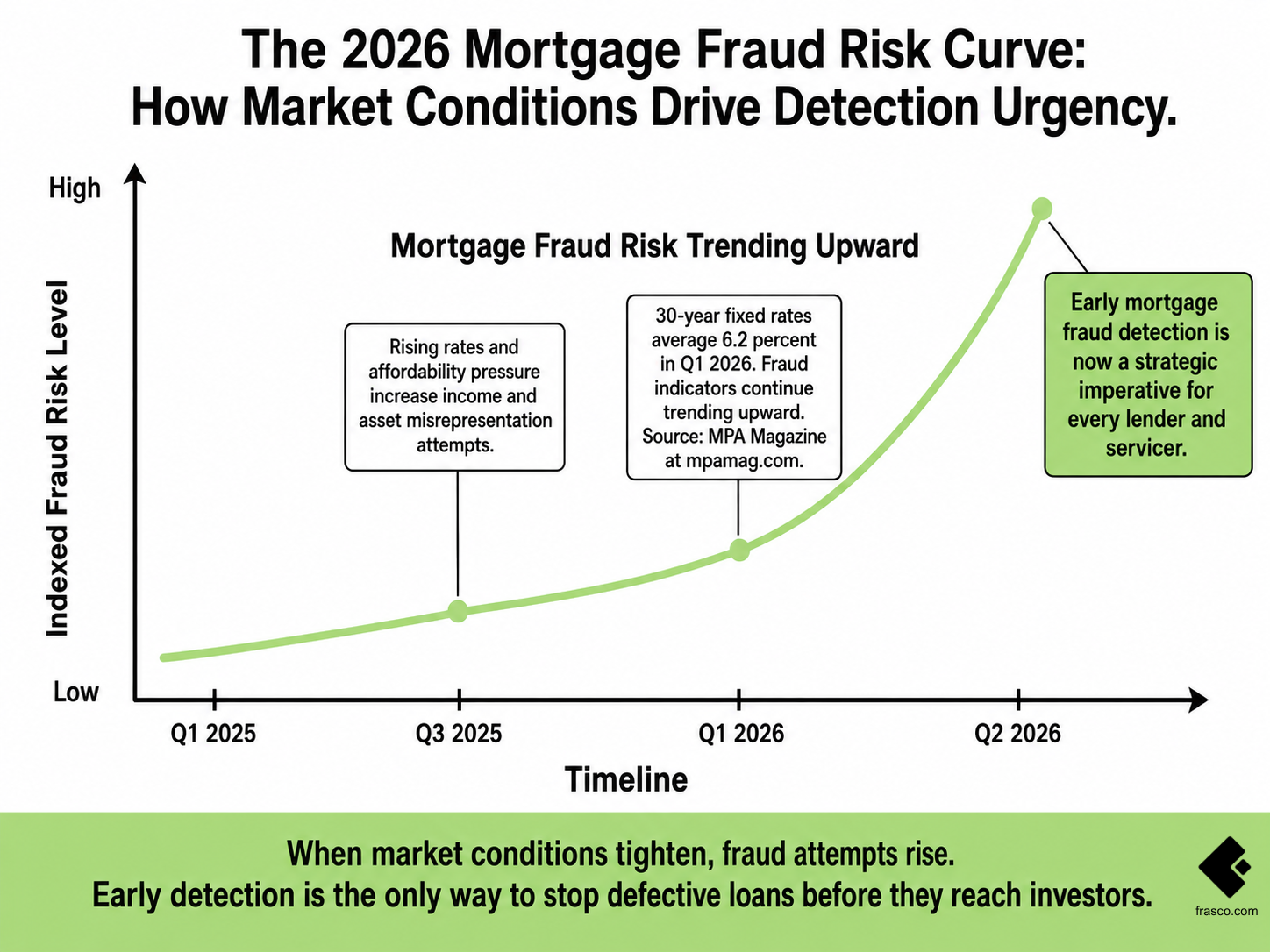
Industry data reinforces this urgency. Forecasts show the 30-year fixed mortgage rate averaging 6.2% in Q1 2026, with an expected decline to 5.9% by year-end. Rising rates in late 2025 and early 2026, combined with affordability challenges, have historically aligned with increased instances of fraud. Specifically, income, occupancy, and asset misrepresentation all trend upward when borrowers stretch to meet qualification thresholds. Reports from 2025 into 2026 confirm fraud risk moving higher as market pressures intensify. (Source: mpamag.com)
Against this backdrop, early-stage mortgage fraud detection is no longer optional. It is a strategic priority for every lender and servicer that aims to protect portfolio performance, maintain investor confidence, and meet evolving regulatory expectations.
Why Mortgage Fraud Detection Is More Urgent in 2026 Than Prior Years
Market conditions in 2026 differ significantly from the relative stability of just a few years ago. This shift makes proactive mortgage fraud detection more financially consequential than ever.
Economic indicators show a mixed environment marked by rate changes, low inventory, and cautious buyers. Mortgage brokers describe 2026 as cautiously optimistic but dependent on how rate trends develop. Meanwhile Freddie Mac data from February 2026 shows the weekly 30-year fixed rate at 6.11%. (Source: themortgagereports.com)
These conditions create conditions where misrepresentation grows. When borrowers must stretch to meet qualification thresholds the likelihood of falsified income statements, manipulated bank documents, and occupancy misrepresentation rises. Furthermore pressure on lenders to keep pipelines moving can reduce the depth of early reviews unless processes are specifically built with mortgage fraud detection in mind.
Common Misrepresentation Types That Require Early Detection in 2026
The following misrepresentation types intensify when homebuyers face affordability limits or when investor demand for mortgage-backed assets shifts. Both conditions exist in the early 2026 environment:
- Stated income inconsistencies where reported earnings do not match verifiable employment records or industry norms
- False employment or unverifiable employer relationships that cannot be confirmed through independent third-party sources
- Occupancy misrepresentation where borrowers claim primary residency on properties intended as rentals or investment assets
- Inflated asset documentation involving manipulated bank statements or unsupported large deposits
- Conflicting data between loan applications, credit files, and external verification sources
Each of these patterns represents a mortgage fraud detection opportunity that pre-funding review can catch before the loan reaches investors or insurers.
Pre-Funding Review as the First Line of Mortgage Fraud Detection
Pre-funding quality control is one of the most effective mortgage fraud detection strategies available to lenders today. Moving reviews earlier in the origination cycle allows teams to correct errors, re-underwrite questionable files, and uncover misrepresentation while the loan is still recoverable.
Five elements drive an effective pre-funding mortgage fraud detection review:
1. Identity and Employment Verification
Cross-check employer details using independent data sources, confirm employment tenure, and validate income consistency across all submitted documents. Specifically this step targets false employer relationships and income misrepresentation before they advance to underwriting approval.
2. Borrower Occupancy Assessment
Compare occupancy declarations with property location, commuting distance, utility projections, and behavioral indicators. Occupancy misrepresentation is one of the most common and financially damaging fraud types that mortgage fraud detection must address at the pre-funding stage.
3. Data Integrity Validation
Compare application inputs against credit bureau data, public records, and digital footprint resources. Inconsistencies between these sources are among the clearest early signals that a file contains misrepresentation requiring deeper mortgage fraud detection review.
4. Automated Document Analysis
Use tools that detect tampering, duplicated textures, and inconsistent metadata in income or asset documentation. In addition automated analysis flags formatting anomalies in pay stubs, W-2 files, and bank statements that manual review alone may miss.
5. Third-Party Fraud Tools and Investigative Expertise
Blend automated alerts with experienced analyst evaluation for a balanced mortgage fraud detection approach. Frasco Mortgage Risk Mitigation supports lenders in these early-stage checks with investigative due diligence and specialized verification designed to uncover red flags before loans are sold or insured.
A Mortgage Fraud Detection Checklist for Risk Managers and QC Teams
Use this checklist as a practical mortgage fraud detection framework across five verification categories before every loan advances to the secondary market.
Borrower Income and Employment
- Validate employer legitimacy through independent third-party sources before accepting stated income
- Cross-check stated income against industry norms for the borrower’s reported occupation and location
- Review pay stubs and W-2 files for formatting problems that signal document manipulation
- Compare employment timelines with credit report activity for consistency
Asset Verification
- Review bank statements for inconsistent sequencing, formatting gaps, or unusual deposit patterns
- Confirm large deposits with documented and verifiable sources before accepting asset totals
- Validate account ownership and cross-reference account details with application information
Occupancy and Property Use
- Assess commuting distance between the stated primary residence and the borrower’s verified employer
- Research prior addresses to identify patterns that suggest rental or investment property use
- Analyze utility projections and insurance quotes for occupancy signals that contradict the application
Identity and Document Integrity
- Inspect documents for digital changes, mismatched fonts, or formatting inconsistencies
- Use validated software to screen for photo editing or metadata manipulation in submitted files
- Confirm identification numbers with issuing agencies where available and applicable
Data Consistency
- Review application data against public records for address, employment, and marital status alignment
- Check for mismatched employment dates, address histories, or status details across the full file
- Compare loan file details with external datasets and verification tools to identify conflicts
How the Loan Lifecycle Risk Funnel Illustrates the Value of Early Mortgage Fraud Detection
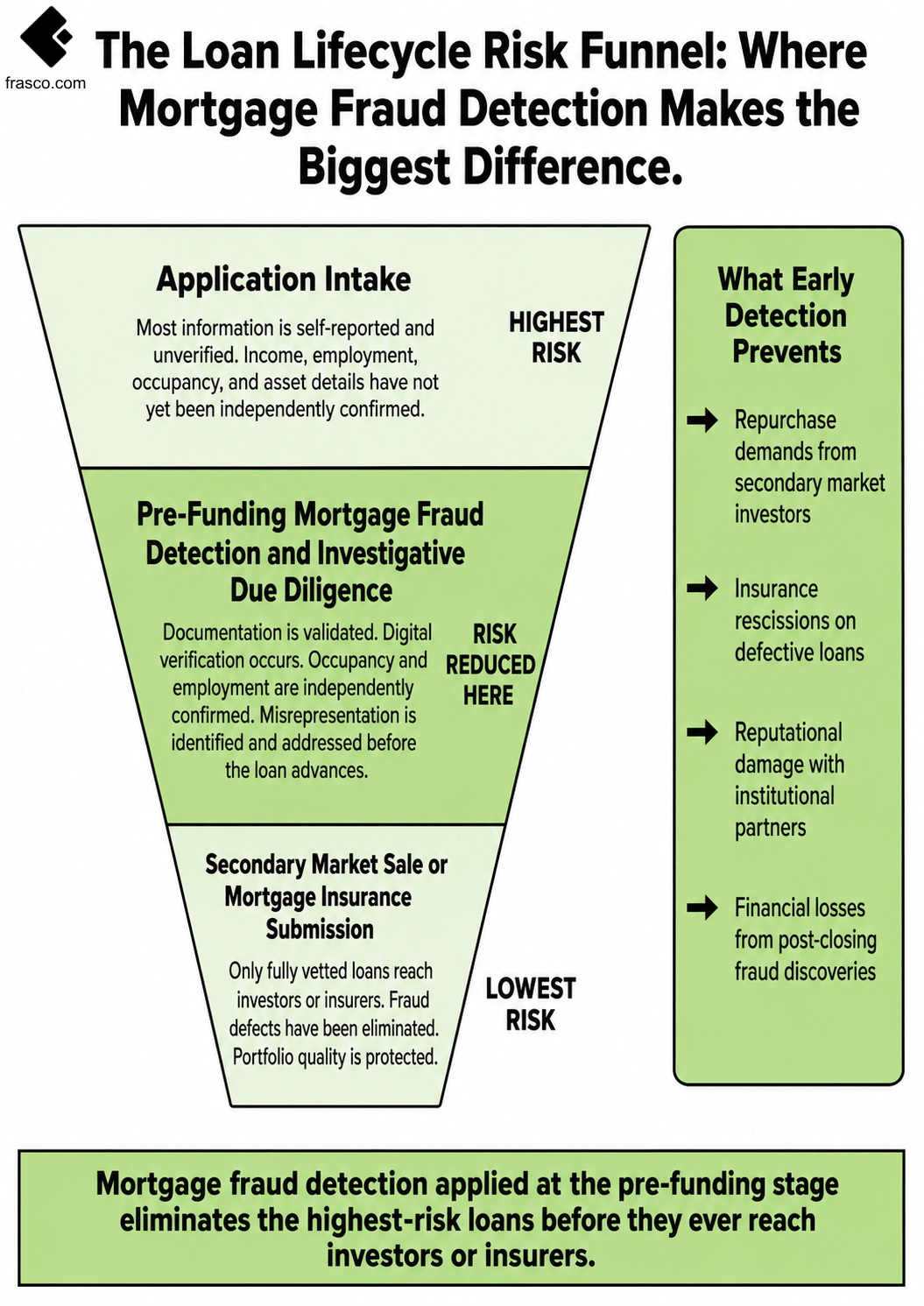
Mortgage fraud detection applied at the pre-funding stage eliminates the highest-risk loans before they ever reach investors or insurers. The loan lifecycle risk funnel makes this case visually clear.
At the top of the funnel, application intake represents the highest fraud risk moment in the entire loan lifecycle. Most information is self-reported and unverified. Income, employment, occupancy, and asset details have not yet been independently confirmed. Consequently this is where misrepresentation enters the file.
In the middle of the funnel, pre-funding mortgage fraud detection and investigative due diligence validate documentation, confirm identity and employment independently, assess occupancy legitimacy, and identify misrepresentation while the loan is still recoverable. This is where the most impactful mortgage fraud detection work happens.
At the bottom of the funnel, only fully vetted loans reach secondary market sale or mortgage insurance submission. Fraud defects have been eliminated. Portfolio quality is protected. Furthermore investor and insurer confidence is preserved because every loan that advances has passed a structured and defensible review process.
The Portfolio Impact of Strong Mortgage Fraud Detection
Early mortgage fraud detection significantly reduces downstream risk. When fraud surfaces after closing or after loan sale, lenders face financial losses, repurchase demands, and insurance rescissions that far exceed the cost of pre-funding prevention.
With 2026 shaping up as a year influenced by economic uncertainty, continued rate changes, and tight underwriting margins, the cost of missing fraud early grows higher. Investors are increasingly cautious as forecasts show shifting rate expectations and uneven housing demand. (Source: mpamag.com)
By building robust mortgage fraud detection into the earliest origination stages, lenders achieve five specific portfolio outcomes:
- Stronger asset quality across the loan portfolio as defective files are removed before they reach investors
- Reduced repurchase exposure by eliminating suspect loans before secondary market partners ever review them
- Stronger relationships with secondary market partners who see consistently clean and well-documented loan files
- Greater investor and insurer confidence built on a track record of thorough pre-funding mortgage fraud detection
- Long-term portfolio profitability protected by a disciplined and repeatable fraud prevention process
Make Mortgage Fraud Detection a Strategic Priority Before Mid-2026
Detecting misrepresentation before loans are sold or insured is one of the most important actions lenders can take in 2026. Economic conditions, regulatory scrutiny, and investor expectations all demand proactive, repeatable, and data-backed safeguards at the pre-funding stage.
By applying rigorous pre-funding quality control, leveraging investigative due diligence, and using structured mortgage fraud detection checklists, lenders can elevate portfolio performance and reduce fraud exposure before it becomes a costly downstream problem.
Frasco Mortgage Risk Mitigation provides verification, investigative reviews, and fraud-focused due diligence solutions that support these goals and adapt to the complex environment forecasted for the 2026 mortgage market.
Want to Learn More?
At Frasco, we believe knowledge is the foundation of stronger, smarter lending practices. That’s why we provide resources to help lenders deepen their understanding of risk mitigation and compliance.
📄 Download our white paper:
Unlocking Success: 3 Keys for Maximizing Occupancy Verification in Mortgage Lending
Stay Updated: Get real-time insights, the latest blogs, and updates on upcoming industry events.
👉 Follow Frasco on LinkedIn
Contact Us Today
Frasco® Mortgage Risk Mitigation delivers ethical and efficient solutions tailored to your needs. Have questions or want to discuss your investigative needs further? Schedule a call with one of our experts today to find the answers you’re looking for.
If you know a company that could benefit from our investigative services, Submit a Referral Here to help them make informed decisions and prevent costly risks.
Disclaimer: This blog post is for informational purposes only and should not be considered legal advice. Please consult your general counsel for specific legal guidance. Frasco investigators are licensed, and our operations comply with US industry, federal, state, and local laws.