

Early Payment Default in 2026: How Field-Based Mortgage Investigations Uncover Hidden Red Flags Before They Cost You
Early payment default remains one of the clearest and most costly indicators of origination risk in the mortgage industry. As lenders navigate the second quarter of 2026, they face a shifting landscape defined by rate adjustments, cautious borrower behavior, and growing pressure on loan quality.
However, analysts caution that the 2026 recovery will be steady rather than explosive. Buyers may regain some leverage, but overall market sentiment stays measured. Affordability gains will be gradual, and uncertain economic conditions could still affect lending risk. (Source: mpamag.com)
These conditions make strong risk mitigation strategies more important than ever, especially around early payment default. As secondary market investors increase scrutiny, lenders must ensure their due diligence is thorough, field-verified, and designed to reveal risks that digital or automated checks consistently miss.
Field-based mortgage investigations have emerged as an essential tool in this environment. They help lenders uncover hidden borrower and property red flags before those risks turn into costly buybacks or compliance issues.
Why Early Payment Default Is a Top Priority for Lenders in 2026
Early payment default typically occurs within the first 90 to 180 days of a loan. It often signals deeper origination problems that went undetected during the underwriting process.
Common triggers include overstated income, unstable employment, occupancy misrepresentation, and non-arm’s-length transactions. Because the first months after closing directly reflect borrower stability, early payment defaults send immediate risk signals to both investors and regulators.
In 2026, lenders are paying even closer attention to these warning signs for three specific reasons:
1. Increased Investor Scrutiny on Original Loan Quality
Investors are paying closer attention to original loan quality, especially when comparing performance across portfolios. Furthermore, any early payment defaults in a portfolio will draw immediate scrutiny during those reviews. (Source: mpamag.com)
2. A Resetting Market Brings New and Less Predictable Borrower Profiles
With 2026 shaping up as a reset year, lenders will work with a wider mix of borrower types, including those returning to the market after extended time away. Consequently, this creates greater variability in borrower behavior and verification needs that automated tools alone cannot adequately address.
(Source: mpamag.com)
3. Cautious Market Sentiment Demands Stronger Verification
Mortgage professionals describe buyer behavior as optimistic yet hesitant, with concerns that unexpected economic events could slow the recovery. Therefore, lenders face growing pressure to confirm borrower stability with more than digital documentation. (Source: mpamag.com)
Field investigations directly satisfy this need by producing verified, on-the-ground intelligence that strengthens every underwriting decision.
What Field Investigations Reveal That Digital Checks Miss in Early Payment Default Cases
Desktop verification tools remain valuable, but they cannot validate the critical borrower details that require physical observation, in-person interviews, or real-time property checks.
Field investigators who focus on mortgage risk mitigation provide confirmation of five high-value indicators that are invisible to automated systems:
1. Borrower Employment and Income Stability
- On-site interviews confirm actual job duties, work schedules, and employment continuity.
- This directly reduces misrepresentation risk, especially for commission-based or self-employed borrowers.
- In addition, field interviews often reveal employment instability that pay stubs alone do not reflect.
2. Occupancy Verification That Protects Against Early Payment Default
- Investigators confirm whether a borrower truly occupies a property by observing household activity, utility usage, and personal presence indicators.
- Occupancy misrepresentation is consistently one of the top drivers of early payment default across all loan types.
- Moreover, physical observation captures evidence that no database search can replicate.
3. Property Condition and Maintenance Signals
- Physical inspections uncover neglected maintenance, hidden hazard conditions, and unauthorized tenants.
- They also reveal visible signs of financial stress that often appear on the property before they appear in payment records.
4. Neighborhood Risk Factors That Affect Loan Performance
- Local economic shifts, property turnover rates, and environmental conditions often go undetected by automated tools.
- Field teams capture these real-world indicators and add context to borrower risk assessments that desk-based analysis cannot provide.
5. Borrower Behavioral Cues Visible Only In Person
- Face-to-face interactions reveal financial stress signals not found on any application, including inconsistent stories, unstable schedules, and visible signs of hardship.
- These behavioral observations often serve as the earliest indicators of future early payment default risk.
Together these five areas of field intelligence reduce early payment default risk by exposing discrepancies early, before they develop into costly repurchase events or investor disputes.
![Early Payment Default Red Flags — What Field Investigations Uncover]<br />
Alt Text: "A checklist infographic showing the key early payment default red flags that field-based mortgage investigations uncover, including borrower employment issues, occupancy misrepresentation, property neglect, and neighborhood economic decline indicators.](https://frasco.com/wp-content/uploads/2026/03/FMRM-202604-Blog-Post-Infographic-1.png "FMRM - 202604 - Blog Post Infographic 1")
Why Field Verification Is Essential in a Resetting Mortgage Market
Analysts predict 2026 will be defined by steady affordability improvements rather than rapid price changes. However, this gradual recovery comes with its own early payment default risks.
Housing economists warn that the overall mortgage environment remains sensitive to economic shifts. Several major events could still affect market stability, making 2026 more unpredictable than the year before.
This unpredictability places a higher value on thorough verification. Lenders must confirm that borrowers entering or returning to the market have reliable employment, stable income, and genuine occupancy intentions. Desktop verification simply cannot capture the context-level evidence needed to make those assessments with confidence.
Field-based mortgage investigations bridge the gap between borrower-stated information and real-world borrower circumstances. Specifically they strengthen:
- Loan quality assurance before and after closing
- Repurchase defense documentation that holds up under investor review
- Early payment default detection and deterrence at the origination stage
- Servicing risk predictions based on verified field data
- Regulatory compliance alignment with current investor and agency guidelines
In an environment where investor scrutiny is intensifying, field investigations serve as a preventive control that improves both origination quality and servicing outcomes across the full loan lifecycle.
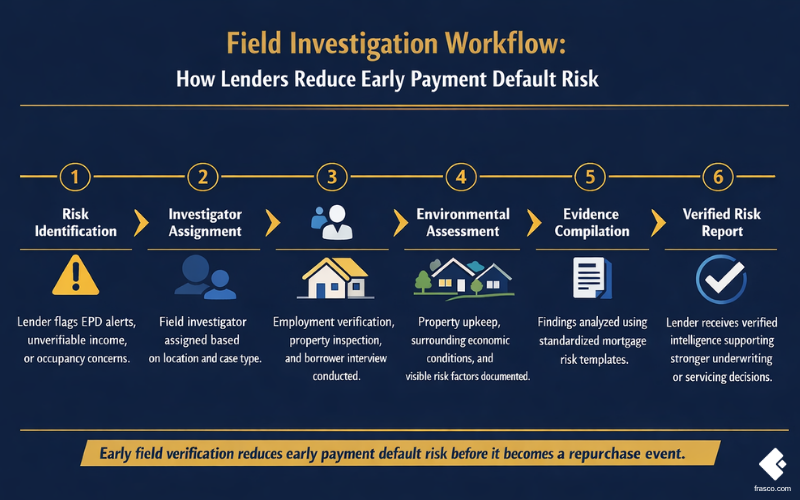
A Practical Guide for Lenders: Implementing Field Investigations to Reduce Early Payment Default in 2026
Step 1 — Identify Loans With Elevated Early Payment Default Probability
Start by flagging loans that show common early payment default triggers before they reach closing:
- First payment late or missed within the first 30 days
- Employment information that cannot be independently verified
- Credit score profiles with known correlations to higher early payment default rates
- Properties located in high-turnover neighborhoods or areas showing economic stress
Step 2 — Deploy Field Investigators Within the First 30 Days of Concern
Rapid deployment preserves the clarity of borrower conditions before circumstances change. Consequently, the sooner a field investigation begins, the more accurate and defensible the resulting evidence will be. Delays in investigation allow borrower situations and property conditions to shift, which reduces the value of the findings.
Step 3 — Standardize Investigation Reports for Consistent Decision-Making
Consistent report templates support defensible documentation during investor reviews and regulatory audits. Furthermore, standardized findings make it easier to identify patterns across a loan portfolio that may signal broader early payment default risk at the program or product level.
Step 4 — Integrate Field Findings Into Underwriting and Servicing Policies
Use field-verified data to refine three key areas:
- Income validation policies and the thresholds that trigger additional review
- Occupancy documentation standards and the conditions that require field confirmation
- Servicing outreach timelines when early payment default indicators appear in the portfolio
Step 5 — Track Early Payment Default Reduction Metrics Every Quarter
Lenders who adopt structured field verification consistently see a measurable reduction in early payment default rates over time. In addition, tracking these metrics quarterly builds an internal evidence base that demonstrates the return on investment of field-based mortgage investigations to leadership, investors, and auditors.
Start Reducing Early Payment Default Risk Before the 2026 Market Peaks
As lenders navigate the 2026 mortgage market, the combination of cautious optimism, moderate rate improvements, and unpredictable economic conditions reinforces one clear conclusion: strong risk mitigation is not optional.
Early payment default remains a costly and reputation-sensitive challenge across all loan types and borrower profiles. Field-based mortgage investigations give lenders the verified borrower and property intelligence they need to uncover hidden red flags that digital processes cannot detect. As a result, lenders who invest in field verification now will strengthen their decision-making, protect their portfolios, and meet investor expectations for transparency and loan quality throughout 2026.
Want to Learn More?
At Frasco, we believe knowledge is the foundation of stronger, smarter lending practices. That’s why we provide resources to help lenders deepen their understanding of risk mitigation and compliance.
📄 Download our white paper:
Unlocking Success: 3 Keys for Maximizing Occupancy Verification in Mortgage Lending
Stay Updated: Get real-time insights, the latest blogs, and updates on upcoming industry events.
👉 Follow Frasco on LinkedIn
Contact Us Today
Frasco® Mortgage Risk Mitigation delivers ethical and efficient solutions tailored to your needs. Have questions or want to discuss your investigative needs further? Schedule a call with one of our experts today to find the answers you’re looking for.
If you know a company that could benefit from our investigative services, Submit a Referral Here to help them make informed decisions and prevent costly risks.
Disclaimer: This blog post is for informational purposes only and should not be considered legal advice. Please consult your general counsel for specific legal guidance. Frasco investigators are licensed, and our operations comply with US industry, federal, state, and local laws.