
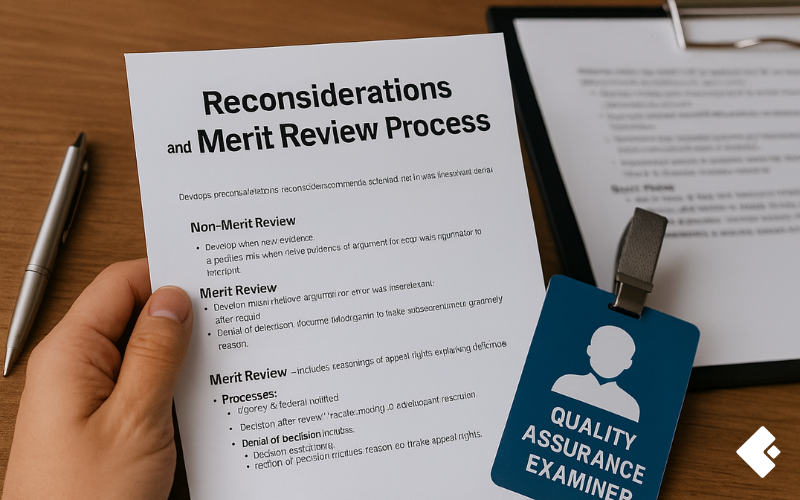
As an agency Workers’ Compensation Specialist (WCS), you receive a decision denying a claimant’s workers’ compensation claim and may assume the case is closed. However, each decision includes information about appeal rights, including the claimant’s option to request reconsideration.
To file a timely reconsideration request, the claimant must submit it within one year from the decision date. This one-year window begins the day after the contested decision. Additionally, if the final day falls on a weekend or holiday, the next business day becomes the last acceptable date. The “received date” in iFECS determines timeliness. If the system shows a received date beyond one year, OWCP will consider the request untimely.
Types of Reconsiderations: Non-Merit Reviews vs. Merit Reviews
Non-Merit Reviews
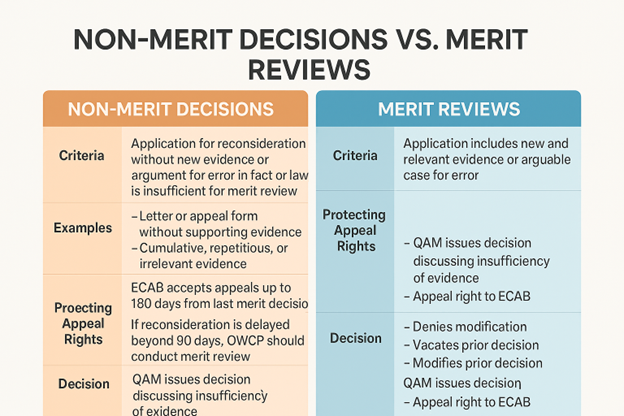
A non-merit review applies when the claimant submits a timely reconsideration request without new evidence or without a valid argument showing factual or legal error.
Examples include:
-
Submitting only a letter or form identifying the decision.
-
Providing evidence that is repetitive or irrelevant.
-
Regulation: 20 CFR 10.608(b).
Appeal Rights Considerations
-
ECAB accepts appeals for up to 180 days from the last merit decision.
-
If a reconsideration sits with OWCP for more than 90 days, the claimant may unintentionally lose ECAB rights.
Decision Requirements
-
The QAM must explain what evidence was submitted and why it does not warrant a merit review.
-
The QAM must avoid wording that implies a merit evaluation occurred.
-
If no evidence is submitted, a letter decision is sufficient.
-
If evidence is included, OWCP must issue a Notice of Decision with an explanation.
Important Timing Factor
If a claimant waits nearly a full year to request reconsideration and ultimately receives a non-merit decision, the original merit decision may now be more than a year old. Consequently, the claimant may lose all remaining appeal rights.
Merit Reviews
A reconsideration request triggers merit reviews when the claimant submits new, relevant evidence or identifies a reasonable argument for error.
How Merit Reviews Function
-
OWCP notifies the employing agency only when administrative—not medical—issues are involved, such as:
- Timeliness of the initial claim
- Federal employee status
- Fact of injury (factual elements)
- Performance of duty
-
For medical issues, OWCP typically does not notify the agency.
-
The QAM develops evidence independently and maintains jurisdiction through the entire merit review process.
Possible Outcomes of a Merit Review
- Deny modification with a detailed rationale.
- Vacate the prior decision and accept the claim or condition.
- Modify the prior decision while clearly explaining the changes
Here’s a clear comparison chart for Merit vs Non-Merit Decisions:
Why Merit Reviews Affect Long-Term Case Management
The main takeaway for Workers’ Compensation Specialists professionals is that even denied claims require monitoring throughout the claimant’s appeal window. Merit reviews reset the one-year clock for filing future reconsiderations. Therefore, as long as new merit decisions continue, administrative finality does not apply.
This ongoing cycle underscores the importance of tracking each decision carefully to maintain awareness of potential reopenings.
Want to Learn more?
Explore how leading government agencies and risk managers are using our investigative services to strengthen oversight of legacy claims.
📄 Download our white paper: FECA Claims Investigations by the Numbers
Stay Updated: Get our latest posts, FECA Trends, and upcoming trainings—right in your feed
👉 Follow Frasco on LinkedIn
Contact Us Today
Frasco® Government Services delivers ethical and efficient solutions tailored to your needs. Have questions or want to discuss your investigative needs further?
Schedule a call with Craig DeMello, a nationally recognized expert in Federal Workers’ Compensation. With over 30 years of experience in public service, Craig provides practical insight and proven expertise to help clients navigate complex federal claims. As a Government Services Specialist at Frasco, he is dedicated to delivering clear answers and effective strategies to support your agency’s goals.
Disclaimer: This blog post is for informational purposes only and should not be considered legal advice. Please consult your general counsel for specific legal guidance. Frasco investigators are licensed, and our operations comply with US industry, federal, state, and local laws.