

How to Reduce Liability Exposure This Spring With Expert Insurance Claims Investigations
Liability exposure rises every spring, and claims teams that prepare early are the ones that manage it best.
Spring is a transition period for the insurance industry. Warmer weather brings more outdoor activity, seasonal hiring, and an increase in physical work across construction, hospitality, agriculture, recreation, and retail. With that shift comes a clear rise in certain claim types and a direct increase in liability exposure for carriers, TPAs, and self-insured employers.
The scale of the challenge is significant:
- The Insurance Information Institute estimates insurance fraud across property casualty lines costs over $40 billion annually in the United States, excluding health insurance.
- The National Insurance Crime Bureau reports persistent patterns in questionable claims, noting that fraud increases when overall claim volume rises or when incidents become harder to verify.
During spring, these forces combine with real operational pressures. Claims teams must balance speed with accuracy under regulatory expectations for fairness and thoroughness. In that context, expert investigations are not a luxury. They are a practical way to reduce liability exposure by delivering objective information that supports defensible decisions.
This post explores seasonal trends, common pressures on claims teams, and how a structured investigative approach helps organizations move faster while maintaining accuracy and compliance.
Seasonal Trends That Drive Liability Exposure Higher in Spring
Several recurring patterns make spring the highest-risk period of the year for liability exposure and workers compensation claims.
1. More Outdoor and Physical Activity Means More Claims
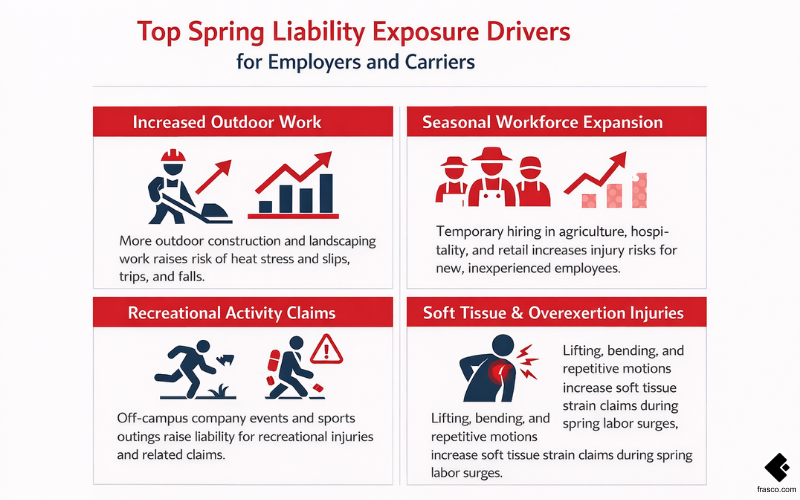
As weather improves, more people return to outdoor work and recreational activities. This directly drives increases in:
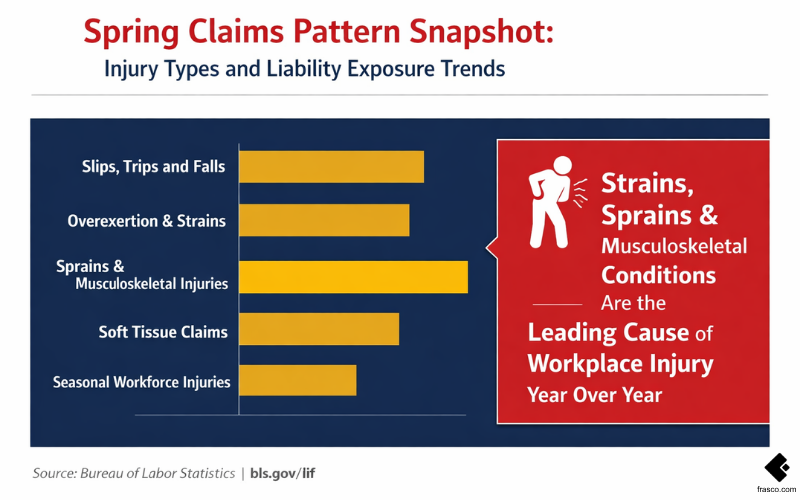
- Slips, trips, and falls both on and off the job
- Overexertion claims across construction, agriculture, and hospitality
- Strains, sprains, and musculoskeletal injuries that are hard to assess from paperwork alone
- Soft tissue claims where pain is unclear or activity levels are difficult to confirm
Year after year, the Bureau of Labor Statistics confirms that strains, sprains, and musculoskeletal conditions remain the leading cause of workplace injury.
2. Seasonal Workforce Growth Adds Complexity to Liability Assessment
Industries such as agriculture, hospitality, tourism, and retail expand their teams every spring. This creates direct liability exposure challenges:
- New or short-term workers often have less training and shorter job experience
- OSHA Young Workers and New Workers confirms newer workers face higher injury risks as they learn job tasks and safety procedures
- More frequent onboarding and varying experience levels make incident reconstruction harder
- Shifting schedules complicate liability assessment across multi-party incidents
3. Claim Types and Patterns Shift With the Season
When seasonal patterns shift, past assumptions about exposure and claim behavior may not apply.
- Property casualty carriers and self-insured employers regularly see their mix of general liability, auto, and workers compensation claims change each spring
- NCCI Workers Compensation Insights analysis confirms that certain business classes and injury types follow clear seasonal patterns
- Early fact development becomes more important when historical assumptions no longer apply directly
4. Pressure for Faster Claim Resolution Intensifies
Rising claim volume means adjusters carry heavier workloads at exactly the moment when accuracy matters most.
- Regulatory frameworks including state unfair claims settlement practices and prompt payment requirements push for timely responses
- Inadequate documentation or rushed decisions create direct compliance risk
- Reliable information early in the life of every claim reduces this pressure significantly
(Source: National Association of Insurance Commissioners)
Why Expert Investigations Are Essential for Managing Liability Exposure in Spring
Investigations are not only for suspicious claims. They are a decision support tool that helps claims professionals understand what actually happened, what the claimant can realistically do, and where liability actually sits.
Three areas stand out specifically in the spring environment:
1. Liability Clarity Reduces Unnecessary Exposure
With more activity and more complex incidents, witness accounts often conflict. Scene conditions change quickly outdoors. Expert investigations address this through:
- Interviews and recorded statements from witnesses and involved parties
- Scene documentation before conditions change
- Contemporaneous fact gathering that reconstructs events accurately
- Objective evidence that supports defensible settlements and reduces unnecessary liability exposure
2. Injury and Activity Verification Supports Accurate Claim Decisions
Soft tissue injuries, overexertion, and falls are common in spring. These claims can be legitimate yet still unclear in terms of recovery timeline and work restrictions.
The Bureau of Labor Statistics consistently shows that cases involving days away from work are dominated by sprains, strains, and tears all of which lead to longer claim durations if not verified early.
Structured verification supports accurate decisions through:
-
Activity checks that confirm real functional capabilities
-
Background research relevant to the claim
-
Properly executed surveillance that aligns benefits and restrictions with actual conditions
- Return to work planning grounded in verified facts rather than estimates
3. Early Intervention Lowers Liability Exposure and Claim Costs
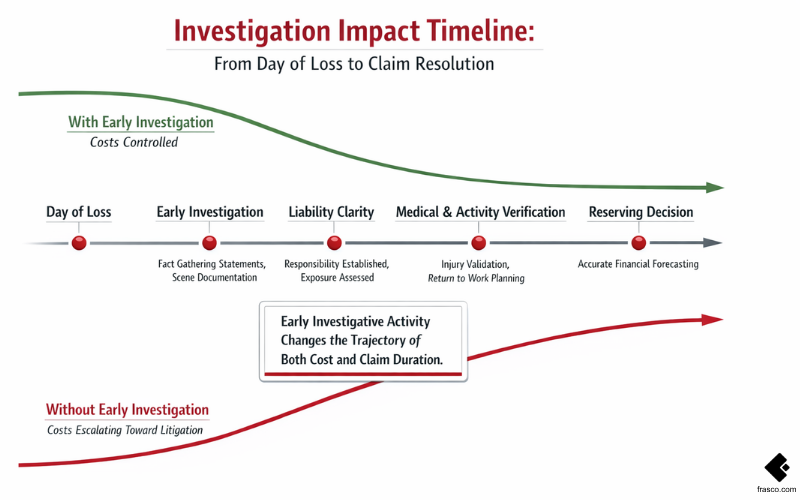
Claims handled with meaningful early intervention consistently produce better outcomes in both cost and duration.
When investigations deliver timely insight, organizations can:
-
Set reserves more accurately based on verified facts
-
Start the right medical management earlier in the claim
-
Make informed settlement decisions before costs escalate
-
Reduce the chance of escalation, litigation, and regulatory review
For example, see general workers compensation analytics from NCCI.
Common Pain Points for Claims Teams in Spring
Claims leaders and front-line professionals face the same challenges every spring. Recognizing them early makes them easier to manage.
- Rising claim volume: Spring strains adjuster capacity and delays information gathering at exactly the moment when speed matters most.
- Conflicting or incomplete information: Witness accounts differ, injury details change, and documentation is inconsistent without additional objective input.
- Regulatory expectations: State regulators expect reasonable investigation and timely communication, and rushed decisions create direct compliance risk.
(Source: NAIC Model Regulations and State Guidance) - Fraud indicators: Red flags from claim analytics, SIU triage, or adjuster judgment need careful evaluation, as the cost of ignoring or mislabeling them is significant.
- Reputational and relationship risk: Poorly supported decisions damage trust with employers, policyholders, and claimants alike.
Structured investigative resources address each of these pain points by delivering clear, well-documented information that supports objective decision making.
What Motivates Claims Leaders in This Environment
Behind metrics and regulations, claims leaders focus on a consistent set of core goals when managing liability exposure during high-volume periods.
- Accuracy over assumption: Decisions should reflect the best available facts, not incomplete narratives or guesswork.
- Speed without sacrificing quality: Claims leaders are accountable for both resolution cycle times and financial leakage.
- Scalability during seasonal peaks: Investigative resources need to flex up or down quickly as claim volume changes.
- Transparency for all stakeholders: Leadership, actuaries, employers, and reinsurers expect a clear record of how decisions were made.
- Compliance and defensibility: Every claim file should hold up to internal audit, external review, and legal scrutiny.
When investigations are structured, well-documented, and aligned with these goals, they become a strategic tool for managing liability exposure rather than a reactive response.
How Expert Investigations Reduce Liability Exposure at Every Stage of the Claim
A consistent investigative approach delivers better results at each stage of the claim life cycle.
1. Timely Fact Development Narrows Disputes Early
- Early gathering of statements, background information, and activity details builds a reliable narrative from the start.
- This process narrows disputes before they escalate.
- Critical information is documented before it can be lost or changed.
2. Better Reserving Accuracy Improves Financial Planning
-
When facts are clearer earlier, reserving decisions rest on verified information rather than estimates.
-
This supports more accurate financial planning and capital management.
-
Especially valuable for carriers and large self-insured employers managing significant claim portfolios.
3. Cost Containment and Fraud Deterrence Protect the Bottom Line
-
Clear, well-documented investigations identify misrepresentation or exaggeration early.
-
Structured investigations limit overpayment and deter future fraud.
-
According to the Coalition Against Insurance Fraud, fraud is a significant cost driver across multiple lines of business.
4. Stronger Defense Support in Litigated Claims
-
A thorough investigative file gives legal counsel access to objective facts and clear timelines.
-
Well-documented evidence supports a stronger defense position when litigation cannot be avoided.
-
Early investigation reduces the volume of claims that escalate to litigation in the first place.
5. Protection From Regulatory and Reputational Risk
- Consistent, objective investigative practices demonstrate responsible claim handling.
- A genuine effort to determine the truth supports positive regulatory relationships.
- This approach protects brand reputation with policyholders, employers, and claimants alike.
How Frasco Investigative Services Helps Claims Teams Reduce Liability Exposure
Frasco Investigative Services focuses specifically on insurance claims investigations across workers compensation, liability, auto, property, and related lines. As a family-owned, technology-forward provider, Frasco tailors its services to the needs of carriers, TPAs, and self-insured employers at an enterprise level.
Key strengths that directly support spring liability exposure management:
-
Experience with complex claims and SIU coordination across multiple lines of insurance.
-
Timely, clear reporting that supports faster and more defensible claim decisions.
-
Technology that gives claims teams direct visibility and secure access to investigative findings.
-
A flexible partnership approach that adapts to seasonal volume changes and organizational needs.
For claims leaders who want to reduce liability exposure while maintaining fairness and full regulatory compliance, a structured investigative partner delivers meaningful support both during spring and throughout the year.
Start Reducing Liability Exposure Before Spring Claim Volume Peaks
Spring brings a consistent combination of higher activity, shifting claim types, seasonal workforces, and stronger expectations for timely and accurate claim handling.
The bottom line is clear:
-
Expert investigations move claims teams from uncertainty to clarity.
-
Gathering objective facts early verifies injury and activity before narratives shift.
-
Well-documented findings reduce liability exposure and produce better outcomes for insurers, employers, and injured parties.
-
Reviewing investigative strategy now and working with a specialized partner is the most practical next step before peak season arrives.
Industry data from the Insurance Information Institute, the National Insurance Crime Bureau, the Bureau of Labor Statistics, and NCCI all point to the same conclusion: understanding changing patterns of risk and cost is essential for managing liability exposure effectively this spring.
Contact Us Today
Frasco® Investigative Services delivers ethical and efficient solutions tailored to your needs. Have questions or want to discuss your investigative needs further? Contact one of our experienced experts today to find the answers you’re looking for.
Disclaimer: This blog post is for informational purposes only and should not be considered legal advice. Please consult your general counsel for specific legal guidance. Frasco investigators are licensed, and our operations comply with US industry, federal, state, and local laws.