

Manufacturing workers compensation claims increase every spring, and organizations that prepare early are the ones that manage them best. Spring is a transition period for warehouse and manufacturing operations. Production ramps up, staffing levels shift, and facilities move from winter-constrained operations into higher-activity cycles. This combination consistently increases exposure to workplace incidents when risk controls and incident response processes are not reviewed before volume peaks.
According to the Bureau of Labor Statistics, transportation, warehousing, and manufacturing remain among the highest-risk sectors for workplace injuries. Warehousing alone reports injury rates significantly above the national private industry average. For enterprise operators, spring is not just a safety checkpoint. It is a strategic window to reduce manufacturing workers compensation claim exposure before activity increases. (Source: democrats.edworkforcehouse.gov)
This guide outlines what decision-makers should inspect, investigate, and improve this spring to reduce incidents and control downstream claim costs across warehouse and manufacturing operations.
(Source: US Bureau of Labor Statistics)
Why Spring Is the Highest-Risk Period for Manufacturing Workers Compensation Claims
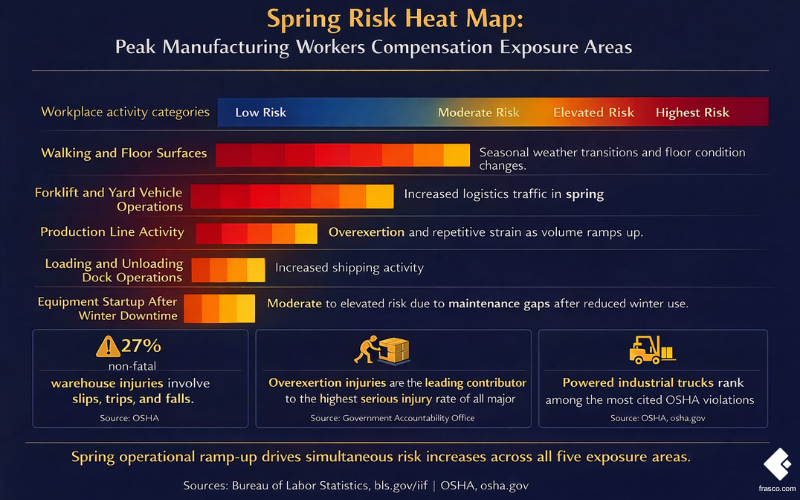
Spring consistently produces the highest concentration of workplace incidents in warehouse and manufacturing environments. Understanding why helps organizations act before claims accumulate.
Several seasonal factors combine to create elevated manufacturing workers compensation exposure every spring:
- Production volume increases after winter slowdowns, placing greater physical demand on workers and equipment simultaneously.
- Seasonal hiring and onboarding brings new workers onto active floors who may have less training and shorter job experience.
- Higher equipment utilization after months of reduced activity increases the chance of mechanical issues and operator incidents.
- Facility transitions from winter to spring operating conditions introduce floor hazards, ground instability, and changing environmental risks.
OSHA data confirms that powered industrial trucks, machine guarding, and slips and falls continue to rank among the most frequently cited safety violations across general industry, including manufacturing and warehousing.
Consequently, organizations that do not review their risk controls before spring activity peaks face a predictable and preventable rise in manufacturing workers compensation costs. (Source: osha.gov)
The Most Common Spring Injury Categories in Warehouse and Manufacturing Operations
Across warehouse and manufacturing environments, the highest-frequency spring-related risks include:
1. Slips, trips, and falls
Changing weather conditions and floor transitions create hazard exposure that peaks as outdoor and indoor activity increases simultaneously.
2. Forklift and yard incidents
As logistics traffic increases with production ramp-up, forklift paths become busier and collision risk rises.
3. Overexertion and repetitive strain injuries
Production volume increases place greater physical demand on workers, driving a seasonal spike in musculoskeletal claims.
The Government Accountability Office reports that warehousing and delivery had the highest serious injury and illness rate of all major sectors, with overexertion injuries as a leading contributor. Furthermore, these injury types are among the most expensive in manufacturing workers compensation programs because they often involve extended recovery times and disputed activity levels.
(Source: democrats.edworkforcehouse.gov)
Why Early Investigation Is Critical for Manufacturing Workers Compensation Outcomes
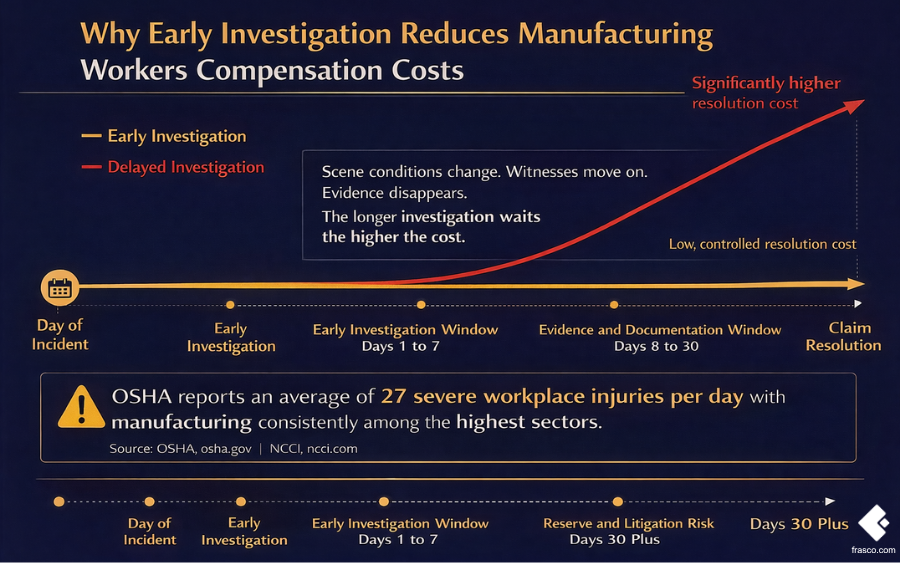
Delayed investigations increase uncertainty, raise reserve costs, and reduce the defensibility of claim decisions. Acting early changes the outcome.
When a manufacturing workers compensation incident occurs, the investigation window is narrow. Scene conditions change quickly on active production floors. Witnesses move between shifts. Equipment is returned to service. Documentation gaps expand with every day that passes without a structured response. (Source: osha.gov)
OSHA severe injury reporting data shows an average of 27 severe injuries reported per day across U.S. workplaces, with manufacturing consistently ranking among the highest sectors for hospitalizations and amputations. In that environment, early fact development is not optional. It is the foundation of every defensible claim decision.
Which Manufacturing Workers Compensation Claims Benefit Most From Early Investigation
Not every claim requires the same level of investigation. However the following claim types consistently produce better outcomes when investigation begins immediately:
1. Workers compensation injuries with unclear mechanisms:
When the cause of injury is disputed or unclear, early scene documentation and witness interviews establish the facts before they become contested.
2. Premises liability incidents involving third parties:
Multi-party incidents in warehouse and manufacturing environments require rapid evidence capture before responsibility becomes ambiguous.
3. Auto and yard claims involving forklifts or company vehicles:
Equipment incidents need timely documentation of operator logs, maintenance records, and site conditions.
4. Long-term disability claims where restrictions are disputed:
Early activity verification and background research support accurate reserve setting and return-to-work planning.
Early investigation helps organizations establish defensible facts before manufacturing workers compensation reserves escalate or litigation becomes likely. Moreover, claims addressed with meaningful early intervention consistently produce better outcomes in both cost and duration.
How to Turn Incident Data Into Fewer Manufacturing Workers Compensation Claims
The most effective manufacturing workers compensation programs use incident data not just to resolve claims but to prevent the next one.
The CDC National Institute for Occupational Safety and Health confirms that workers compensation and injury data are most effective when organizations use them to identify patterns and prevent repeat incidents rather than simply respond after the fact. (Source: cdc.gov)
When investigations consistently capture the following elements, organizations gain the insight needed to drive operational improvements alongside claim resolution:
- Environmental conditions at the time of the incident including floor surfaces, lighting, and equipment placement
- Equipment condition and maintenance status relevant to the incident
- Job task alignment between the worker’s assigned duties and the activity being performed
- Compliance with established safety procedures at the time of the incident
Why Spring Is the Right Time to Act on Incident Data
OSHA requires many employers to post Form 300A injury summaries between February and April, making spring a natural review period for incident trends and corrective action planning.
This requirement creates a direct alignment between compliance activity and proactive risk reduction. Organizations that use this period to analyze their manufacturing workers compensation incident patterns are positioned to implement corrective actions before peak spring activity begins rather than after the next preventable incident occurs. (Source: hipaajournal.com)
As a result, the organizations that reduce manufacturing workers compensation costs most consistently are the ones that treat the Form 300A review period as a strategic planning window rather than a compliance checkbox.
The Enterprise Case for Tailored Manufacturing Workers Compensation Investigations
Large warehouse and manufacturing organizations do not benefit from one-size-fits-all investigation approaches. The scale and complexity of enterprise operations demand something more structured.
Enterprise warehouse and manufacturing operators run across varied facility layouts, equipment profiles, and staffing models. An investigation approach designed for a single-location operation will not scale effectively across 20, 50, or 100 facilities with different risk profiles and claims patterns.
A tailored manufacturing workers compensation investigation model supports three enterprise priorities:
- Consistent documentation across facilities: Standardized investigation protocols ensure that claims data is captured uniformly regardless of location, making portfolio-level analysis accurate and actionable.
- Faster triage of high-exposure claims: A structured approach identifies which claims require immediate investigative resources and which can be managed through standard processes, improving resource allocation across large claim volumes.
- Scalable reporting for executive review: Technology-enabled reporting gives risk and claims leadership visibility into incident trends, reserve accuracy, and investigation outcomes across the entire enterprise portfolio.
What to Look for in an Investigation Partner
For enterprise organizations with 30 to 90-day decision cycles, the right investigative partner must deliver:
- Objective, defensible documentation that holds up under investor review, regulatory audit, and litigation scrutiny
- Technology-enabled reporting and surveillance capabilities that provide real-time visibility into claim status and findings
- Industry-specific investigative experience in warehouse and manufacturing environments where equipment incidents, floor hazards, and multi-party liability are common
- Flexibility to align with internal risk and claims workflows without disrupting existing processes
Looking for an investigative partner that understands the complexity of warehouse and manufacturing workers compensation claims? Our team delivers objective, technology-enabled investigations tailored to enterprise operations across the full spectrum of claim types.
Warehouse and Manufacturing Claims Investigation Services
Your Spring Readiness Checklist
Use this checklist to confirm your organization enters peak spring activity with strong investigation processes and risk controls in place across every facility.
Inspect:
- Review high-traffic zones and forklift paths for seasonal hazard exposure before production ramps up
- Assess floor conditions and housekeeping standards across all facilities after winter operations
- Evaluate equipment use patterns and maintenance status after winter downtime periods
Investigate:
- Assign immediate investigation resources to any incident with an unclear or disputed mechanism
- Flag and prioritize injuries inconsistent with the reported activity for early verification
- Review any claims showing early reserve escalation for structured investigative support
Improve:
- Review Form 300A incident trend data at the executive level and identify patterns requiring corrective action
- Standardize investigation protocols across all locations to ensure consistent documentation and defensible outcomes
- Establish feedback loops between claims teams and safety teams so investigation findings drive prevention as well as resolution
Reduce Manufacturing Workers Compensation Claims Before Spring Activity Peaks
Manufacturing workers compensation claims do not have to increase every spring. Organizations that align inspection, investigation, and improvement efforts before risk compounds are the ones that see measurable reductions in incident frequency and claim costs over time.
Spring presents a narrow strategic window where operational changes, compliance cycles, and injury trends intersect. Organizations that act during this period position themselves for fewer incidents, stronger claim outcomes, and more defensible decisions throughout the year.
Contact Us Today
Frasco® Investigative Services delivers ethical and efficient solutions tailored to your needs. Have questions or want to discuss your investigative needs further? Contact one of our experienced experts today to find the answers you’re looking for.
Disclaimer: This blog post is for informational purposes only and should not be considered legal advice. Please consult your general counsel for specific legal guidance. Frasco investigators are licensed, and our operations comply with US industry, federal, state, and local laws.