

Employee Relations Investigation: How HR Should Respond When Workplace Concerns Escalate
An employee relations investigation can become necessary when performance reviews, promotion decisions, corrective action, or terminations lead to allegations of unfair treatment, retaliation, harassment, or other misconduct. A clear workplace investigation process helps HR respond quickly, gather facts objectively, and protect employee trust when workplace concerns escalate.
When that happens, HR teams need more than good intentions. They need a fair and consistent way to determine what occurred and what action, if any, is appropriate.
As a result, a well-structured investigation can reduce unnecessary escalation, support more defensible decisions, and maintain confidence in how HR addresses sensitive workplace concerns.
Why Employee Relations Issues Escalate During Review Season
Performance review season can create a unique level of workplace tension.
HR Acuity’s 2026 Employee Relations Benchmark Study found that employee relations case volumes increased, while discrimination, harassment, retaliation, performance, and behavioral issues also rose.
Employees may react strongly to:
- unexpected performance ratings
- denied promotions
- disciplinary action
- changes in job responsibilities
- performance improvement plans
- termination decisions
In many cases, the issue is not the review alone. The real risk begins when an employee believes a manager made an unfair, biased, retaliatory, or inconsistent decision.
At that point, what may have started as a routine employee relations matter can escalate into a formal complaint that requires a structured response.
This is why HR and employee relations professionals should treat review season as a period of increased workplace risk, especially when employee morale, internal trust, and company reputation may be affected.
What is an employee relations investigation?
An employee relations investigation uses structured fact-finding to examine workplace concerns, employee complaints, and allegations involving misconduct, policy violations, or inappropriate treatment.
The investigation helps HR identify who participated in the events, determine whether conduct may have violated company policies, and evaluate whether available evidence supports the complaint.
An employee relations investigation is not simply about reducing legal risk. It is also about protecting fairness, preserving workplace trust, and helping leaders respond consistently to sensitive workplace issues.
When HR should begin an employee relations investigation
Not every complaint requires the same level of response. However, HR should strongly consider an employee relations investigation when concerns involve:
- harassment
- discrimination
- retaliation
- threats or workplace violence concerns
- bullying or inappropriate conduct
- wrongful termination allegations
- ethics complaints
- serious employee conflict
- repeated claims of unfair treatment
- performance-review disputes tied to misconduct allegations
ADP recommends that employers evaluate whether an investigation is warranted when concerns involve issues such as harassment, discrimination, retaliation, workplace violence, safety concerns, or other potential misconduct.
The biggest mistake organizations make is often waiting too long.
If HR ignores a complaint or handles it informally when the issue requires objective fact-finding, the situation may escalate quickly.
A timely investigation helps prevent confusion from becoming a larger organizational problem.
Common workplace issues that trigger employee relations investigations
Harassment complaints after performance reviews
Employees who receive critical feedback may believe they are being singled out unfairly or treated differently from others. In some cases, they may raise concerns involving harassment, discrimination, or retaliation.
A prompt employee relations investigation can help determine whether the complaint reflects misconduct, a communication breakdown, inconsistent management practices, or another underlying issue.
Workplace violence concerns or threats
Review discussions, disciplinary meetings, and terminations can heighten emotions. If an employee makes a threat, exhibits troubling behavior, or creates a safety concern, HR should respond immediately.
An investigation can help assess what occurred, what warning signs were present, and whether additional protective steps are necessary.
Wrongful termination or retaliation allegations
When an employee challenges the legitimacy of a disciplinary or termination decision, HR needs clear documentation and an objective record of the facts.
A structured investigation helps the employer evaluate whether the decision-making process was appropriate and whether additional facts may affect the organization’s response.
Complaints involving bias, fairness, or inconsistent treatment
Some of the most difficult workplace issues are not always clear misconduct cases. Instead, they involve concerns about favoritism, inconsistent standards, or perceived unfairness in how decisions are made.
These situations can still damage morale and trust if they are not reviewed carefully.
Why a strong workplace investigation process matters
A clear workplace investigation process helps organizations respond consistently rather than emotionally.
When concerns arise during performance review season or other sensitive employment moments, the process matters just as much as the outcome.
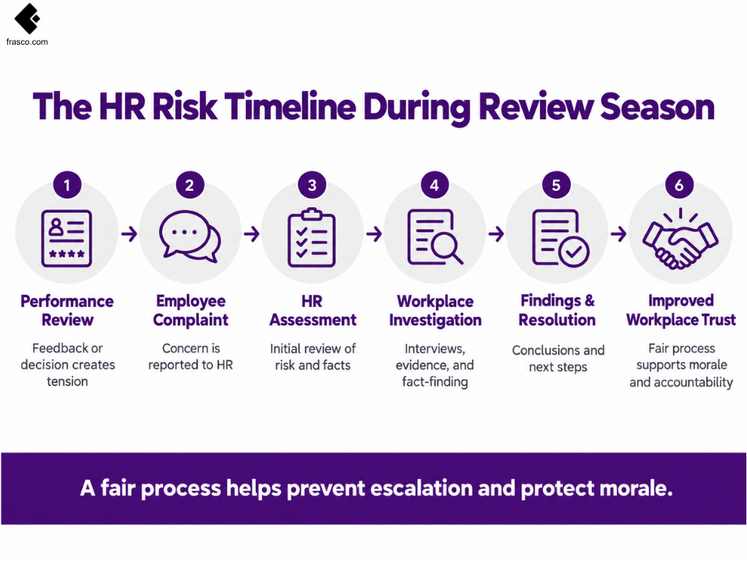
A strong workplace investigation process helps HR:
- respond promptly
- preserve relevant facts
- reduce confusion
- document findings clearly
- demonstrate fairness
- support leadership decisions
- protect confidentiality where appropriate
- reinforce accountability
It also helps employees feel that concerns are being taken seriously, even when the investigation does not confirm misconduct.
A practical workplace investigation process for HR teams
The strongest employee relations investigations usually follow a structured process.
1. Receive and assess the complaint
Start by understanding the concern clearly.
Key questions include:
- What is being alleged?
- Who is involved?
- When did the issue occur?
- Does the complaint involve immediate safety, retaliation, or legal risk?
- Does the matter require urgent intervention?
This first stage helps HR determine whether a formal investigation is needed and what level of response is appropriate.
2. Preserve relevant information early
Before details change or disappear, HR should preserve the information that may be relevant.
This may include:
- emails
- chat messages
- performance documents
- witness names
- security footage
- schedules
- HR notes
- prior complaint history
- relevant policies
Early preservation is especially important when emotions are running high and facts may later be disputed.
3. Define the scope of the investigation
A good investigation starts with a clear scope.
HR should determine:
- what issues are being investigated
- which policies may be involved
- who should be interviewed
- what documents should be reviewed
- whether outside investigative support is appropriate
This keeps the investigation focused and helps avoid unnecessary confusion or scope drift.
4. Conduct objective interviews
Interviews are often one of the most important parts of an employee relations investigation.
HR or the investigator should speak with:
- the complaining employee
- the respondent
- relevant witnesses
- managers or decision-makers with relevant knowledge
Interview questions should focus on facts, observations, timing, communication, and documentation rather than assumptions or conclusions.
5. Review evidence and evaluate consistency
After gathering statements and records, the next step is to compare what was reported with the available evidence.
This includes reviewing:
- consistency between accounts
- supporting documents
- timeline accuracy
- policy context
- prior internal actions
- any contradictions or gaps
The goal is not to defend a prior decision. The goal is to understand the facts objectively.
6. Reach findings and document them clearly
A strong investigation should conclude with a clear summary of:
- the complaint
- the steps taken
- the information reviewed
- the key facts identified
- the findings reached
- any recommended next steps
This documentation is important for internal decision-making and helps demonstrate that the organization responded responsibly.
7. Communicate appropriately and follow through
Once findings are reached, HR should communicate next steps appropriately while protecting confidentiality.
That may include:
- corrective action
- coaching
- policy reminders
- mediation
- safety planning
- leadership follow-up
- no policy violation finding, but communication improvement steps
The investigation should not end with the report alone. Follow-through is what helps restore trust and reduce future issues.
When an Employee Relations Investigation Needs Independent Support
Internal HR teams can handle some employee relations matters effectively. Others benefit from independent support.
An outside investigator may be especially useful when:
- leadership neutrality may be questioned
- senior employees are involved
- the complaint is highly sensitive
- emotions are elevated
- workplace violence concerns exist
- retaliation is alleged
- the organization needs more objective fact-finding
- internal HR resources are limited
Independent investigations can help strengthen credibility, reduce perceived bias, and give decision-makers a clearer factual record.
This is especially valuable when employee morale and company reputation are both at risk.
How employee relations investigations help protect morale and reputation
An employee relations investigation is not just a compliance exercise.
When handled well, it helps organizations:
- show employees that concerns are taken seriously
- reinforce fairness and accountability
- reduce rumor-driven workplace disruption
- support more consistent decision-making
- strengthen confidence in HR and leadership
- protect company reputation during sensitive situations
Even when a complaint is not substantiated, the way an organization responds can still influence trust.
A fair process often matters as much as the final conclusion.
Employee Relations Investigation Example
A manager delivers a lower-than-expected performance rating to a long-tenured employee. The employee responds by alleging harassment and retaliation, claiming the review was tied to prior concerns they raised informally.
Instead of dismissing the allegation or treating it as a routine disagreement, HR opens an employee relations investigation.
The investigation includes interviews, a review of documentation, and an assessment of the communication leading up to the performance review. The findings do not support misconduct, but they do reveal communication gaps and inconsistent expectations between the manager and employee.
Because HR addressed the concern promptly and followed a fair workplace investigation process, the organization is able to de-escalate the issue, improve communication, and avoid a more serious employee relations dispute.
Employee Relations Investigation Best Practices for HR
If your organization wants to reduce escalation during review season and similar high-risk moments, these best practices can help:
Establish clear reporting channels
Employees should know where to raise concerns and how complaints will be handled.
Respond early
Delay often increases confusion, mistrust, and workplace tension.
Use objective fact-finding
Investigations should focus on evidence, consistency, and fairness.
Document the process carefully
Clear records support better decisions and help the organization respond consistently.
Protect confidentiality appropriately
Employees are more likely to trust the process when HR handles concerns professionally and respectfully.
Know when independent support is needed
Sensitive matters sometimes require outside investigators to strengthen neutrality and credibility.
Frequently asked questions about employee relations investigations
Q1. When should an employer use an outside investigator?
An outside investigator may be appropriate when the issue is highly sensitive, leadership neutrality may be questioned, the matter involves senior personnel, or the organization needs independent fact-finding.
Q2. When should HR open an employee relations investigation?
HR should consider an investigation when a complaint involves harassment, retaliation, threats, discrimination, workplace conflict, wrongful termination concerns, or other allegations that require formal fact-finding.
Q3. What is the difference between an employee relations investigation and a workplace investigation?
An employee relations investigation is often a type of workplace investigation focused specifically on employee complaints, workplace treatment, behavior, and internal employment concerns. A workplace investigation can be broader and may include other types of organizational issues.
Q4. Why does the workplace investigation process matter?
The workplace investigation process matters because a fair, consistent, and well-documented process helps employers respond objectively, reduce risk, and maintain employee trust.
Better employee relations investigations lead to stronger workplace outcomes
Review season, disciplinary action, and employment decisions can all increase workplace tension. However, those moments do not need to turn into larger organizational risk.
A well-executed employee relations investigation helps HR teams respond fairly, protect morale, and build confidence in how workplace concerns are handled.
When supported by a strong workplace investigation process, organizations are better equipped to address complaints before they escalate into deeper trust, reputation, or legal challenges.
The goal is not only to resolve complaints. It is to strengthen confidence in the workplace itself.
Contact Us Today
Frasco® Workplace Investigations delivers ethical and efficient solutions tailored to your needs. If you have questions or want to discuss your investigative needs further? Schedule a call with one of our experts today to find the answers you’re looking for.
Disclaimer: This blog post is for informational purposes only and should not be considered legal advice. Please consult your general counsel for specific legal guidance. Frasco investigators are licensed, and our operations comply with US industry, federal, state, and local laws.